
Key Takeaways
- Data engineering is the operational floor underneath your AI and analytics investments. It's a permanent capability, not a side project.
- Most enterprise data initiatives fail in execution, not strategy. Funding, sequencing, and governance discipline matter more than tool choice.
- The single biggest decision is architecture: lake, warehouse, or lakehouse. Get this wrong and every downstream investment compounds the mistake.
- Governance and quality cannot be bolted on later. Design them into pipelines from day one, or every AI project pays.
- The build-versus-partner decision shapes outcomes more than headcount. Pair internal ownership with specialist partners to scale faster.
Most enterprise AI programmes stall before a single model ships — not because the technology was wrong, but because the data underneath it wasn't ready. The architecture, pipelines, and governance you put in place today will determine whether your AI investments pay off. The model is the easy part. The infrastructure underneath it is where you win or lose.
And most enterprises fund the model first, the tooling second, and the engineering never quite enough. The result is predictable. An MIT NANDA study found 95% of enterprise AI pilots deliver zero measurable return — not because the AI was wrong, but because the foundation wasn't ready.
This guide is for the CTO, CDO, or VP of Data sponsoring that foundation — and for the platform owners doing the sequencing. It covers the architecture decision, the governance discipline, the funding model, and the partner choices that determine whether your data engineering capability is real or just well-intentioned.
What Data Engineering Means for Your Enterprise
Data engineering is the discipline of designing, building, and operating the systems that make enterprise data usable for analytics, AI, and business decisions. That's the textbook definition. It's correct, and it's also useless for funding conversations.
Here's what data engineering for enterprise actually means in practice.
Data engineering is the operational floor underneath every AI investment your CFO has approved in the last 18 months. It's the reason your dashboards either get trusted or get ignored. It's the difference between an AI model that ships and one that quietly dies in a Slack thread six months in. Your data engineers are the people who decide whether the rest of your data strategy is real or theatre.
We're not being dramatic. Look at what Gartner actually said.
"63% of organisations either do not have or are unsure if they have the right data management practices for AI." — Gartner, February 2025
That's the group that quietly funds the 60% project failure rate. They have AI ambition. They don't have AI-ready data. And the only function that bridges the two is data engineering.
When senior leaders ask us whether to hire more data scientists or invest in data engineering first, the answer is almost always the same. The engineering first. The science comes next.
But what is the engineering, in concrete terms? It's five things, working together.
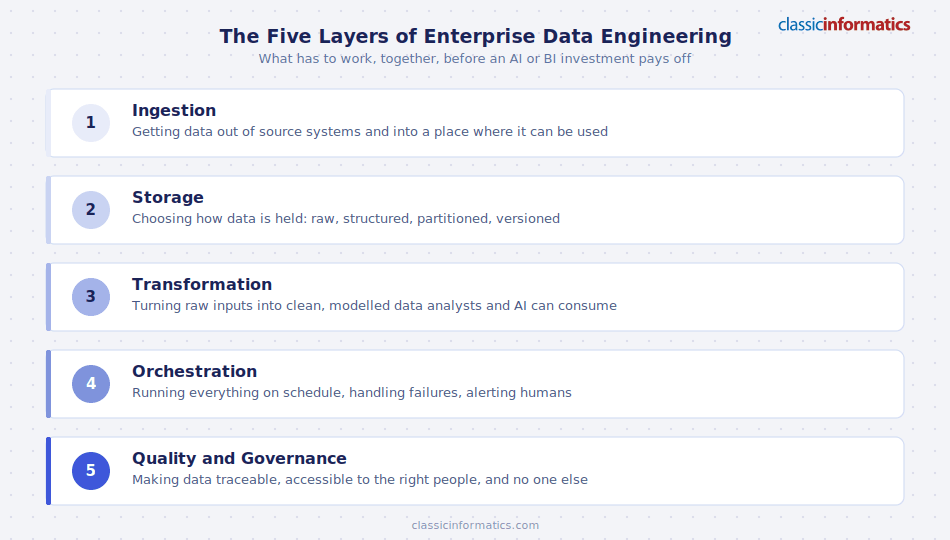
The 5 Things Data Engineering Actually Delivers
- Ingestion. Getting data out of source systems (CRMs, ERPs, transactional databases, SaaS apps, IoT) into a place where it can be used. This is the most visible part. It's also the easiest to overinvest in early.
- Storage. Choosing how data is held: raw, structured, partitioned, versioned. This is where the lake/warehouse/lakehouse decision lives.
- Transformation. Turning raw inputs into clean, joined, modelled data that analysts and AI systems can actually consume. The work of ETL pipelines lives here.
- Orchestration. Running everything on schedule, handling failures, retrying jobs, alerting humans when something breaks. Apache Airflow is the most widely deployed tool here. Boring but critical.
- Quality and governance — making sure the data is right, that it can be traced, that the right people can access it, and that the wrong ones can't. Treated as an afterthought in most organisations. Punished accordingly.
When all five are well-engineered, your AI projects work. When one is broken, they don't. We've seen organisations spend six figures on AI tooling while their orchestration layer is a developer's personal cron job. That's not a strategy problem. That's a data engineering problem.
It's a pattern we see consistently across the data engineering programmes Classic Informatics has been part of: the teams that ship AI reliably are the ones who treated the engineering as the primary investment, not the afterthought.
Why Data Engineering Is Now the Bottleneck — Not Data Science
For roughly a decade, the default assumption in enterprise tech has been that data science is the scarce resource. Everyone needs more data scientists. Hire more data scientists. The market priced data scientists at a premium, and we all funded accordingly.
That assumption is now demonstrably wrong.
The MIT NANDA report found that the difference between the 5% of AI deployments producing real value and the 95% producing nothing wasn't model quality. It wasn't algorithmic sophistication. It was the underlying systems — the data, the integration, the workflows — that determine whether a model lands inside the business or doesn't. Translation: the engineering, not the science.
We see the same pattern in every initial conversation we have with new clients. The data science team has built something impressive in a notebook. The data engineering team can't operationalise it because the pipelines aren't there. The model never gets to production. The board asks where the AI investment went.
This is what data engineering being the bottleneck looks like in practice.
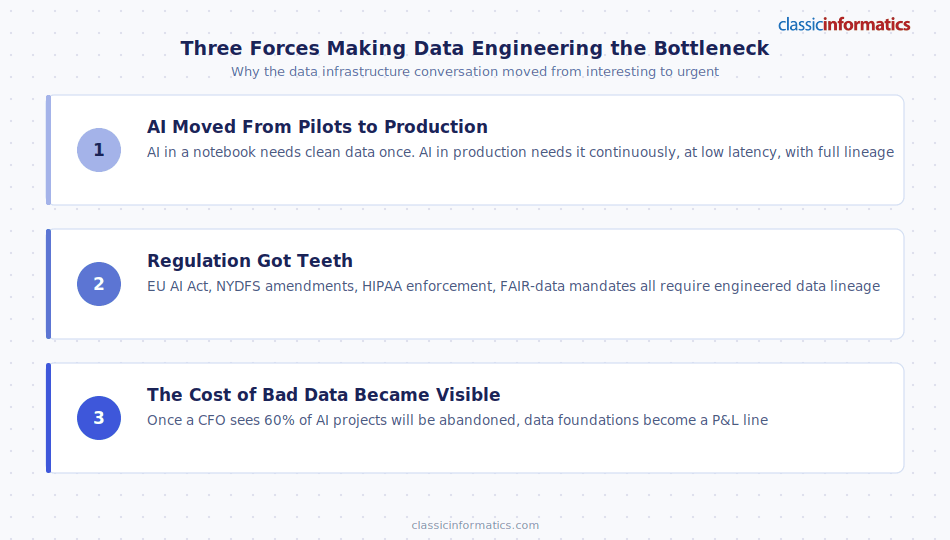
It also explains why the data infrastructure conversation has moved from "interesting" to "urgent" in the last 24 months. Three forces are colliding:
- AI moved from pilots to production demand. AI in a notebook needs clean data once. AI in production needs clean data continuously, at low latency, with full lineage.
- Regulation got teeth. EU AI Act, NYDFS Cybersecurity Regulation amendments, HIPAA enforcement for AI-driven decision systems, FAIR-data mandates in pharma. None of it is satisfiable without engineered data lineage.
- The cost of bad data became visible. Once a CFO sees that 60% of approved AI projects will be abandoned, "data foundations" stop being IT's problem and start being a P&L line.
When the question becomes where to invest first, the answer is the layer that all three forces converge on. The engineering.
Which brings us to architecture — the decision you can't avoid.
The Architecture Decision: Lake, Warehouse, or Lakehouse
Every enterprise data conversation eventually arrives at one question: what's the right architecture? The honest answer is "it depends on your workloads," but that answer is so over-used it's stopped being helpful. Let's get specific.
The three serious options for enterprise data platforms in 2026 are the data lake vs data warehouse vs lakehouse — and the trade-offs between them are more consequential than most tool comparisons your team will make. Here we'll stay at the decision-maker layer.
Before the detail, a quick comparison:
| Architecture | Best fit | Governance effort | Typical cost profile | AI/ML readiness |
|---|---|---|---|---|
| Data warehouse | Structured BI + reporting | Low | Predictable; climbs steeply with volume | Moderate — SQL-first |
| Data lake | Diverse ML workloads, long-term storage | High (active effort required) | Low storage; high if ungoverned | High — raw, flexible |
| Lakehouse | Mixed BI + AI on the same data | Medium | Higher upfront; lower long-term ops cost | High — unified compute |
Data Warehouse: Structured, Governed, Expensive
A data warehouse is a system optimised for structured, queryable data. Snowflake, BigQuery, Synapse, Redshift. These are the platforms BI teams have been running on for years. They're predictable. They're well-governed. They're also expensive for high-volume or semi-structured data.
When to pick a data warehouse:
- Your primary workloads are BI, reporting, and dashboarding
- Your data is mostly structured (CRM, ERP, transactional)
- Cost predictability and SQL access for analysts matter more than ML/AI flexibility
For most enterprises with mature BI but limited AI ambition, a cloud data warehouse is still the right answer.
Decision signal: If your workloads are 80%+ structured reporting and your AI roadmap is 12+ months out, a warehouse is the right investment now. If you already have AI use cases in flight or a data lake in place, evaluate the lakehouse path instead.
Data Lake: Flexible, Low-Cost, Ungoverned by Default
A data lake is a low-cost storage layer for raw and semi-structured data, usually on S3 or equivalent. It's the architecture that opened the door to ML and AI workloads on enterprise data.
The trade-off is that lakes are ungoverned by default. Without active engineering effort, they become "data swamps" — useful for nothing, expensive to maintain, and impossible to audit.
When to pick a lake:
- You have heavy ML/AI workloads on diverse data types
- You need cheap long-term storage of large volumes
- You have the data engineering capability to keep the lake clean
Decision signal: If you have the engineering capacity to govern a lake actively, and your workloads are predominantly ML and big data analytics, a lake gives you the flexibility and cost profile you need. If governance is already stretched, the lakehouse is a better starting point — you'll spend less time fighting the swamp.
Lakehouse: The Convergence Pattern Winning in 2026
A data lakehouse combines the low-cost flexibility of a lake with the governance, performance, and SQL access of a warehouse. Databricks, Snowflake's Iceberg integration, Microsoft Fabric. This is where new enterprise platform investments are converging in 2026.
When to pick a lakehouse:
- You have both BI and AI workloads on the same data
- You want one governance model across both
- You're building new, or your existing warehouse is hitting cost or flexibility limits
Decision signal: If you're starting a new platform, or your existing warehouse is straining under ML workloads, the lakehouse is the architecture to build toward. If you already have a well-governed warehouse and no immediate AI workloads, the migration cost likely isn't justified yet.
The most common mistake isn't picking the wrong architecture. It's picking one without first deciding what the next three years of workloads actually look like. That decision lives in your data strategy, not your data engineering plan.
Once the architecture is decided, the rest of the platform stacks around it.
What Modern Data Architecture Looks Like in 2026
The architecture decision is one piece. The full picture is what sits around it and modern data architecture in 2026 looks meaningfully different from what most enterprises built five years ago. Here's the senior leadership view.
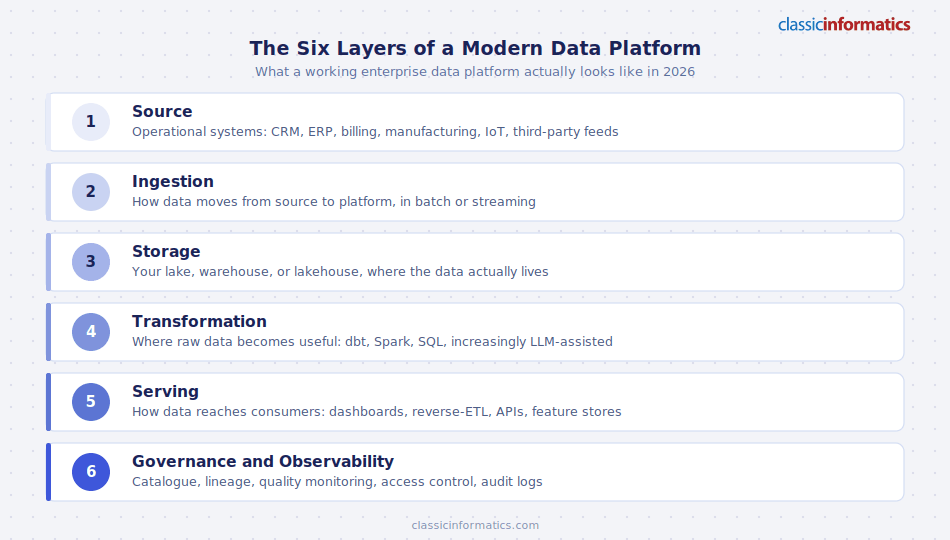
A working enterprise data platform in 2026 has six layers:
1. Source layer. Your operational systems. CRM, ERP, billing, manufacturing systems, web/mobile, IoT, third-party data feeds. You don't engineer this. You receive it.
2. Ingestion layer. How data moves from source to platform. Two main patterns: batch (scheduled jobs) and streaming (continuous, low-latency). Most enterprises need both. Tools like Fivetran, Airbyte, Kafka, Debezium live here.
3. Storage layer. Your lake, warehouse, or lakehouse. Where the data actually lives.
4. Transformation layer. Where raw data becomes useful data. dbt, Spark, SQL, increasingly LLM-assisted transformation. This is the layer most of your data engineers spend their time in. The work of building a data pipeline that holds up under enterprise load happens here.
5. Serving layer. How data gets to consumers. BI dashboards (Tableau, Power BI, Looker), reverse-ETL into operational systems (Hightouch, Census), APIs for applications, feature stores for ML.
6. Governance and observability layer. Cuts across everything else. Catalogue (Atlan, Collibra, DataHub), lineage, quality monitoring, access control, audit logs. This is the layer that gets cut from the budget early and added back expensively later.
That's the technical picture. The architecture only works if the operating model around it does. Which is where most enterprises run into trouble.
ETL, ELT, and Why Your Pipeline Design Will Outlive Your Tool Choice
Most data engineering conversations start with tools. They should start with patterns.
ETL (Extract, Transform, Load) is the legacy pattern. You extract data from sources, transform it in flight, then load the cleaned result into the warehouse. Worked well when warehouses were expensive and storage was cheap. Doesn't fit modern cloud economics.
ELT (Extract, Load, Transform) is the modern default. You extract data, load it raw into the lake or warehouse, then transform it in place using the platform's compute. This is what dbt, Snowflake, BigQuery, and the modern stack are built around.
You can run both. Most large enterprises do. The point is that the pattern choice — and the discipline of how transformations are written, tested, and documented — outlives any specific tool you pick. We see organisations migrate from Informatica to Fivetran to Airbyte over five years and watch their pipelines get re-engineered every time, because the pattern was never properly codified.
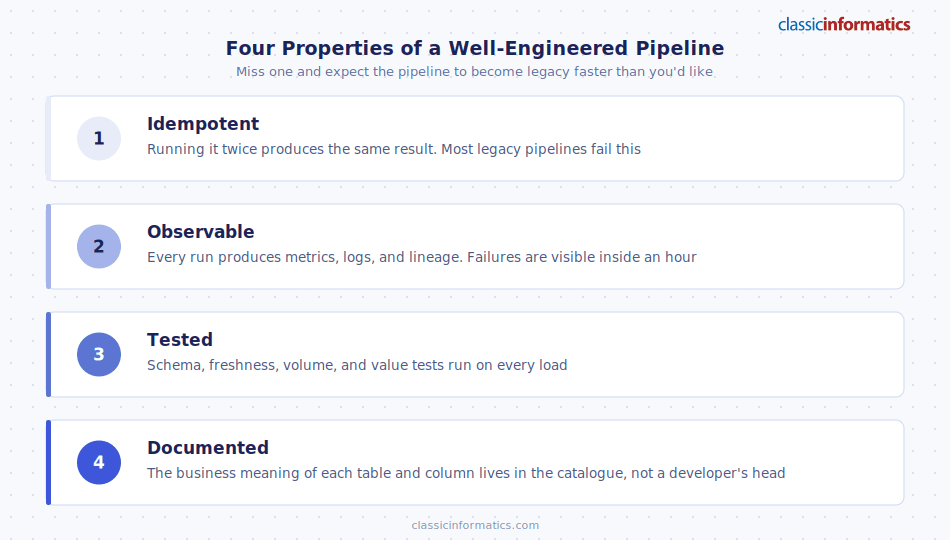
A well-designed ETL pipeline (or ELT pipeline — same logic) has four properties:
- Idempotent. Running it twice produces the same result. Sounds obvious. Most legacy pipelines fail this.
- Observable. Every run produces metrics, logs, and lineage. Failures are visible inside an hour, not three weeks.
- Tested. Schema, freshness, volume, and value tests run on every load. Bad data is rejected, not absorbed.
- Documented. The business meaning of each table and column is in the catalogue. Not in a developer's head.
Miss any one of these and expect the pipeline to become legacy faster than you'd like.
That's the technical hygiene. Governance is what makes it durable.
The InterDent engagement is a useful illustration of what durability looks like at scale. Classic Informatics has supported three generations of analytics infrastructure for InterDent — a 250-clinic US dental group — over 20 years. The pipelines that have held up across those generations weren't the ones built on the newest tools. They were the ones built on documented patterns, with clear ownership and observable failure modes. Tools changed. The pattern discipline didn't.
Data Quality and Governance: The Layer Every Enterprise Underfunds
The 60% AI project abandonment rate Gartner is forecasting isn't being driven by missing tooling. Most of those organisations have already bought the tools. It's being driven by missing governance and quality discipline, and data quality management at enterprise scale is a discipline, not a feature you configure once and forget.
Data quality and governance aren't separate functions you can stand up next year. They're properties of how the engineering work gets done from day one. Bolt them on later and you'll rebuild your pipelines twice.
Three things make a real difference at enterprise scale:
- Active metadata. Your catalogue can't be a static document that gets updated quarterly. It has to update from the pipelines themselves: what tables exist, who owns them, what columns mean, what the lineage looks like, what the quality scores are. Live. AI-ready data is, by Gartner's own definition, continuously quality-assured. Not annually audited.
- Quality gates in pipelines. Bad data should be blocked at the loading layer, not discovered when an executive's dashboard shows the wrong number. dbt tests, Great Expectations, Monte Carlo, Soda — pick a tool, but pick one.
- Clear ownership. Every critical dataset has one named owner. Not "the data team." A named person. When the quality of customer_dim drops, there's exactly one inbox the alert lands in.
The TL;DR for executives: a data governance framework fails when it's positioned as compliance overhead. It works when it's positioned as the enabling layer for AI and analytics, because that's what it actually is.
The funding question follows directly from this. If governance is an enabling layer, it needs to be funded like one, not as a one-off project.
How to Fund Data Engineering
Funding a data engineering programme well comes down to three principles. We've watched enterprises succeed and fail with all three, and the pattern is consistent.
1. Fund the capability, not the project.
The "project" funding model, where the board approves $X for an AI initiative and data engineering gets a slice — is the single biggest reason data foundations don't get built. Project budgets end. Foundations need to keep going. Fund the platform team as a permanent capability with a multi-year mandate, even when individual use cases come and go.
2. Sequence the work behind specific use cases.
The opposite mistake — the "let's modernise everything before we do anything" instinct — kills programmes too. Pick one or two use cases with clear business value: a churn model, a real-time pricing engine, a regulatory reporting workflow. Let the data engineering work be sequenced to enable them. Each use case earns the next round of investment.
3. Measure foundational work, even when it's invisible.
Pipeline reliability, mean time to detect, lineage coverage, governed dataset count. These metrics aren't sexy, and they don't make great board slides. But they're the leading indicators of whether the platform is healthy. The lagging indicators — AI projects shipping, analytics being trusted — follow them by 6–12 months.
The organisations that get this right treat data engineering investment the way they treat security investment. Continuous. Mostly invisible. Catastrophic when neglected. Your enterprise data strategy is the document that ties the funding model to the business outcomes — without it, every data engineering investment becomes a one-off negotiation.
With funding in place, the next decision is who does the work.
What Goes Wrong: Three Failure Modes to Design Around
Before covering the operating model, it's worth naming the failure patterns we see most often. All three are organisational, not technical.
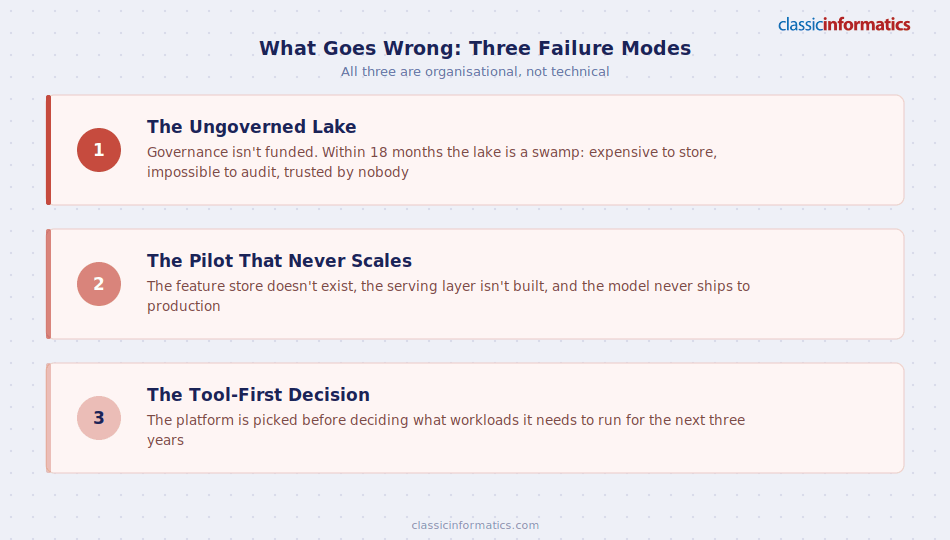
Failure mode 1: The ungoverned lake. The team builds a data lake to enable AI workloads. Governance isn't funded. Within 18 months the lake is a data swamp — expensive to store, impossible to audit, trusted by nobody. The fix is treating governance as a first-day engineering constraint, not an afterthought. Budget for a catalogue, assign data owners at ingestion, and run quality tests on every load from the start.
Failure mode 2: The pilot that never scales. An impressive data science notebook gets built. The engineering team can't operationalise it because the feature store doesn't exist, the serving layer isn't built, and the pipeline isn't production-grade. The model never ships. The lesson: build the serving infrastructure in parallel with the model, not after it.
Failure mode 3: The tool-first decision. The organisation picks a platform (Databricks, Snowflake, Fabric) before deciding what workloads it's running for the next three years. When the workloads don't fit the platform's strengths, a re-platforming project follows 18 months later. The fix: architecture-first, then tools. The workload decision drives the platform decision, not the other way round.
Build, Buy, or Partner: How to Think About the Operating Model
Enterprises typically run their data engineering function in one of four models. Each has different cost, control, and speed trade-offs.
In our experience working with mid-to-large enterprises, the third model — internal capability paired with a specialist partner — produces the best outcomes for most senior leaders we talk to. The internal team holds architecture, governance, and accountability. The partner brings delivery velocity, specialist skills (streaming, ML platforms, specific cloud ecosystems), and the ability to scale up and down without permanent headcount.
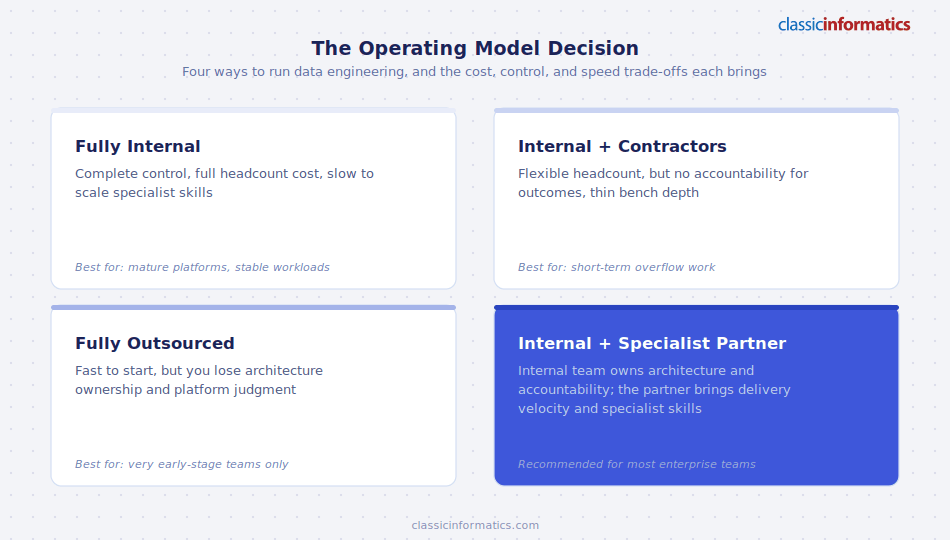
Most enterprises that get this right treat data engineering services the way they treat cloud infrastructure — something you partly own, partly operate with a trusted partner, and never fully outsource.
If you do bring in a partner, the selection criteria matter more than most procurement teams give them credit for. The difference between a good data engineering company and a bad one isn't logo recognition — it's whether the partner can be accountable for outcomes, not just hours. The short list is straightforward:
- Engineering ownership. They're accountable for outcomes, not hours.
- Architecture-first, tools-second. They'll push back on tool choices when the architecture isn't ready.
- Industry depth where you need it. Healthcare, insurance, manufacturing, financial services. Each has demands the others don't.
- Real governance practice. They've operated data platforms under regulation, not just built them.
That last one — industry depth — deserves its own discussion. Because some industries change every assumption in this guide.
What Changes When You're in Healthcare or Insurance
The generic data engineering playbook works for most enterprises. Two industries are exceptions, and they're worth calling out because they reshape almost every decision above.
Healthcare: when patient data changes the engineering, not just the policy
In healthcare, HIPAA isn't a policy layer you add on top of the platform. It's a constraint that runs through every architectural decision. PHI (protected health information) lineage has to be auditable across every transformation.
Access control has to be enforced at the column and row level, not just the database. De-identification pipelines need their own engineering, with cryptographic guarantees, not best-effort anonymisation.
The healthcare-specific demands also reshape the cloud decision (data residency, BAA requirements), the streaming decision (real-time clinical decision support needs latency commitments commercial pipelines don't), and the governance model (every algorithm touching patient data needs a documented audit trail).
The engineering discipline required to run a compliant healthcare data platform is materially higher than the equivalent commercial workload — and in our experience, almost none of that overhead can be deferred.
When Classic Informatics built clinical systems, MDT workflows, and an Azure analytics platform for Chris O'Brien Lifehouse — Australia's leading specialist cancer centre — the compliance and lineage requirements shaped every architectural decision, from database design through to the serving layer. The engineering came first. The governance wasn't added on.
Insurance: where the data infrastructure is the underwriting
Insurance is the other industry where data engineering decisions are business decisions. Underwriting models, claims fraud detection, catastrophe risk modelling, parametric products. They're all built on the data infrastructure. The quality and integration of policy systems, claims systems, third-party data feeds, and IoT inputs directly determines whether the business can price risk competitively.
The shift toward real-time underwriting and the growing role of third-party and unstructured data (satellite imagery, telematics, social signals) is forcing insurers to confront data engineering challenges that standard commercial playbooks don't cover — infrastructure that, in many cases, hasn't been touched in 15 years.
For senior leaders in either industry, the lesson is the same. The generic guides are starting points. The industry-specific engineering decisions are where competitive advantage actually lives.
Where AI and BI Fit, and Why Neither Is Separate
A note about AI and BI, because both keep coming up.
There's a temptation to treat AI/ML as something that lives next to data engineering, with a different team, different tools, different roadmap. That model is increasingly broken. Production AI is just data engineering with stricter SLAs.
A working enterprise AI capability needs:
- Feature stores. Engineered data, served at low latency, for both training and inference. Pure data engineering.
- Training pipelines. Reproducible, lineage-tracked, automated. Pure data engineering.
- Monitoring. Drift detection, data quality at inference, alert routing. Pure data engineering.
- Governance. Every model decision auditable back to the data it was trained on. Pure data engineering.
The teams that ship AI reliably treat the AI team and the data engineering team as one extended function with one set of platforms. The teams that don't run two parallel programmes that never reconcile — and end up in the 60% Gartner cohort.
BI sits in the same position. It hasn't gone away just because AI showed up. For most enterprises, BI still drives 80% of the daily data-driven decisions inside the business — and it's where most of the trust is built or lost. Trusted dashboards need the same clean pipelines, governed datasets, and clear ownership that AI does. The "BI versus AI" framing that some vendors push is mostly noise. Both depend on the same platform.
What changes is the specialist expertise. Knowing how to scope a business intelligence consulting engagement — the semantic layer design, the KPI frameworks, the dashboard standards — is its own discipline. For senior leaders managing both investments, the practical answer is to fund the underlying engineering once and use it for both.
With the platform logic clear, the sequencing question is what most teams get wrong.
A Practical 12-Month Plan for Building Data Engineering Capability
Most data engineering programmes fail in the first 12 months. Either the scope balloons and nothing ships, or the scope shrinks and nothing meaningful gets built. Here's a sequence that works in our experience.
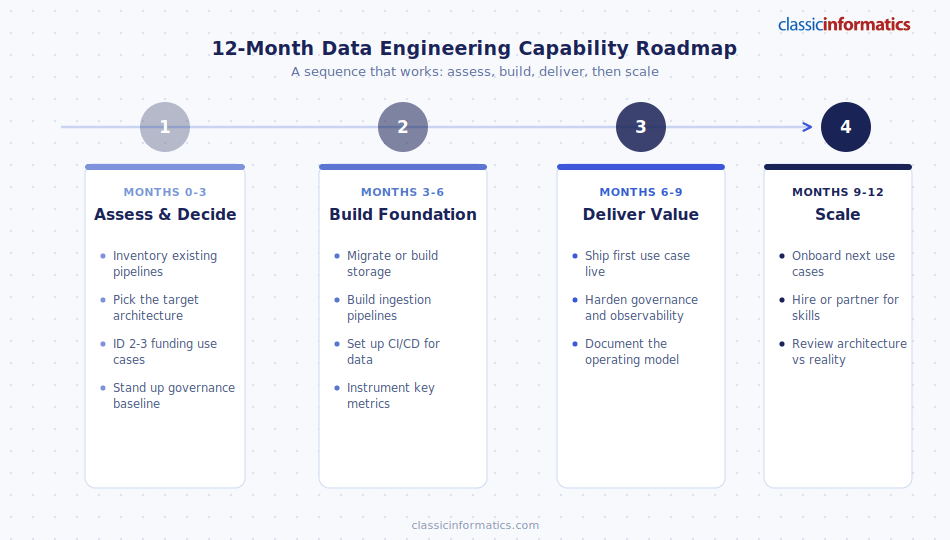
Months 0–3: Assess and decide.
- Inventory existing pipelines, platforms, and data domains. Be honest about what's actually working.
- Pick the target architecture (warehouse, lake, lakehouse) based on the next three years of workloads, not the next three months.
- Identify two or three use cases that will fund the first phase of platform work.
- Stand up the governance baseline: catalogue, lineage capture, owner assignment.
Months 3–6: Build the foundation.
- Migrate or build the storage layer.
- Build the ingestion pipelines for the priority use cases.
- Establish CI/CD for data: version-controlled transformations, automated testing, and separate environments.
- Define and instrument the operational metrics (pipeline reliability, freshness, quality scores).
Months 6–9: Deliver the first use cases.
- Ship the first use case end-to-end. AI model, BI dashboard, or operational workflow.
- Use the live use case to harden governance and observability.
- Document the operating model and the cost of running the platform.
Months 9–12: Scale.
- Onboard the next set of use cases on the existing foundation.
- Hire (or partner) for the next layer of specialist skills.
- Review the architecture decision against the actual workloads. Adjust.
This is the cadence we've seen work across multiple industries. The mistake to avoid is trying to do everything in parallel. Sequence ruthlessly. The platform will be more valuable in month 18 than in month 6, and that's fine.
One rule of thumb per phase:
- Months 0–3: Pick the architecture before signing any platform contract.
- Months 3–6: Get one pipeline to production before building ten.
- Months 6–9: Measure the platform before expanding it.
- Months 9–12: Expand the team after the operating model is documented, not before.
Summing Up!
Data engineering used to be a back-office concern that lived inside IT. It isn't anymore. It's the operational layer that determines whether your AI, BI, and analytics investments produce returns or quietly join the 60% Gartner expects to be abandoned. The architecture decision, the governance discipline, the funding model, and the partner choice are now executive decisions, not technical ones.
If you take one thing away, take this. The teams that will own their categories in the next three years aren't the ones with the most data scientists or the flashiest AI demos. They're the ones with the cleanest pipelines, the most governed datasets, and the most boring, reliable platform underneath all of it. The engineering is the moat.
Not sure where your data engineering capability stands today? Or what it needs to look like in 12 months? Connect with our experts at Classic Informatics. We work with enterprise teams across healthcare, insurance, financial services, retail, and manufacturing — and we'd love to help you figure out the right next step.
Frequently asked questions
What is data engineering and why does it matter for enterprise AI?
Data engineering is the discipline of building and operating the systems that make data usable — the pipelines, storage, transformations, and governance infrastructure that sit underneath analytics and AI. For enterprises, it matters because production AI isn't a model problem. It's a data infrastructure problem. The MIT NANDA finding that 95% of enterprise AI pilots deliver zero measurable return traces back to data foundations that weren't ready before the model was built.
What's the difference between a data lake, data warehouse, and data lakehouse?
A data warehouse is optimised for structured, queryable data — good for BI and reporting, expensive for high-volume or ML workloads. A data lake is low-cost storage for raw and semi-structured data, flexible for AI and big data analytics, but ungoverned by default. A lakehouse combines both — lake-scale storage with warehouse-grade governance and SQL access. Most new enterprise platform investments in 2026 are converging on the lakehouse, particularly where BI and AI workloads share the same data.
What's the difference between ETL and ELT, and which should we use?
ETL (Extract, Transform, Load) transforms data before loading it into the warehouse — the legacy pattern, built for expensive warehouse compute. ELT (Extract, Load, Transform) loads raw data first, then transforms it in place using cloud compute — the modern default, and what dbt, Snowflake, and BigQuery are built around. Most enterprises run both across different parts of the platform. The more important question is whether your pipelines are idempotent, observable, tested, and documented — those properties matter more than which pattern you use.
How do we fund data engineering without it becoming a never-ending IT budget?
Fund it as a permanent capability with a multi-year mandate, not as a slice of each AI project budget. Project budgets end; the data foundation doesn't. Sequence the engineering work behind specific use cases with clear business value — each one earns the next round of investment. Measure foundational metrics (pipeline reliability, lineage coverage, governed dataset count) as the leading indicators. The lagging indicators — AI projects shipping, analytics being trusted — follow by 6–12 months.
When should we build data engineering capability internally vs. bring in a partner?
The model that produces the best outcomes in our experience is internal capability paired with a specialist partner. The internal team holds architecture, governance, and accountability. The partner brings delivery velocity and specialist skills — streaming, ML platforms, regulated-industry experience — that are expensive to hire permanently. Evaluate partners on outcome accountability, architecture-first thinking, and whether they've operated data platforms under regulation, not just built them.
What's different about data engineering in healthcare or insurance?
In healthcare, HIPAA isn't a policy layer — it's an architectural constraint. PHI lineage must be auditable across every transformation. Access control operates at the column and row level. De-identification needs cryptographic guarantees. In insurance, the data infrastructure is the underwriting — the quality of policy systems, claims data, and third-party feeds directly determines whether the business can price risk competitively. Both industries require materially more engineering overhead than equivalent commercial workloads, and that overhead can't be deferred.
How does data engineering relate to our AI programme?
They're the same programme. Production AI requires feature stores, reproducible training pipelines, inference-time quality monitoring, and model governance — all of which are data engineering problems. The teams that ship AI reliably treat the AI team and the data engineering team as one extended function on one set of platforms. Running them as separate programmes with separate tools is one of the three most reliable ways to end up in Gartner's 60% cohort.