
You've got a shortlist of MVP companies. They all say they build MVPs. They all have a discovery phase on the website. They all quoted somewhere between reasonable and ambitious. And now you have to actually pick one — knowing that the wrong call doesn't just waste budget. It wastes time. In a startup, that's the one thing you can't buy back.
Australia's MVP development companies market is bigger than it looks and more variable than the Clutch listings suggest. The gap between "we build MVPs" and "we've shipped products that survived past the first round of real user feedback" is real — and it doesn't show up in a portfolio PDF.
This list has 10 MVP software development Australia teams worth evaluating seriously. For each one, we'll tell you what they're good at, what stage they suit, and where they're probably the wrong fit.
Key Takeaways
- The cheapest MVP quote rarely reflects what the full engagement will actually cost you.
- Post-MVP scalability should be evaluated before you sign, not after you've already shipped version one.
- Australia-targeting MVP teams vary widely in agile maturity — look for delivery evidence, not process claims.
- Most MVP failures trace back to poor discovery and rushed architecture decisions, not bad code.
What Most Founders Get Wrong About MVP Development
Most founders treat the MVP as a cheaper version of the full product. It isn't. A good MVP is a focused test of a specific assumption — designed to generate validated learning, not just a working prototype you can demo. The problem is that most dev teams aren't set up to help you make that distinction. They take requirements, they build, they invoice.
The result? You get a technically complete product that answers the wrong question. You've validated that the team can build — not that the market wants what you built. And by the time you realise it, you've spent six months and a significant budget getting there.
Speed matters. But speed without strategic framing is just expensive trial and error.
Here's what separates strong MVP partners from average ones:
-
Discovery discipline: They push back on your feature list before writing a line of code
-
Architecture thinking: They build for what comes after the MVP, not just the MVP itself
-
Design integration: UX and engineering are not handled as separate workstreams
-
Honest scoping: They tell you what you don't need, not just what they can build
-
Post-launch clarity: They have a plan for what happens after go-live
-
Founder communication: They speak your language, not just engineering language
If a prospective partner can't demonstrate most of these, the low quote is not a saving — it's a risk premium you'll pay later.
How We Evaluated These MVP Development Companies
Every company on this list was assessed against the same set of criteria — no exceptions for brand size or geography.
-
Technical depth and stack: Does the team have genuine full-stack capability, or are they specialists in one layer who subcontract the rest?
-
Startup experience (not just enterprise): Enterprise projects and MVP sprints require completely different delivery mindsets — we looked for both.
-
Design-to-engineering handoff: Poor handoff between design and development is one of the most common causes of MVP delays and rework.
-
Agile delivery model: Sprint-based delivery with visible checkpoints matters more for MVPs than it does for long-cycle projects.
-
Post-MVP support and scalability: The MVP is not the end — the partner you choose needs to still be useful after launch day.
-
Australia market familiarity: Whether based locally or globally, the team should understand the AU regulatory environment, time zones, and startup ecosystem.
Companies at a Glance
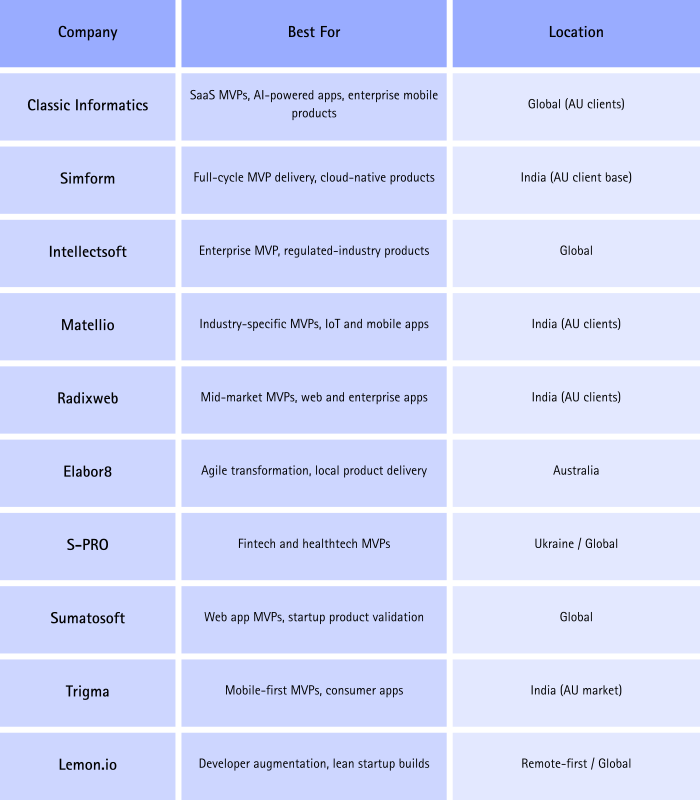
10 MVP Development Companies Worth Evaluating
1. Classic Informatics
If you're building a SaaS platform, an AI-powered product, or an enterprise mobile application and you need a team that can take you from validated concept all the way to a scalable product — not just a working demo — Classic Informatics is built for that engagement.
With 23+ years of delivery experience, 3,000+ projects across 30+ countries, and a 95% client retention rate, Classic Informatics brings a depth of delivery knowledge that most MVP-specialist agencies simply can't match. The team has worked across startup solutions and enterprise product builds alike, which means they understand both the urgency of a first launch and the architectural decisions that determine whether version two is manageable or a rewrite. That balance — between moving fast and building right — is harder to find than it sounds.
Classic Informatics covers the full product stack: mobile and web, AI integrations, SaaS platforms, workflow automation, and enterprise systems. Their software development practice is structured around sprint-based delivery with defined checkpoints — so you're never three months in before you see something working. The team includes product strategists and UX designers working alongside engineers, not after them (and yes, that matters more than most founders expect).
Post-MVP, the engagement doesn't end at launch. Classic Informatics supports scale-up phases, product iteration, and team augmentation — which is why over 1,000 clients across industries have stayed long past the first project.
-
Full-stack mobile app development and web product delivery
-
AI-powered application development including LLM integrations and intelligent automation
-
SaaS platform architecture with scalability built into the MVP phase
-
Discovery and UX workshops before development begins
-
Agile sprint delivery with consistent client visibility
-
Dedicated post-launch support and product scaling pathways
If your product needs to survive past version one — and it does — Classic Informatics is the partner that keeps that long-term architecture in view from day one.
2. Simform
Simform is a strong fit for founders who need a full MVP-to-scale delivery partner with a solid Clutch track record and an established Australian client base. They cover the full cycle from product discovery to deployment.
Based in India with strong international delivery credentials, Simform has built a reputation for cloud-native product development and engineering quality. Their process includes a dedicated discovery phase, which reduces the likelihood of scope drift after the sprint kicks off. They work across web, mobile, and cloud infrastructure, giving them good coverage for modern product stacks.
Simform performs well for mid-complexity MVPs where cloud scalability is a core requirement from the start. According to Clutch's app development directory, they consistently rank among the top-reviewed development partners globally.
-
Cloud-native MVP architecture (AWS, Azure, GCP)
-
Web and mobile product development
-
Product discovery and roadmapping
-
DevOps and CI/CD pipeline setup
-
Post-launch scaling and maintenance
Simform is a reliable option for founders who want proven delivery quality at competitive rates. If you need very deep local Australian market knowledge or highly specialised AI engineering, you may want to supplement with additional expertise.
3. Intellectsoft
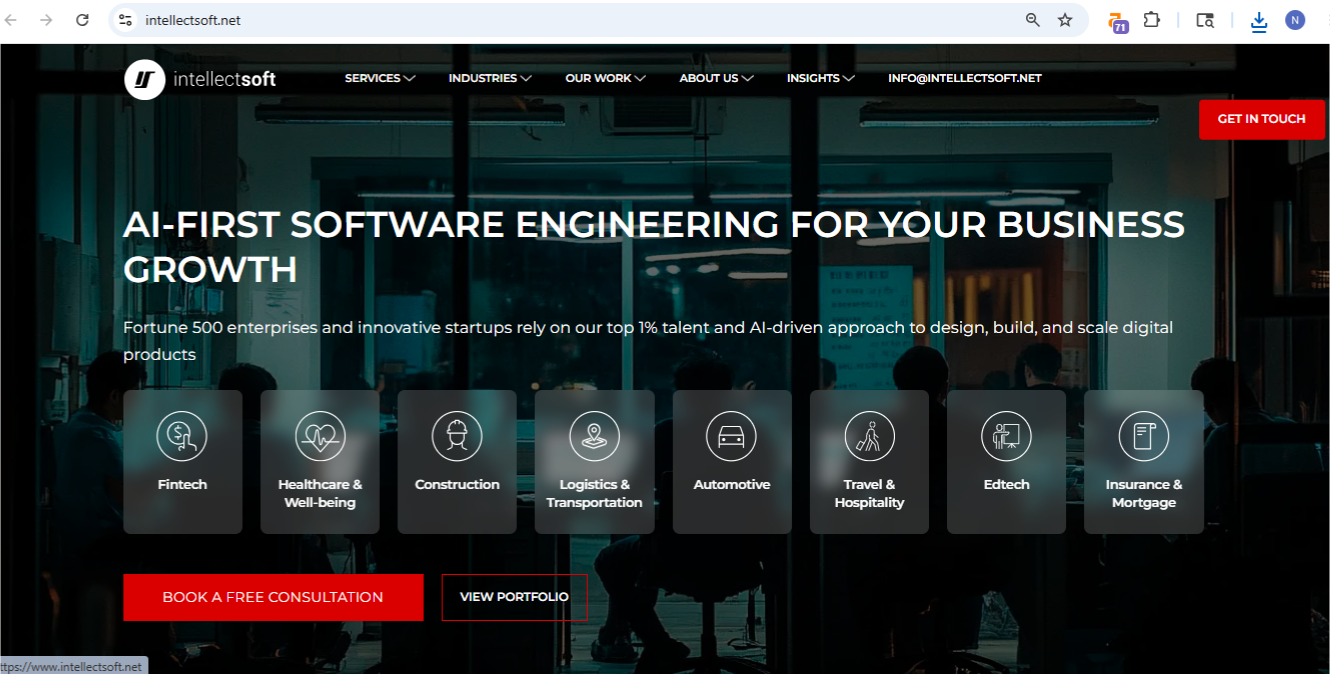
Intellectsoft is worth evaluating if you're building an MVP in a regulated or complex industry — fintech, healthcare, logistics — where enterprise-grade delivery standards matter even at the validation stage.
With a Domain Rating of 68 and global delivery teams, Intellectsoft brings structured delivery methodology to startup and enterprise MVP builds. They're Clutch-listed with strong reviews across North American and European clients, and their team covers the full stack from product design through to backend engineering and QA.
Their strength is in technically demanding builds where architecture decisions made at the MVP stage have real downstream consequences. They're less ideal for founders who need ultra-lean, low-budget validation sprints.
-
Enterprise and startup MVP development
-
Fintech, healthtech, and logistics product specialisation
-
Full-stack engineering with dedicated QA
-
Product design and UX research
-
Agile delivery with iterative sprint structure
Intellectsoft is best for founders building in regulated verticals who can't afford to cut corners on technical quality. If budget is the primary constraint, there are leaner options on this list.
4. Matellio
Matellio has positioned itself specifically as an MVP development specialist — it's not a generalised dev shop that happens to offer MVPs. That focus shows up in their process, which emphasises rapid iteration and lean scoping from the outset.
They're India-based, ranked in Clutch's Top 100, and have worked with Australian clients across mobile and IoT product categories. Their team covers product ideation, UI/UX design, development, and testing under one engagement model, which reduces handoff friction in the early build stages.
Matellio works best for product teams building industry-specific MVPs — particularly in manufacturing, healthcare, and field services — where domain-specific feature logic needs to be validated quickly.
-
MVP-specific product development methodology
-
IoT and hardware-integrated app development
-
Mobile-first MVP builds (iOS and Android)
-
UI/UX design integrated into the sprint cycle
-
Post-launch iteration and feature expansion
Matellio is a practical choice for founders who need fast, focused MVP delivery in a specific vertical. If your product is platform-agnostic or heavily AI-driven, evaluate whether their stack depth matches your requirements.
5. Radixweb
Radixweb brings 20+ years of software delivery experience to MVP engagements — which is unusual for a company still operating at competitive MVP rates. Their longevity means they've navigated enough technology cycles to have genuine opinions about architecture, not just process.
Based in India with Australian clients, Radixweb covers web application development, enterprise systems, and mid-market product builds. They're Clutch-listed and have built a stable delivery reputation across international markets.
They're a solid option for mid-market founders who need a capable, reliable team without enterprise pricing. Their sweet spot is web-first products with clear technical requirements and defined scope.
-
Web application MVP development
-
Enterprise software integration
-
Full-stack development across .NET, PHP, and JavaScript frameworks
-
QA and testing as part of the delivery cycle
-
Ongoing maintenance and support
Radixweb suits founders with reasonably defined requirements who want execution quality at a predictable price. If your product is highly exploratory or requires deep design research, a more discovery-oriented partner may serve you better.
6. Elabor8
Elabor8 is one of the few genuinely Australian-based options on this list, and their value is strongest for teams that need local presence, in-person collaboration, and deep alignment with the Australian enterprise and government technology market.
They specialise in agile transformation and product delivery — making them a natural fit for product teams inside larger Australian organisations that need to move faster, rather than pure startups building from zero. Their team covers product management, delivery coaching, and engineering, often in combination.
Elabor8's delivery model is rigorous and well-suited to organisations that want to build internal capability alongside the product itself.
-
Agile delivery methodology and coaching
-
Local Australian market presence and in-person delivery
-
Product strategy and roadmapping
-
Enterprise digital transformation
-
Team capability uplift alongside delivery
Elabor8 is best for Australian enterprise teams or government-adjacent product builds that benefit from local presence and agile transformation expertise. Pure early-stage startups with lean budgets may find them over-engineered for their stage.
7. S-PRO
S-PRO consistently appears at the top of SERP results for MVP development searches — and their ranking reflects genuine delivery capability, not just content volume. They're a Ukraine-based global team with particular strength in fintech and healthtech product builds.
Their MVP process is structured around technical prototyping and market validation, with an emphasis on getting testable product versions in front of users quickly. They work across web and mobile, and their design and engineering teams operate in an integrated model.
-
Fintech and healthtech MVP specialisation
-
Rapid prototyping and user testing
-
Cross-platform mobile and web development
-
Product design integrated with engineering
-
Technical consulting and architecture review
S-PRO is a strong option for founders in regulated industries who need a technically confident team. Time zone alignment and communication cadence are worth clarifying early in the engagement process given the European base.
8. Sumatosoft
Sumatosoft is a global development team with a Domain Rating of 56 and a track record in startup product validation. They appear consistently in top search results for MVP company lists, and their positioning is squarely aimed at early-stage founders who need a capable web application team.
Their delivery model is agile, their pricing is competitive for the quality tier, and they have experience across a range of startup-focused product categories — marketplace platforms, SaaS tools, and consumer web apps.
-
Startup-focused web application MVP development
-
Marketplace and SaaS platform experience
-
Agile delivery with iterative reviews
-
UI/UX design as part of the engagement
-
Post-MVP support and feature iteration
Sumatosoft is a practical option for early-stage startup MVP development where the primary deliverable is a web application and budget efficiency matters. For more complex mobile or AI-driven products, evaluate whether their stack depth matches your technical needs.
9. Trigma
Trigma focuses on mobile-first MVP delivery and has built a presence in the Australian market through Clutch listings and a clear positioning around consumer and B2B mobile applications. They're India-based with an active international client portfolio.
Their delivery model covers iOS, Android, and cross-platform development, with UI/UX design integrated into the project cycle. For founders whose MVP hypothesis is best tested through a native mobile experience, Trigma offers focused capability at competitive rates.
-
iOS and Android native app development
-
Cross-platform development (React Native, Flutter)
-
Mobile-first UI/UX design
-
Web application development as a secondary capability
-
Post-launch maintenance and feature rollout
Trigma suits founders whose MVP is mobile-native and relatively well-scoped. If your product involves significant backend complexity or enterprise integration, assess whether their infrastructure experience matches the requirement.
10. Lemon.io
Lemon.io operates differently from every other company on this list. It's not a traditional development agency — it's a vetted marketplace of remote developers, specifically positioned for startup teams that need to augment quickly without committing to an agency engagement model.
Their vetting process screens for quality, and their startup focus means they understand MVP constraints — lean scope, fast iteration, tight budgets. If you already have a product lead or CTO and need to add engineering capacity without building an internal team, Lemon.io is worth exploring.
-
Vetted remote developer marketplace
-
Startup-focused, MVP-compatible engagement model
-
Flexible team augmentation (add one developer or several)
-
Web and mobile engineering across common stacks
-
No long-term agency contract requirements
Lemon.io is ideal for founders who need hands-on engineering support rather than full-service product delivery. If you don't have internal product or technical leadership, a structured agency partner will likely serve you better than a developer marketplace.
How to Choose the Right MVP Development Partner
The right partner depends on your product type, your stage, and what you're actually trying to validate. Here's what to weigh:
-
Discovery capability: Can they help you define what to build before they start building? A team that skips discovery is a team that builds what you asked for, not what you need.
-
Prototype-to-product continuity: Does the MVP code get thrown away after validation, or does it form the foundation of the real product? Get this answered upfront.
-
Technical depth for your stack: "We build MVPs" is not the same as "we have senior engineers experienced in your specific stack." Ask for concrete examples.
-
Communication model: Weekly standups, sprint reviews, and async documentation are table stakes — but confirm the cadence and who your main point of contact will be.
-
Post-MVP roadmap alignment: The best partners start thinking about version two during the MVP sprint. Ask how they approach feature prioritisation after launch.
-
Pricing structure transparency: Fixed-price contracts can create incentives to cut corners. Time-and-materials with a defined scope works better for most MVPs — but understand what you're signing.
-
Reference availability: Ask for two client references from engagements similar to yours. How a company responds to this request tells you a lot about their confidence in their own delivery.
Let's Wrap This Up!
We started with a simple truth: hiring the wrong MVP team is one of the most expensive mistakes a founder can make. Not because the cost is always obvious — it rarely is — but because the consequences compound. Wrong architecture means a rewrite at scale. Wrong discovery means you validate the wrong thing. Wrong partner means you're having the wrong conversations at the worst possible time.
None of the ten app development companies Australia founders typically consider are universally wrong. They serve different stages, budgets, and product types. Elabor8 is excellent if you're an Australian enterprise team that needs local delivery and agile coaching. Lemon.io is a smart choice if you have technical leadership in place and need flexible engineering capacity. S-PRO and Intellectsoft earn their place for regulated-industry product builds where architecture precision is non-negotiable.
The right question isn't "which company is best?" It's "which company is right for what I'm building, at the stage I'm at, with the constraints I have?" That's a harder question — but it's the one worth answering before you sign anything.
If you're evaluating product development companies Australia options for a SaaS platform, an AI-powered product, or an enterprise mobile application, Classic Informatics can help you validate and ship without sacrificing the long-term architecture quality that determines whether your product scales. We've worked with 1,000+ clients across 30+ countries, and we're just as focused on what happens after the MVP as we are on building it. Talk to our team whenever you're ready.

FAQS

Frequently Asked Questions
MVP development in Australia typically costs between AUD $30,000 and $150,000 depending on product complexity, the team's seniority, and whether you're working with a local agency or an offshore partner. A mobile-only MVP with defined scope sits at the lower end; multi-platform products with integrations push higher.