
Key Takeaways
- Outsourcing decisions get made on hourly rate and fail on ownership. The rate is the smallest variable in the outcome.
- Four models cover almost every arrangement, and they differ mainly by how much decision-making authority moves outside your organisation.
- Product direction, architecture ownership, and anything that defines your competitive position should stay in-house regardless of budget pressure.
- The right time to bring in an outside team is when hiring would finish after your deadline, not when the budget gets cut.
- Most engagements that fail were already failing by week six, on a decision about authority that nobody wrote down.
- Time zone overlap and who makes architecture calls predict outcomes better than which country the team sits in.
Most teams start the decision to hand software work to an outside team by asking what a developer costs in another country. That's the last question worth asking, and asking it first is how engagements get built on the wrong foundation.
Software development outsourcing is a decision about control. Every model available to you differs mainly in how much authority over what gets built transfers to someone outside your organisation. The failure cases almost always trace back to a mismatch between the authority that actually transferred and the authority the client thought they were giving up.
Get that wrong and the rate stops mattering. A team billing $30 an hour that needs a decision nobody was authorised to make will sit idle, and idle is more expensive than expensive.
This guide is for the CTO scoping engineering capacity, the founder without a technical co-founder, and the engineering leader holding a budget and a deadline that don't fit each other.
What Is Software Development Outsourcing?
Software development outsourcing is the practice of contracting an external team to design, build, or maintain software, instead of doing that work with employees you've hired directly.
That definition is deliberately wide, because the term covers arrangements that have very little in common with each other. A single contractor writing a payment integration and a thirty-person team owning your entire platform are both described by the same word, and treating them as the same kind of decision is where a lot of the confusion starts.
Why Companies Actually Do It
The reason has changed, and the change is recent enough that a lot of published advice hasn't caught up.
Cost used to be the whole story. It isn't anymore. In Deloitte's Global Outsourcing Survey, the share of organisations naming cost reduction as their primary driver fell to 34 percent, down from 70 percent in 2020. What replaced it was access to specialised skills and speed to market.
That shift matters for how you approach the decision. If cost is the driver, you optimise for rate. If capability and speed are the drivers, you optimise for whether the team can actually do the thing, and how fast they can start. Those two approaches lead to different partners and different contracts.
The market context is worth one line and no more. Global spending on IT services is projected to reach roughly $1.87 trillion in 2026, and a growing share of it is product engineering rather than infrastructure and support. The number tells you the practice is mainstream. It tells you nothing about whether it's right for you.
What It Isn't
Two things get filed under this heading that don't belong there.
It isn't a way to avoid managing engineering. Every model below still requires someone on your side making product decisions, answering questions, and reviewing what comes back. The amount of management changes. The existence of it doesn't.
It isn't automatically cheaper. A lower hourly rate multiplied by more hours is not a saving. Rework driven by unclear requirements is the most common way a cheaper engagement ends up costing more than an expensive one, and it has nothing to do with the quality of the engineers involved.
The Four Models, Ranked by How Much Control You Give Up
Four models cover almost every arrangement, and they differ mainly by where the ownership line sits: the point at which decision-making authority about what gets built transfers from you to the partner.
Everything else about these models is negotiable. That one thing is structural, and it's the variable most worth choosing deliberately.
| Model | Who decides what gets built | Who manages the team | Typical commitment | Fits when |
|---|---|---|---|---|
| Individual contractors | You | You | Weeks to months | A specific, bounded skill gap |
| Extended team | You | Shared | 6–24 months | Ongoing capacity against your roadmap |
| Managed team | You set direction, they sequence | Partner | 12+ months | Multi-year product work |
| Full project ownership | Partner, within your goals | Partner | Per project | No internal engineering leadership |
Note: commitment ranges reflect the engagements Classic Informatics typically sees across product engineering and modernization work. Shorter and longer arrangements exist in all four categories.
The table is the answer. The sections below are the support.
Individual Contractors
What it is: One or more engineers contracted directly to work on your backlog, under your management, using your process.
Where the ownership line sits: Entirely on your side. You decide what gets built, how it gets built, and in what order. The contractor executes.
When it makes sense: A specific skill your team lacks for a bounded piece of work. A payments integration, a performance problem in an unfamiliar part of the stack, a mobile build when your team is web-only.
What to watch for: This model transfers no risk. If your requirements are unclear, you get an unclear thing built quickly rather than slowly. It also scales badly. Managing six individual contractors is a full-time coordination job that usually nobody has been assigned. Past a couple of months the dedicated development team vs freelancers maths tips toward the team, because coordination cost rises with headcount while a team absorbs it internally.
Decision signal: If the work is bounded, you can describe it precisely, and you have someone with capacity to manage it day to day, contractors are the cheapest path. If any of those three isn't true, look at the next model.
Extended Team
What it is: A group of engineers assembled by a partner who work as part of your engineering organisation, in your sprints, reporting into your leadership.
Where the ownership line sits: Mostly on your side. You own the roadmap and the architecture. The partner owns hiring, retention, and replacing anyone who leaves.
When it makes sense: You have engineering leadership and a roadmap, and you need more hands against it. This is the model most organisations actually want when they say they're considering outsourcing, and it's the one most often mislabelled as something else.
What to watch for: Continuity. The value of this model compounds over time as the team learns your domain, which means turnover on the partner's side costs you more than it costs them. Ask directly about attrition and about who specifically is assigned before you sign anything.
Decision signal: If you have a product owner and someone who can make architecture calls, an extended team gives you capacity without giving up direction. If you don't have those roles filled internally, fill them first or choose a model that supplies them. Be aware that building an offshore development team commits you to hiring, onboarding, and retention decisions you'll live with for years, which is more setup than the other three models ask for.
Managed Team
What it is: A cross-functional team run by the partner, including their own delivery management, working against a roadmap you set.
Where the ownership line sits: Split. You decide what matters. They decide how to sequence and staff it.
When it makes sense: Long-running product work where you'd rather manage outcomes than manage a team. It works particularly well when the relationship runs for years rather than months, because the partner accumulates context that a project-shaped engagement never gets the chance to build.
That accumulation is the thing most people underestimate. When Classic Informatics built a closing cost calculation platform for First American Title, the work covered 28 US states and more than 650 counties across a partnership that's now run 14 years. A platform handling that much jurisdictional complexity isn't something a team learns in a quarter. The domain knowledge is the asset, and it only exists because the engagement was structured to keep the same people on it.
What to watch for: The gap between "you set direction" and "they sequence" is where friction lives. If your prioritisation changes weekly, a managed team will feel slow, because re-sequencing is a conversation rather than a standup decision.
Decision signal: If you're planning multiple years of development and would rather review outcomes monthly than run sprints yourself, a managed team is the fit. If you need to reprioritise inside a sprint without a conversation, use an extended team instead.
Full Project Ownership
What it is: The partner takes a defined outcome and delivers it, making the architecture, design, and sequencing decisions along the way.
Where the ownership line sits: Almost entirely on their side, bounded by the goals you defined at the start.
When it makes sense: You have a clear business outcome and no internal engineering leadership to direct how it gets achieved. Founders without a technical co-founder are the classic case.
What to watch for: This model is only as good as the outcome definition it starts from. Everything downstream inherits whatever ambiguity was present at the beginning, and there's no internal architect to catch a drifting interpretation in month three.
Decision signal: If you can define what success looks like in business terms but not in technical ones, and you have nobody internally who could direct a team, full ownership is the right shape. If you have an architect or a technical founder, you're paying for judgment you already have.
A Note on Staff Augmentation
The term shows up constantly and maps to the first two models rather than being a fifth one. When people say staff augmentation they usually mean either individual contractors or an extended team, depending on whether the partner is supplying people or supplying a team.
The distinction that actually matters isn't the label. It's whether the partner is accountable for delivery or accountable for supplying qualified people. Those are different commitments and they price differently.
Choosing the model is one decision. Contracting it is another, and product development outsourcing is where engagement structure, cost drivers, and contract terms get settled.
Where an arrangement sits on this spectrum also determines what your software development outsourcing engagement needs from you internally, and that requirement is the one most often underestimated.
What to Outsource and What to Keep In-House
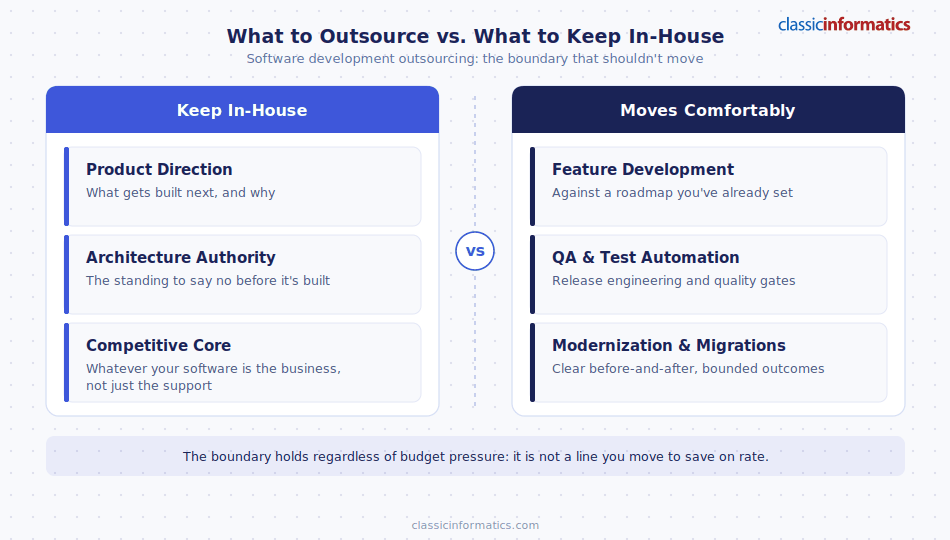
Some work should stay inside the building regardless of budget or timeline pressure: the decisions that define the product, the systems that are your competitive position, and anything where losing context costs more than the work itself.
This is the section most published advice skips, and skipping it is expensive. The question isn't only whether to bring in an outside team. It's which parts of the work you're prepared to move.
The Three Things That Stay
Product direction. What gets built next, and why, is a decision that needs to sit with someone accountable for the business outcome. A partner can advise on it. A partner shouldn't own it, because they don't carry the consequence of getting it wrong.
Architecture authority. Someone internal should be able to say no to a structural decision. Not review it after the fact. Say no to it before it's built. Data models and service boundaries are expensive to reverse, and an organisation with no internal voice on those decisions inherits whatever the partner defaulted to.
The thing you compete on. If your software is the product rather than the support for it, the core of it belongs to a team that isn't going anywhere. A logistics company building an internal route tool has different constraints from a logistics company whose route optimisation is why customers choose them.
What Moves Comfortably
Most of the rest, honestly.
- Feature development against a defined roadmap
- Platform and infrastructure work
- QA, test automation, and release engineering
- Modernization of systems your team didn't build and doesn't want to own
- Integrations, migrations, and anything with a clear before and after state
- Mobile or specialist builds outside your team's stack
The pattern across that list: the work has a definable outcome and doesn't require carrying five years of undocumented business context to do well.
The boundary shifts depending on which function you're looking at. IT outsourcing services span infrastructure, support, QA, and development, and each of those sits differently against the three things that stay.
Decision signal: If the work requires someone to make a judgment call about what the business should do, keep it. If it requires someone to build a thing the business has already decided on, it can move.
When Outsourcing Is the Right Call, and When It Isn't
Bringing in an outside team is right when hiring would finish after your deadline, and wrong when the thing you'd hand over is the thing you compete on.
Timing is the variable people get wrong most often, and it's usually because the trigger was financial rather than operational. The benefits of outsourcing software development are well established: capacity without a hiring cycle, skills you don't carry permanently, turnover risk sitting on someone else's ledger. Whether those are available to you is the harder question, and it's a timing one.
The Conditions That Point Toward It
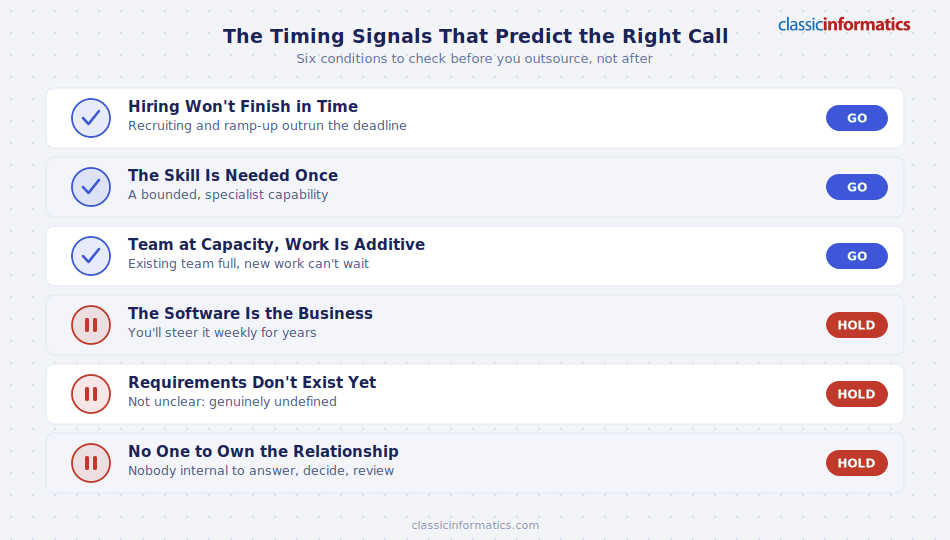
Hiring won't finish in time. This is the strongest signal and the most common legitimate one. Recruiting, notice periods, and ramp-up routinely add up to a quarter or more before an internal hire is productive. If your deadline sits inside that window, hiring isn't a realistic option regardless of budget. The pressure is widespread: ManpowerGroup's talent shortage research has employers reporting difficulty filling skilled roles at close to record levels.
The skill is needed once. A permanent hire for a one-off capability leaves you carrying a salary after the need has passed. Specialist work with a defined end is a clean fit.
Your team is at capacity and the work is additive. Existing team fully committed, new work that can't wait, and no appetite to compromise either. That's the textbook case.
The Conditions That Point Away From It
The software is the business. If you'll be making weekly prioritisation calls on this product for years, and those calls need deep context on customers and market, an external team working against a defined scope will always be a step removed from that.
Requirements genuinely don't exist yet. Not "are still being refined." Genuinely unknown. Discovery is cheaper internally, and handing an undefined problem to an external team produces an expensive education for both sides.
You have nobody to own the relationship. Every model above needs a named person internally who can answer questions and make decisions. Without that role filled, the engagement stalls on your side and gets billed anyway.
The Honest Counter-Case
There's a version of this argument worth taking seriously, and it's not the usual quality objection.
Outsourcing gets you a delivered product efficiently. It doesn't automatically get you a product organisation. If what you actually need is a team that owns discovery, makes prioritisation calls, and iterates on live user data over years, then an external team delivering against a scope, however well, is solving a different problem from the one you have.
The fix isn't avoiding external teams. It's being clear about which of the two you're buying, and not being surprised later that you bought the one you asked for. A prior question sits upstream of all of this: whether custom software development is the right answer at all, or whether a packaged tool would have done the job. Getting that one wrong makes the sourcing decision moot.
Decision signal: If the product is a means to a business outcome you already understand, an external team is usually the faster path. If the product is the business and you expect to be steering it weekly for years, build the internal capability instead. The in-house vs outsourcing software development call turns on how long you'll be maintaining the thing, not on this quarter's headcount budget.
Where the Work Gets Done
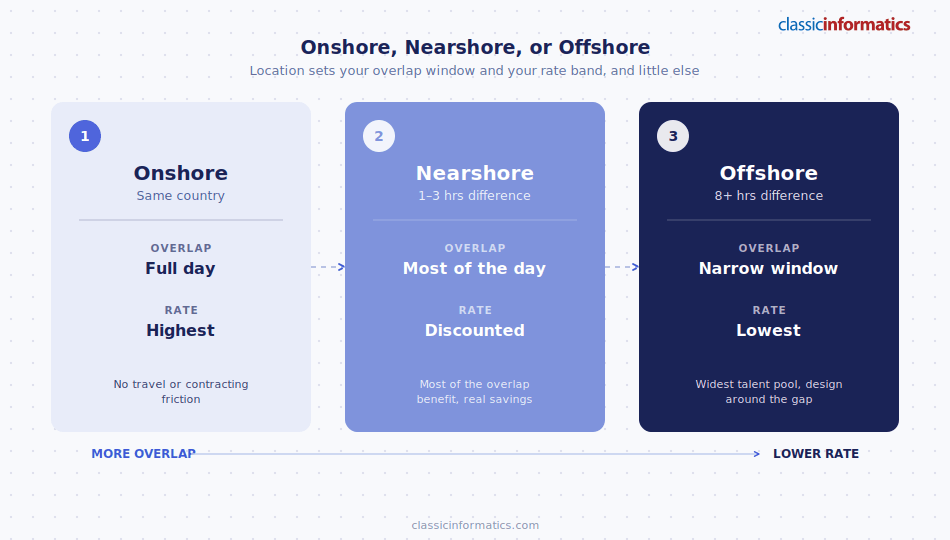
Location determines your overlap window and your rate band, and very little else that matters to the outcome.
The regional comparison gets more attention than it deserves. Quality varies more between two companies in the same city than between two countries, and rate differences narrow considerably once you account for the hours actually needed.
What Location Actually Changes
The overlap window. This is the real variable. A four-hour overlap works. A one-hour overlap makes every clarifying question a next-day event, and on ambiguous work that compounds fast.
The rate band. Real, but smaller than headline comparisons suggest, and shrinking. The global market sits at roughly $638 billion in 2026 with buyers increasingly blending regions rather than picking one.
Nothing else, reliably. Language, quality, and process maturity are company-level attributes, not country-level ones.
The Three Categories
Onshore: same country. Maximum overlap, highest rate, no travel or contracting friction.
Nearshore: nearby country, one to three hours difference. Most of the overlap benefit at a meaningful discount.
Offshore: distant time zone, typically eight or more hours. Lowest rates and the widest talent pool, with the overlap window as the thing to design around rather than ignore. Outsourcing to India buys a deeper talent pool and English fluency alongside the rate difference, which is why it holds the share of this category that it does.
Choosing between the three depends on how much of your work needs same-day back-and-forth. Offshore vs nearshore vs onshore software development is a trade of overlap against rate, and the right answer moves with how ambiguous the work is rather than with how big the budget is.
Decision signal: If your work involves frequent ambiguity that needs same-day resolution, buy overlap and accept the rate. If your work is well-specified and reviewable asynchronously, the overlap premium isn't worth paying.
Choosing a Partner: Three Questions That Predict the Outcome
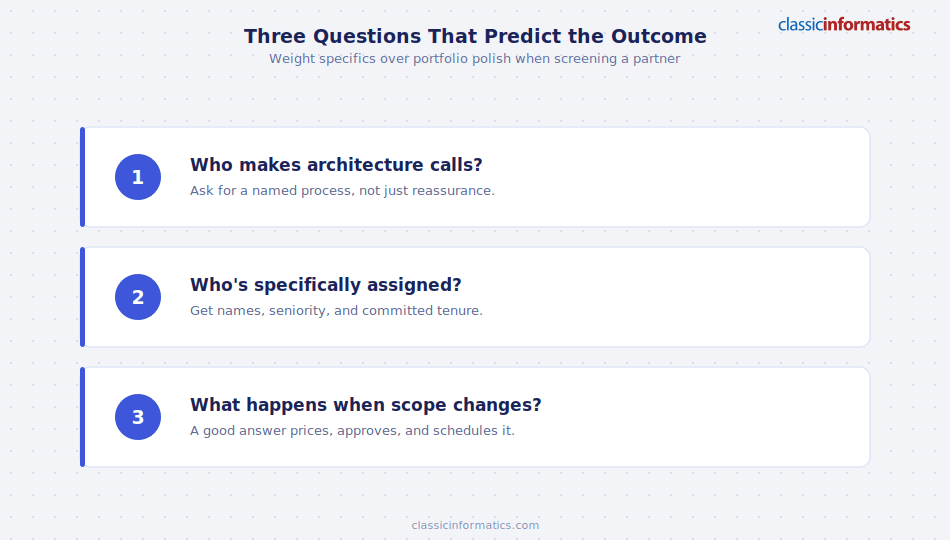
Three questions predict engagement outcomes better than any capabilities deck: who makes architecture calls, who specifically is assigned, and what happens when requirements change.
Most partner-selection advice produces a checklist long enough that everything on it gets a passing grade. Among the key factors in the right outsourcing decision, these three are where a vague answer reliably turns into a problem later.
Who Makes Architecture Calls?
Ask it directly, and listen for whether the answer describes a process or a person.
Structural decisions get made early, usually before either side has enough information. What matters is whether they're made deliberately, with a record of the reasoning, or made implicitly by whoever writes the first migration. A partner who can describe how they document and review those decisions is telling you something real. A partner who says the team will figure it out is also telling you something.
Running the design against a published framework is a reasonable baseline here. The AWS Well-Architected Framework organises the same territory most architecture reviews cover, and asking whether a partner works against something like it separates teams with a method from teams with opinions.
Who Specifically Is Assigned?
The gap between the people in the sales conversation and the people who write the code is the single most common unpleasant surprise in this process.
Ask for names, seniority, and whether those people are committed for the engagement's duration. A partner with hundreds of engineers doesn't help you if yours is a rotating cast. Continuity is where domain knowledge lives, and domain knowledge is most of what you're paying for after month three.
What Happens When Requirements Change?
They will. The question is whether there's a process.
A good answer describes how a change gets priced, who approves it, and what it displaces in the schedule. A bad answer is the word "flexible" with nothing behind it, which in practice means undocumented scope creep that both sides resent by month four.
Decision signal: If a partner answers all three with specifics, weight that above portfolio polish. If they answer any of them with reassurance rather than detail, expect the same vagueness after signing.
These three questions sit inside a longer screening process. Running every candidate through the same vendor due diligence checklist for IT outsourcing keeps the comparison consistent, and a ranked list of software development outsourcing companies is a reasonable way to assemble the shortlist you'll then screen.
Why Outsourced Engagements Fail
Engagements fail on organisational decisions made in the first six weeks, not on code written in month five. Three patterns account for most of what goes wrong, and none of them are technical.
This matches the broader evidence on large technology programmes. The McKinsey and University of Oxford study of more than 5,000 large IT projects found average budget overruns of 45 percent, with the value shortfall running larger than the cost one. The pattern behind those numbers is rarely a single bad technical decision.
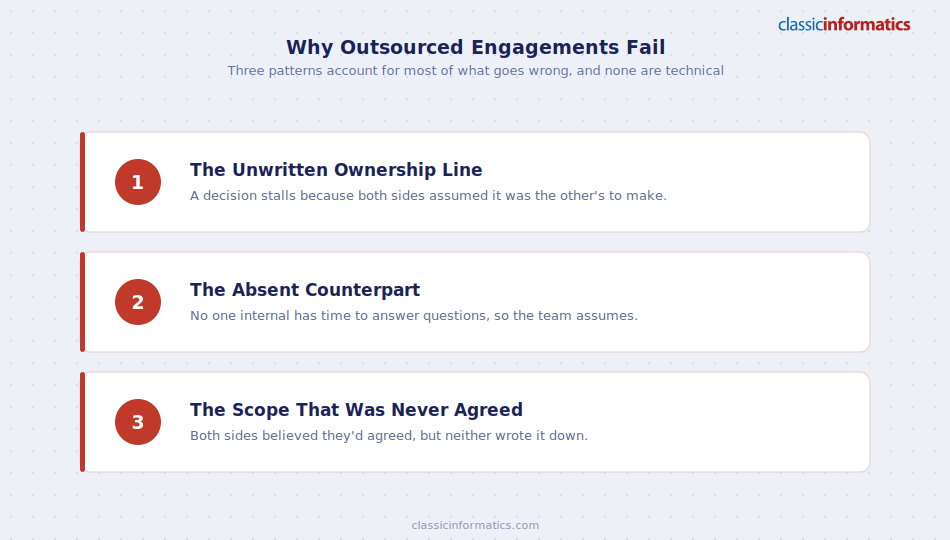
The Unwritten Ownership Line
What it looks like: Six weeks in, a decision needs making. The partner assumes it's yours. You assumed it was theirs. The sprint stalls while both sides wait, and the delay gets attributed to velocity rather than to authority.
Why it happens: The contract specified scope and rate. It didn't specify who decides. In our experience this is the most common single failure in the first quarter of an engagement, and it's almost always visible in retrospect as a conversation nobody had during onboarding.
How to fix it: Write down, before the first sprint, which categories of decision belong to which side. Architecture, scope changes, technical trade-offs, and prioritisation each need an owner named. It takes an hour and it prevents the most expensive kind of idle time.
The Absent Counterpart
What it looks like: Nobody internal has the time to answer the partner's questions. Responses take days. The team makes reasonable assumptions to keep moving, and three months later those assumptions have become the product.
Why it happens: The engagement was justified partly on the basis that it would free up internal time, so no internal time was allocated to it.
How to fix it: Name a counterpart before the engagement starts and protect their calendar for it. The commitment is smaller than people expect, but it isn't zero, and treating it as zero is what produces the drift.
The Scope That Was Never Agreed
What it looks like: Both sides believed they'd agreed what was being built. Neither wrote it down in enough detail to test that belief. The disagreement surfaces at the first demo.
Why it happens: Detailed scoping feels like delay when everyone wants to see progress, and a paid discovery phase is an easy line to cut when the budget is tight.
How to fix it: Treat scoping as deliverable work with a written output that both sides sign, including an explicit list of what's out of scope. The out-of-scope list does more work than the in-scope one.
These three cover most of what goes wrong, not all of it. Why outsourcing product development fails almost always traces back to the same root as the patterns above, which is a decision about authority that nobody made. The IT outsourcing challenges that stop short of outright failure, time zone friction and thin visibility, are survivable, but they compound if left alone.
The First Ninety Days
The shape of a healthy engagement is visible by week six, and so is the shape of one that won't work. Knowing what to look for is the difference between fixing something in month two and writing it off in month eight.
Nobody publishes this part, which is strange, because it's where the outcome actually gets determined.
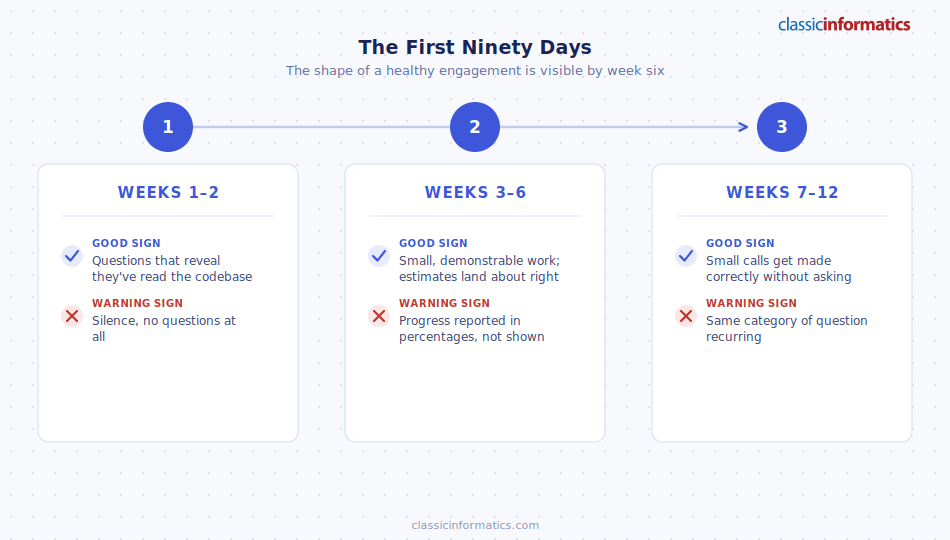
Weeks One to Two
Expect low output and a lot of questions. That's correct. A team that produces a great deal in its first fortnight is usually building against assumptions rather than understanding.
What good looks like: Questions that reveal they've read the codebase. Pushback on something in your brief. A written summary of what they think they're building, sent back to you unprompted.
Warning sign: Silence. A team that has no questions in week one either has extraordinary context or isn't looking closely.
Weeks Three to Six
The first real work lands. This is the diagnostic window.
What good looks like: Something working, demonstrable, and small. Estimates that turn out to be roughly right. At least one instance of the team flagging a problem before you noticed it.
Warning sign: Progress reported in percentages rather than shown in working software. "Ninety percent done" is not an observation about a system, it's an observation about a plan.
Weeks Seven to Twelve
Velocity should be stabilising and the questions should be getting more specific.
What good looks like: The team starts making small decisions correctly without asking, because they've absorbed enough context to predict your answer. That's the clearest signal the engagement is working. Managing outsourced teams well is mostly about keeping context flowing in both directions, not about adding oversight.
Warning sign: The same category of question recurring in month three. It means context isn't accumulating, which usually means the people are changing.
The Call at Ninety Days
If the signals are good, the engagement compounds from here and the sensible move is to extend the commitment and reduce the oversight.
If they aren't, the honest question is whether the problem is the team or the setup. In our experience it's the setup more often than people expect, which is why the fix usually starts with the ownership line rather than with a new partner. Past ninety days the mechanics stop being about sourcing at all. Digital product development runs the same stages whether the team is internal or external, and the handoffs between those stages are where products actually stall.
Decision signal: If the team is making small calls correctly without asking by month three, extend and step back. If they're still asking the same questions they asked in week two, fix the authority structure before you change the team.
Let's Sum Up!
If you take one thing from this guide, make it the ownership line. Where authority sits is the decision that determines whether the engagement works, and it's the one most likely to go unmade.
Everything else follows from it. The model you choose is a statement about how much control you're transferring. What you keep in-house is a statement about which decisions are too consequential to move. The failure patterns are all versions of the same problem: nobody wrote down who decides.
The whole guide, collapsed into eight rules:
- Choose the model by how much authority you mean to transfer, not by rate.
- Keep product direction, architecture authority, and your competitive core in-house.
- Bring in a team when hiring would finish after the deadline, not when the budget gets cut.
- Buy time zone overlap when the work is ambiguous. Skip it when the work is specified.
- Ask who makes architecture calls, who's assigned, and what happens when scope changes.
- Write down which decisions belong to which side before the first sprint.
- Name an internal counterpart and protect their time.
- Judge the engagement at week six, not at month six.
Classic Informatics has run engagements at every point on that spectrum, from a single specialist filling one gap to teams that have owned a platform for over a decade. A 95 percent client retention rate is mostly a function of settling the ownership line early rather than discovering it in month three. If you're weighing how much of a build to hand over, or trying to work out why an arrangement that looked right on paper isn't moving, we're happy to talk it through.
Frequently asked questions
What is software development outsourcing?
Software development outsourcing is contracting an external team to design, build, or maintain software rather than doing that work with directly hired employees. The term covers arrangements ranging from a single contractor on a bounded task to a partner owning an entire platform. What separates them is how much decision-making authority moves outside your organisation, which is the variable worth choosing deliberately rather than inheriting from whatever the contract happened to say.
What's the difference between outsourcing and staff augmentation?
Staff augmentation supplies qualified people who work under your management, your process, and your architecture decisions. Outsourcing in its fuller sense transfers accountability for delivery itself, including sequencing and often architecture. The practical test is what the partner is committing to: supplying capable people, or delivering an outcome. Those are different commitments, they price differently, and confusing them is a common source of mismatched expectations in the first quarter.
What should you never outsource?
Three things should stay in-house regardless of budget pressure. Product direction, because the person deciding what gets built next should carry the business consequence. Architecture authority, because someone internal needs the standing to refuse a structural decision before it's built. And whatever your software competes on, if the product is the business rather than support for it. Everything else moves comfortably when the outcome is definable.
When should a startup bring in an external development team?
The clearest trigger is a deadline that sits inside your hiring timeline. Recruiting, notice periods, and ramp-up routinely take a quarter or more, so if the work can't wait that long, hiring isn't a real option. It's the wrong move when requirements genuinely don't exist yet, or when nobody internally has capacity to own the relationship and answer questions day to day.
How much does software development outsourcing cost?
Rates vary by region, but rate is the smallest variable in what you actually pay. Scope clarity and engagement model drive total cost far more, because an underspecified requirement gets built twice and rework multiplies whatever the hourly figure was. A cheaper team against an unclear brief routinely costs more than an expensive one against a tight scope. Detailed cost drivers and regional bands sit in the product development outsourcing guide.
Is your intellectual property safe when you outsource development?
It's safe when the contract explicitly assigns ownership to you and you hold the accounts. Ownership of commissioned work isn't automatic under copyright law, so it needs to be a written term rather than an assumption. The less obvious risk is operational: if the source repository, cloud accounts, and infrastructure live in the partner's environment, switching later becomes impractical regardless of what the contract says.
How do you know if an engagement is working?
By week six you should see something small working rather than a percentage complete, estimates that land roughly right, and at least one problem the team flagged before you noticed it. By month three, the strongest signal is that they've started making small decisions correctly without asking. If they're still asking the same questions they asked in week two, context isn't accumulating and the setup needs fixing.