
Key Takeaways
- Most enterprise AI projects fail in the infrastructure layer, not the model layer. Data readiness, governance, and integration maturity determine whether AI reaches production.
- The difference between a successful pilot and a scaled deployment is usually an operating model change, not a technology change.
- Enterprise AI strategy needs to be sequenced: data infrastructure first, governance early, use cases matched to what your data can support today.
- Generative AI and agentic AI are different bets with different infrastructure and governance requirements. Knowing which your organisation is ready for prevents expensive restarts.
- ROI from enterprise AI is real, but it arrives unevenly. Measuring it requires baselines set before the project starts, not metrics invented after go-live.
Most enterprise leaders already believe AI matters. That's not the question anymore. The question that keeps the smart ones up at night is a different one: every AI initiative looks promising at the demo stage, then quietly stalls before it touches production.
The answer isn't the model. The vendor's demo worked because the vendor controlled the data. Your implementation stalled because your data doesn't look like that — and probably never will without significant upstream work that nobody scoped for.
This is for the CIO sponsoring the programme, the architect scoping the data work underneath it, and anyone building an AI business case a board will actually approve.
This guide covers why enterprise AI projects fail, what the ones that succeed do differently, and how to build the infrastructure, governance, and strategy that makes the difference.
What Is Enterprise AI?
Enterprise AI is a term used to mean almost everything, and therefore nothing.
Before getting into adoption, strategy, or governance, it's worth being precise. Because the definition you're working with shapes every decision you'll make downstream.
Enterprise artificial intelligence is the application of AI — machine learning, large language models, computer vision, natural language processing, or agentic systems — inside an organisation's operations, products, and decision-making processes, at a scale and reliability that's fit for business-critical use.
That last phrase matters more than the first part. Lots of organisations have AI in enterprise. What most don't have is AI that works consistently, reliably, and in production environments where failure has real consequences.
Enterprise AI isn't a product you buy. It's the combination of data infrastructure, model selection, integration architecture, governance, and change management that makes AI trustworthy enough to run critical operations on.
What makes it distinct from consumer or startup AI is the environment it has to survive: legacy systems that weren't built for API access. Data distributed across dozens of source systems that never agreed on a schema. Compliance frameworks that require explainability, auditability, and defined accountability for AI decisions. Security requirements that most off-the-shelf AI tools don't meet. And organisational cultures that haven't decided yet whether they trust the output.
All of that has to be solved before the model becomes useful.
Enterprise AI vs Enterprise Generative AI
These terms are often conflated, and the conflation causes real problems.
Generative AI — large language models, image generation, code completion — is one type of AI. It's powerful, accessible, and very good at generating content-like outputs. It's also the type most subject to hallucination, unexplainability, and regulatory concern.
Enterprise generative AI is generative AI hardened for enterprise deployment: grounded in your own data through retrieval-augmented generation or fine-tuning, connected to your access controls, with audit trails that satisfy compliance requirements. Using it in a consumer tool is a different proposition from running it on an enterprise AI platform that processes customer contracts, drives underwriting decisions, or surfaces clinical recommendations. The use cases overlap. The infrastructure and governance requirements don't.
For most enterprises, this is also where the buy-versus-build decision surfaces — grounding a generic model in your own data is different work from custom AI development built around your business logic from the start.
Enterprise AI vs Enterprise Machine Learning
Enterprise machine learning — predictive models, classification systems, anomaly detection, forecasting engines — has been running in enterprises for a decade or more. It's established, well-understood, and already working in production at many organisations.
The 2025–2026 wave isn't replacing that. It's adding new capability types on top: large language models, multimodal AI, and increasingly, agentic systems that can reason, plan, and execute multi-step tasks with minimal human input.
Understanding which type of AI you're deploying — and which your data and infrastructure can actually support — is one of the most important decisions in an enterprise AI programme.
The Real Cost of Getting Enterprise AI Wrong
According to McKinsey's 2024 State of AI report, 72% of organisations have now adopted AI in at least one business function. But adoption rates tell you nothing about outcomes. The uncomfortable reality is that most of that adoption hasn't reached the scale or reliability that makes it strategically significant.
Deloitte's 2026 State of AI in the Enterprise report puts a number on the gap: technical infrastructure readiness sits at 43%, data management at 40%, and governance readiness at just 30%. Most organisations rate themselves less ready this year than last — not because the technology got harder, but because ambition outpaced the groundwork underneath it.
The cost isn't just the failed project. It's what the failed project teaches your organisation: that AI is hard, that the results don't match the pitch, and that maybe it's better to wait. That lesson is hard to unlearn.
Why Most Enterprise AI Projects Stall Before They Scale
Here's a pattern that plays out reliably, across industries and organisation sizes.
The pilot works. The demo is impressive. Leadership approves budget. The team starts building. Then, somewhere between proof of concept and production, things get hard. The data isn't as clean as it looked in the demo. The integration with the system-of-record needs six weeks of engineering work nobody scoped. The governance question — who's accountable when the AI is wrong? — surfaces as a blocker three weeks before go-live.
The project either launches in a limited form that never scales, or stalls entirely.
Gartner predicts that at least 30% of generative AI projects will be abandoned after proof of concept, citing poor data quality and unclear business value as the leading causes. That number would probably be higher if organisations tracked their stalled pilots as rigorously as their launched ones.
Three failure modes account for most of it, and they follow the same three-part shape every time.
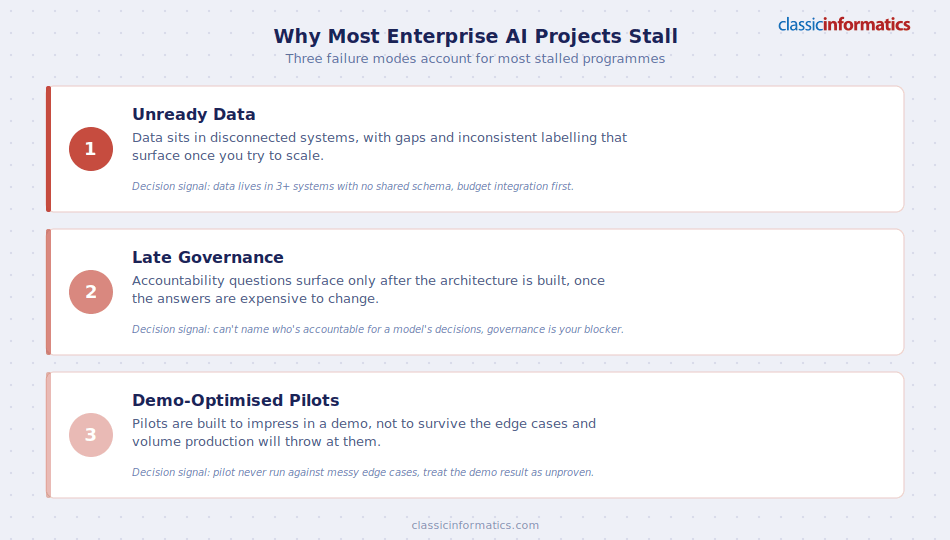
Unready Data
This is the most common cause by a large margin, and it's also the most fixable. Most organisations just don't fix it before they start.
What it looks like: Data sits in systems that don't talk to each other. A dataset that looks clean in a pilot environment turns out to have gaps, inconsistencies, and labelling that varies by team, region, or year once you try to run it at scale.
Why it happens: AI readiness gets treated as a checkbox on a vendor questionnaire instead of an assessment. Nobody scopes the integration architecture needed to keep data current and accessible in real time until it's already blocking the build.
How to fix it: Run the data assessment honestly, before model selection — not after the pilot stalls. The teams that do this are the ones whose projects reach production.
Decision signal: If your data lives in three or more systems that don't share a schema, budget the integration work before you budget the model. If it doesn't, this is probably not your blocker — look at governance or pilot design instead.
Late Governance
What it looks like: The accountability questions surface late — who owns the model's decisions, what happens when it's wrong, how it gets explained to a regulator — after the architecture is already built in ways that make the answers complicated.
Why it happens: Most organisations treat governance as a compliance step near the end of the programme rather than a set of operating decisions — data access policy, explainability requirements, human-in-the-loop thresholds, escalation paths — built into the system from the start.
How to fix it: Write the accountability structure before the first model ships, not after. Bolting governance on after go-live means rework, delay, and sometimes a project that can't proceed at all.
Decision signal: If you can't currently name the person accountable for a specific model's decisions, governance is your blocker, regardless of how clean your data is.
Demo-Optimised Pilots
What it looks like: A pilot that looks good in a board update and falls apart in the first week of real use — because demo environments are controlled: clean data, excluded edge cases, latency that only has to hold for a handful of requests, not thousands.
Why it happens: The pilot was designed to prove the concept, not stress-test the production scenario. Nobody built it to fail in controlled ways.
How to fix it: Design the pilot to find failure modes, not showcase moments. Test the edge cases and the request volume production will actually throw at it.
Decision signal: If your pilot has never been run against messy, real-world edge cases, treat "it worked in the demo" as an open question, not a result.
The Enterprise AI Adoption Roadmap: From Pilot to Production
Getting AI out of pilot mode and into scalable production is the challenge most enterprise teams underestimate. The gap between "we have a demo" and "we have a system we run the business on" is wider than it looks from the pilot side. Closing it is what AI adoption and AI implementation actually mean in practice — moving deliberately through each phase below rather than skipping to the exciting part.
A realistic roadmap runs in four phases, in this order — skipping the order is how an eighteen-month programme happens instead of a six-month one.
| Phase | Primary Focus | Typical Timeline | Risk If Skipped |
|---|---|---|---|
| 1. Data & Infrastructure Readiness | Mapping data sources, compute, storage, MLOps tooling | 2–4 months | Every later phase inherits the gap |
| 2. Use Case Selection & Validation | Matching business value to data readiness and failure cost | 1–2 months | Resources go to the most impressive use case, not the most ready one |
| 3. Build for Production | Designing for production data volumes and edge cases, not pilot conditions | 3–6 months | A pilot that never survives contact with real traffic |
| 4. Governance, Monitoring & Iteration | Ongoing model ownership, drift detection, retrain/retire decisions | Ongoing | A portfolio of models nobody is accountable for |
Note: these are typical ranges from engagements across manufacturing, healthcare, insurance, and technology — a heavily regulated environment or a legacy-system-heavy one will run longer on phases 1 and 4.
Phase 1: Data and Infrastructure Readiness
Before any model selection or vendor evaluation, the most important question is whether your data environment can support the use case you're pursuing.
That means mapping your data sources: where the relevant data lives, how it's structured, how often it's updated, and what engineering work is needed to make it accessible in a format AI systems can use. For most enterprises, this surfaces surprises. Data assumed to be in one place is actually in three. The integration that looked straightforward requires a middleware layer that doesn't exist yet.
This phase also covers establishing the technical infrastructure for AI workloads: compute, storage, vector databases if you're working with unstructured data, and the MLOps or LLMOps tooling needed to build, test, and monitor models in production. The AWS Well-Architected Machine Learning Lens is a useful checklist here even outside an AWS environment — it's built around the same data-processing-through-monitoring lifecycle regardless of cloud provider.
Getting this right upfront is what separates a six-month implementation from an eighteen-month one.
Decision signal: If you can't currently list every system your target use case's data lives in, this phase isn't done — go no further until you can.
Phase 2: Use Case Selection and Validation
Not all AI use cases are equal. Some deliver fast, measurable value with relatively straightforward implementation. Others require infrastructure, data, and change management work that won't pay off for two or three years.
The use cases that work best as first deployments share three characteristics: the data to support them already exists and is reasonably clean; the business process they're improving is well-defined and measurable; and the risk profile of getting them wrong is contained.
A demand forecasting model that's occasionally imprecise is recoverable. A clinical decision support system that hallucinates is not.
Prioritise by the intersection of business value, data readiness, and acceptable failure cost. Not by which use case sounds most impressive in a strategy presentation.
Decision signal: If getting a use case wrong would be expensive to detect and expensive to reverse, it's not a first deployment — however strong the business case looks on paper.
Phase 3: Build for Production, Not for Pilot
The build phase is where most programmes diverge from their roadmap. The fastest path to a working demo is almost never the fastest path to a production system that operates reliably at scale.
Building for production means designing for the data volumes and edge cases you'll see in production, not the controlled conditions of the pilot. It means building monitoring and alerting from day one, not adding it after go-live. It means building the human-in-the-loop workflows that allow operators to catch and correct model errors before they propagate.
The enterprise AI applications that fail most predictably are the ones where the integration architecture was underspecified.
Decision signal: If your build plan doesn't include monitoring and alerting from day one, it's a pilot plan wearing a production label.
Phase 4: Governance, Monitoring, and Iteration
Production AI isn't a fire-and-forget deployment. Models drift as the real-world data they're operating on evolves. Business requirements change. Regulatory expectations shift.
A mature enterprise AI programme has monitoring in place to detect when model performance degrades. It has governance processes for deciding when to retrain, update, or retire a model. And it has a clear owner accountable for each AI system's performance — not just the team that built it, but a business owner who can make the call on when it's no longer fit for purpose.
The enterprise AI adoption pattern that actually works isn't "deploy and move on." It's "deploy, monitor, improve, and eventually retire." Treating production deployment as the finish line is how you end up with a portfolio of AI systems nobody is confident in.
Decision signal: If no named business owner can say when a model stops being fit for purpose, you don't have a governance process — you have a deployment and a hope.
How to Build an Enterprise AI Strategy
Most enterprise AI strategy documents look impressive in the slide deck. Vision statements, capability maps, use case portfolios, and investment frameworks. They were built in a strategy workshop by people who cared about getting it right.
Then reality arrives. The data isn't ready. The first use case runs into an integration wall. A regulatory question stalls the deployment for two months. The executive sponsor changes. And the strategy document — never built to accommodate any of those things — becomes a historical artefact while the real decisions get made ad hoc.
What makes an enterprise AI strategy durable isn't the sophistication of the framework. It's the honesty of the baseline and the specificity of the sequencing.
Start With an Honest Assessment
The strategy needs to be grounded in where you actually are, not where you wish you were or where the vendor told you you could be in twelve months.
That means an honest assessment of your data environment: quality, accessibility, governance maturity. An honest assessment of your engineering team's AI and MLOps capability. And an honest assessment of your organisational readiness — is there a business unit willing to own a real AI deployment, including the messy parts?
A strategy built on an inflated baseline creates expectations it can't meet. And unmet expectations kill AI programmes in the political dimension, long before the technical dimension becomes the problem.
Sequence the Work
AI strategy isn't a use case list. It's a sequencing decision. Which capability does the organisation need to build first, so that the second capability can stand on top of it?
Data infrastructure before model deployment. Governance framework before scaling. Internal capabilities before the use cases that require them. The teams that get AI to scale aren't the ones with the most ambitious strategy document. They're the ones who got the sequence right and didn't skip the foundation work because the business was impatient.
Connect AI Strategy to Business Outcomes
The strategy needs a line from every AI initiative to a specific, measurable business outcome. Not "improve decision making" — that's not an outcome. Specific: reduce claim processing time by 40%. Reduce inventory carrying cost by a defined margin. Increase first-call resolution rate by 15 points.
Those connections are what make the ROI case, what get budget approved, and what keep the programme alive through the difficult middle phase when the results aren't yet visible.
Generative AI vs Agentic AI: What the Difference Means for Your Build
Two terms that get used interchangeably, incorrectly, and consequentially — the generative AI vs agentic AI distinction is worth its own deep dive if this section raises more questions than it answers.
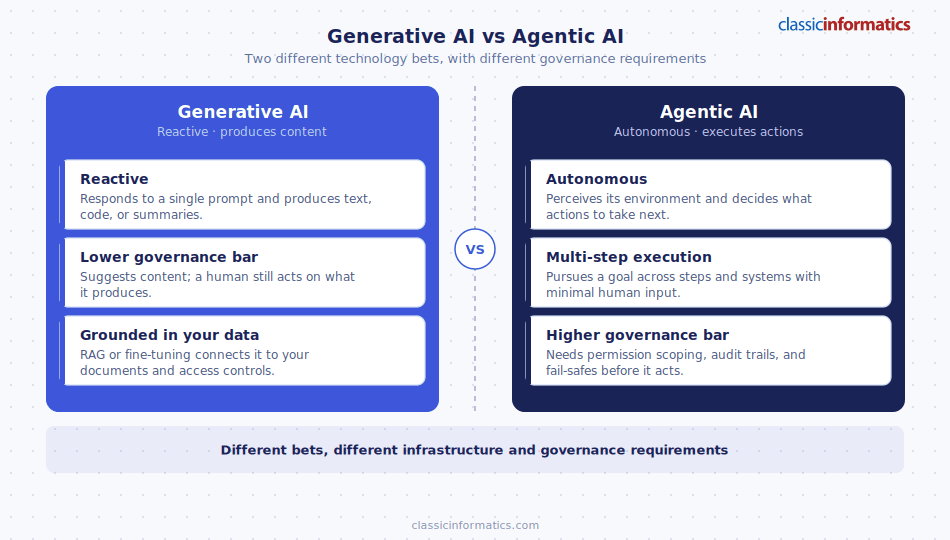
Getting this distinction right shapes your architecture, your governance requirements, your implementation timeline, and your risk profile. Getting it wrong creates projects that look like the wrong thing for the money you spent.
Generative AI produces content: text, images, code, summaries, translations. It's reactive — you give it an input, it produces an output. An enterprise generative AI system is this pattern applied to business processes: a document summarisation tool, a contract analysis system, a customer service copilot, grounded in your data and governed for enterprise use.
Agentic AI is different in kind. An AI agent doesn't just respond to prompts. It perceives its environment, decides what actions to take, executes those actions across systems, and pursues a goal across multiple steps — with minimal human intervention between steps.
The infrastructure requirements are different. The governance requirements are significantly different. An agent that can take actions — send emails, update records, initiate transactions — needs oversight mechanisms, permission scoping, audit trails, and fail-safes that a generative AI tool producing text suggestions doesn't need to the same degree.
Agentic AI for enterprise is where a lot of organisations are currently over-investing in ambition and under-investing in infrastructure. The use cases are genuinely compelling. Gartner predicts that by 2027, 40% of enterprises will demote or decommission autonomous AI agents because of governance gaps discovered only after a production incident — not because the underlying capability failed.
The right question isn't which technology to use. It's what your data infrastructure, governance maturity, and organisational capability support today — and what sequence of investment gets you to the use cases you actually want.
For most enterprises in 2026, the practical answer is: enterprise generative AI grounded in your own data as the near-term bet, with agentic infrastructure built in parallel as you develop the governance and monitoring maturity to trust it operating autonomously.
Decision signal: If you can't yet name who's accountable when an autonomous action goes wrong, build the generative AI use case first and treat agentic AI as the infrastructure project it actually is.
What Enterprise AI Governance Actually Covers
If there's one pattern that distinguishes enterprise AI programmes that scale from those that stall at "promising pilot", it's this: the successful ones built governance into the system from week one. The stalled ones tried to bolt it on at the end. Only 30% of organisations currently rate their own governance readiness as strong, per Deloitte's 2026 survey — the lowest-scoring dimension of the five they measured.
An AI governance framework isn't a compliance document. It's a set of operating decisions built into the architecture, the processes, and the accountability structures of your AI programme. The NIST AI Risk Management Framework is the closest thing to a shared vocabulary for this work — its four functions (Govern, Map, Measure, Manage) map cleanly onto the four areas below.
It covers four areas, and each needs a decision, not just a policy.
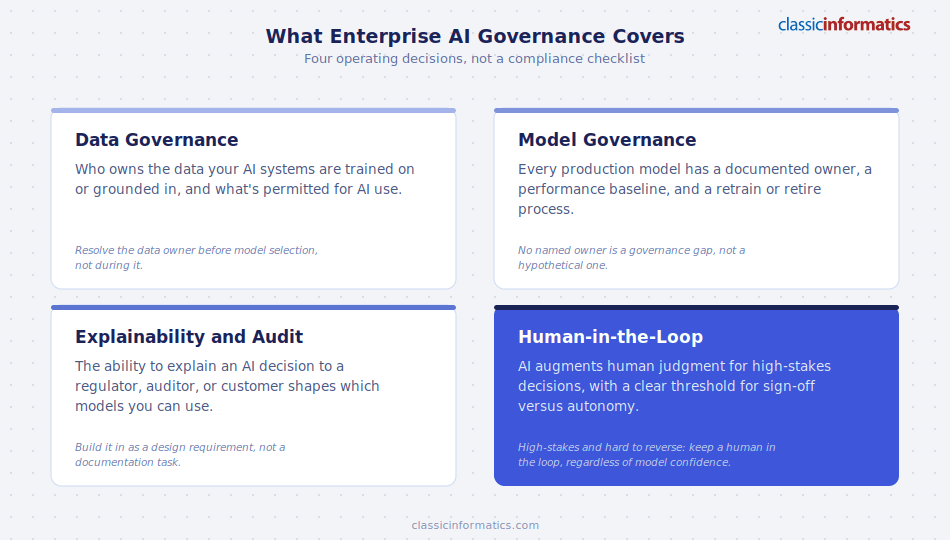
Data Governance for AI
What it is: Who owns the data your AI systems are trained on or grounded in, what's permitted for AI use, and under what conditions.
Where it doesn't work: Nobody has answered the question by the time the model is built — because the architecture depends on the answer, changing it later means rework.
Decision signal: If you can't name the data owner for your target use case's inputs, resolve that before model selection, not during it.
Model Governance
What it is: Every AI model in production has a documented owner, a performance baseline, a monitoring protocol, and a defined process for retraining or retiring it.
Where it doesn't work: Without it, your AI portfolio becomes a collection of black boxes nobody is confidently accountable for.
Decision signal: If you can't currently answer "who decides when this AI system is no longer fit for purpose" for every deployed model, that's your governance gap — not a hypothetical one.
Explainability and Audit
What it is: The ability to explain an AI decision to a regulator, auditor, or customer — which shapes which model types you can use and what human oversight needs to be in place.
Where it doesn't work: Built in after the fact, for regulated industries especially, it's expensive and often inadequate.
Decision signal: If you're in healthcare, finance, or insurance and can't currently produce an audit trail for a model's decision, treat explainability as a design requirement, not a documentation task.
This is also where responsible AI in the enterprise stops being an ethics-checklist exercise and starts being an architecture decision.
Human-in-the-Loop
What it is: For high-stakes decisions, AI augments human judgment rather than replacing it — with a defined threshold for which decisions need sign-off, which can run with monitoring, and which can be fully autonomous.
Where it doesn't work: Get the threshold wrong in either direction and you either lose the speed benefit of automation or create an incident that damages trust in the whole programme.
Decision signal: If a decision is high-stakes and hard to reverse, put a human in the loop regardless of how confident the model is. Reversible, low-stakes decisions are where autonomy earns its keep.
How to Measure Enterprise AI ROI
Enterprise AI has a measurement problem. Not because the value isn't there — it is — but because the instinct when building the business case is to find metrics that make the number look good, not metrics that tell you whether the investment is actually working. Getting how to measure AI ROI right deserves a full framework of its own — the principles below are the foundation of it.
A few principles that hold across how to measure AI ROI in enterprise programmes:
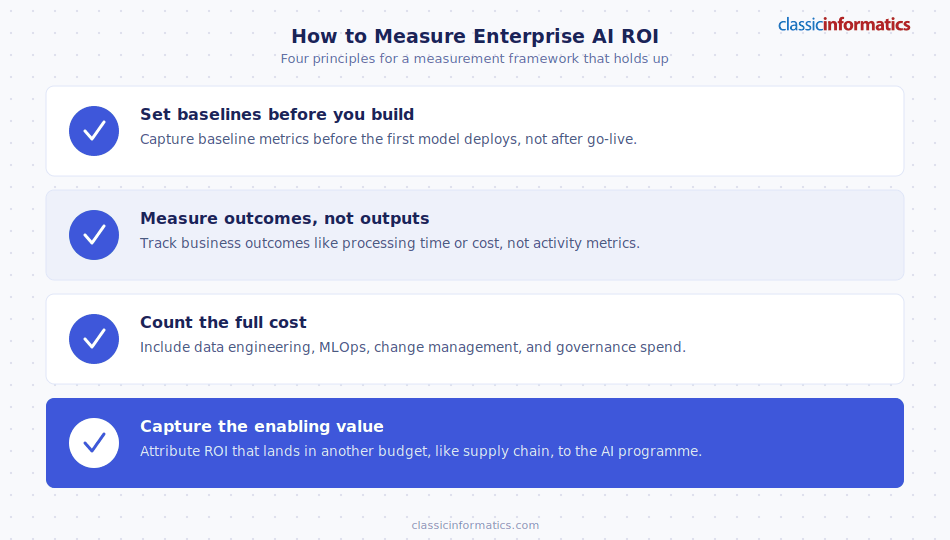
Set baselines before you build, not after go-live. The most common measurement failure is trying to reconstruct what things looked like before the AI was deployed, after it's already running. By that point, processes have changed, the memory of how long things used to take has compressed, and the comparison is contaminated. Baseline metrics need to be captured — and agreed as success criteria — before the first model is deployed.
Measure outcomes, not outputs. "The AI processed 10,000 documents" is an output. "Claims processing time fell by 38%" is an outcome. Build your measurement framework around the business outcomes that motivated the investment, not the AI system's activity metrics.
Account for the costs the business case usually ignores. AI ROI calculations typically include model development, cloud infrastructure, and integration work. They often exclude: the data engineering required to make data accessible; the ongoing MLOps cost of monitoring and retraining; the change management and training investment to get the organisation using the system; and the governance infrastructure that needs to be maintained. Under-counting these costs doesn't make the investment less valuable. It makes the ROI calculation wrong — and that eventually damages trust in the programme.
Capture the enabling value, not just the direct savings. A modernised data infrastructure that enables a demand forecasting model reduces inventory costs. That ROI is attributable to the AI programme but shows up in the supply chain budget, not the IT budget. The measurement framework is what makes the case for continued investment through the long middle of a multi-year programme. It matters almost as much as the ROI itself.
Enterprise AI Use Cases: Where to Start and What Delivers First
Not every use case is equally ready. The ones that deliver value fastest share a common profile: the data to support them already exists, the process they're improving is well-defined, the failure cost is manageable, and the business owner is genuinely committed to making it work.
Here are the enterprise AI applications that most reliably fit that profile — the full ranked breakdown lives in AI use cases for enterprises, with the regulated-industry specifics covered separately in AI in healthcare and AI in manufacturing.
Document intelligence. Semantic search, contract analysis, policy Q&A, automated invoice verification. These use cases are well-served by enterprise generative AI grounded in your own document corpus. Data is already there. The integration surface is relatively contained. The business value — analyst time saved, processing speed improved, search accuracy dramatically improved over keyword approaches — is measurable.
This is close to what Classic Informatics built for a construction technology client: an AI platform for document intelligence and semantic search across construction and operational documents, with automated invoice verification and enterprise-wide Q&A layered on top of the existing document corpus rather than a separate system to maintain.
Decision signal: If your document corpus is already digitised and searchable by keyword, document intelligence is your fastest path to a production AI system — start here before anything more ambitious.
Predictive maintenance. For manufacturing and industrial operations, failure prediction from sensor and operational data is a well-established use case with significant ROI. The data is already being collected. The outcome is measurable — unplanned downtime reduced, maintenance cost reduced. And the enterprise machine learning approaches here are mature.
Demand forecasting. Supply chain and inventory teams consistently cite improved forecast accuracy as one of the clearest AI ROI opportunities in manufacturing, retail, and distribution. The data exists. The baseline is measurable. And the business impact — reduced inventory carrying cost, improved service levels — has a direct line to the P&L.
Customer service automation. AI-assisted response, intelligent routing, and knowledge base access for contact centre teams. Measurable through handle time, resolution rate, and customer satisfaction scores. Already in production at scale in many industries.
Compliance and risk screening. In financial services and insurance, AI for document review, risk scoring, and regulatory compliance screening is delivering real value in production. The governance requirements are high — but in regulated industries, the governance investment is justified.
Decision signal: If your industry is regulated and your failure cost is high, budget for the governance work up front rather than treating compliance screening as a fast-follow use case — it isn't one.
The enterprise AI use cases that actually deliver ROI are rarely the most technically sophisticated. They're the ones where the data, the process, and the business ownership all align.
What to Look for in an Enterprise AI Partner
With the number of organisations offering AI strategy consulting and enterprise AI delivery, the wrong question to ask is "who can do this?" Everyone says yes — which is exactly why a shortlist of top AI consulting companies is worth building before you ask it.
The right question is: "Who has done this before, at this level of complexity, and what happened when something went wrong?" Because something always goes wrong. The data surfaces as messier than scoped. An integration turns out to be undocumented. A compliance question arrives three weeks before go-live.
What separates strong partners from adequate ones isn't whether these things happen. They happen everywhere. It's what happens next.
A few criteria worth applying:
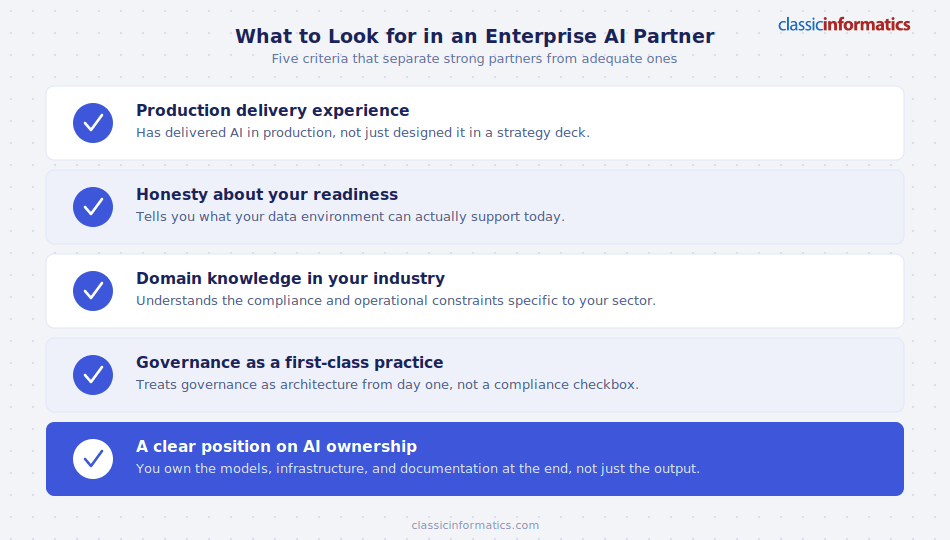
Production delivery experience, not just advisory. Strategy slides and architecture recommendations are easy to produce. What's hard is the build — the data engineering, the integration development, the MLOps infrastructure, the governance implementation. Make sure the partner you're evaluating has delivered AI in production, not just designed it.
Honesty about your readiness. A good partner tells you what your data environment can actually support today. If every partner assessment tells you you're more ready than you feel, that's a signal worth paying attention to.
Domain knowledge in your industry. Healthcare, manufacturing, financial services, and insurance carry specific compliance, integration, and operational constraints that affect AI architecture decisions. Partners who understand those constraints from prior delivery experience avoid mistakes that look obvious in hindsight.
Governance as a first-class practice. Ask specifically how the partner approaches AI governance — not as a compliance checkbox, but as an architectural and operational concern built in from the start.
A clear position on AI ownership. At the end of the engagement, your organisation should own the AI systems: the models, the infrastructure, the documentation, and the operational capability to run them. Not just the output. Ask how knowledge transfer works and what "done" means for the partner, not just for the project.
Decision signal: If a prospective partner can't point to a production AI system they've delivered — not designed, delivered — treat that as disqualifying, regardless of how strong the strategy deck looks.
Classic Informatics has been delivering enterprise technology programmes for over 20 years. In AI development, that means production delivery: data infrastructure that supports real models, integrations built for the systems you actually run, and governance frameworks built for the organisations that have to operate them. If you're evaluating AI development partners or just trying to figure out where a stalled programme is getting stuck, we're happy to compare notes.
Let's Sum Up!
This guide started with a pattern: enterprise AI projects stall not because the model is wrong, but because the infrastructure, governance, and sequencing were never ready for production.
If you've read this far, you probably recognise your organisation somewhere in it. The promising pilot that never scaled. The use case that keeps getting pushed back because the data isn't ready. The governance conversation that hasn't happened yet.
None of that is unusual. And none of it is permanent.
The organisations running production AI at scale today didn't start with better models. They started with better sequencing: data infrastructure assessed honestly, use cases selected for readiness not ambition, governance built in from the start, and measurement frameworks established before the first model went live.
That's the sequence. It's available to any organisation willing to be honest about where it actually is before deciding where it wants to go.
At Classic Informatics, we help mid-to-large enterprises do exactly that work — and then execute on what comes after it. If you're building an enterprise AI business case or trying to get a stalled programme moving, we're happy to compare notes on yours.
Frequently asked questions
What is enterprise AI?
Enterprise AI is the application of machine learning, large language models, or agentic systems inside an organisation's operations at a scale and reliability fit for business-critical use. It isn't a product you buy — it's the combination of data infrastructure, model selection, integration, governance, and change management that makes AI trustworthy enough to run critical operations on, not just a working demo.
Why do most enterprise AI projects fail?
Most fail in the infrastructure layer, not the model layer. Gartner puts the generative AI proof-of-concept abandonment rate at 30%, citing poor data quality and unclear business value. The three recurring causes: data that wasn't actually ready, governance added too late to matter, and pilots optimised for a demo rather than production conditions.
How long does it take to move enterprise AI from pilot to production?
A well-sequenced programme typically runs six to twelve months across four phases: data and infrastructure readiness (2–4 months), use case selection (1–2 months), building for production (3–6 months), and ongoing governance. Skipping the data-readiness phase is the single biggest reason programmes stretch to eighteen months instead.
What's the difference between generative AI and agentic AI in the enterprise?
Generative AI responds to a prompt and produces content — text, code, summaries. Agentic AI perceives its environment, decides what actions to take, and executes multi-step tasks with minimal human input. Agentic systems need permission scoping, audit trails, and fail-safes that generative tools don't require to the same degree, which is why the governance bar for agentic AI is significantly higher.
What does AI governance actually involve?
AI governance is a set of operating decisions, not a compliance document: who owns the data a model is trained on, who's accountable for its decisions, what level of explainability a regulator requires, and where the human-in-the-loop threshold sits. Built in from week one, it's an architecture decision. Bolted on after go-live, it's rework and delay.
How do you measure enterprise AI ROI?
Set baselines before the first model deploys, not after — reconstructing a "before" picture once the AI is running is unreliable. Measure business outcomes (claims processing time, inventory cost) rather than AI activity metrics (documents processed). Count the full cost, including MLOps, change management, and governance, not just model development and infrastructure.
What should you look for in an enterprise AI partner?
Production delivery experience, not just strategy advisory — ask for a system they've actually shipped, not designed. Honesty about your current readiness rather than blanket reassurance. Domain knowledge in your specific regulatory environment. And a clear answer on what "done" means: your organisation should own the models, infrastructure, and documentation at the end, not just the output.