
Key Takeaways
- An MVP is an experiment with a shipping date, not a smaller product. Scope it around one assumption.
- The riskiest assumption decides the feature list. Everything that doesn't test it belongs in version two.
- Cost tracks scope and screen count far more closely than it tracks hourly rates or team location.
- A launch without instrumentation teaches nothing. Decide what you're measuring before the first sprint.
- Most MVPs fail on scope discipline, not engineering. The fix is organisational rather than technical.
- AI shortens the build, not the learning. Faster code makes the wrong-assumption failure cheaper and more frequent.
Twelve weeks and roughly forty thousand dollars into a first build, half the team still can't agree on what the MVP was supposed to prove. The app ships. Sign-ups trickle in at a rate nobody can call good or bad. The build finished. The question didn't.
MVP development exists to prevent exactly that outcome. An MVP is a deliberately scoped first release built to test one assumption with real users, and the scoping is where teams lose it. Every stakeholder adds a feature. The launch date slips twice. What eventually ships is small enough to feel unfinished and expensive enough to hurt, which is the worst combination available.
The cost of getting it wrong is specific. A six-month build that validates nothing burns the runway you needed for the pivot. A three-week build aimed at the wrong audience gives you a very clean answer to a question nobody asked.
This MVP development guide is for the founder about to greenlight a build, the product lead cutting a feature list down to size, and the engineer who just got asked for a timeline before the scope existed.
What is MVP development?
MVP development is the practice of building the smallest working version of a product that can test your riskiest assumption with real users. MVP stands for minimum viable product. The output is software people can actually use, released to a real audience, instrumented so you learn something specific from how they behave.
The word doing the most work is "viable." Minimum is easy to over-read. Teams hear it and ship something broken, then conclude the market didn't want it when what users actually rejected was a product that didn't work. Viable means it solves the core problem end to end for the person you built it for. Everything around that core is negotiable.
The term was coined by Frank Robinson in 2001 and later popularised by Steve Blank and Eric Ries as part of the lean startup movement, which is where most of the vocabulary around build, measure, and learn comes from.
What is MVP in software development?
In a software context, an MVP is one deployed application, one core workflow, one audience, and one question. A ride-hailing MVP books a ride and takes payment. It doesn't split fares, schedule in advance, or rate drivers. A marketplace MVP lets a buyer find a seller and transact. It doesn't do disputes, tiered pricing, or seller analytics.
The distinction that matters for minimum viable product development specifically is that you're shipping production code to real users, not a demo. It runs on real infrastructure, holds real data, and needs to be reliable enough that a failure doesn't invalidate your test.
That reliability floor is the part teams underestimate. If your MVP goes down twice in the first week, you haven't learned that users don't want the product. You've learned they won't tolerate an outage, which you already knew.
Spotify's early build is a useful correction here, because it's usually cited for the wrong reason. Daniel Ek's team spent enormous effort on playback latency in the first version, when most observers assumed a minimal streaming product didn't need to feel instant. Ek later called that obsession the part people misunderstand about MVPs: "that is the V in the MVP." Viable isn't the same as bare. It means the core experience has to actually work.
An MVP is also not a phase you pass through once. Established companies run the same play when they enter a new segment or test a new pricing model. The mechanics don't change with company size.
Why build an MVP before the full product
You build an MVP because the alternative is spending your entire budget on an untested guess. Launching a new venture has always been unforgiving. As Steve Blank wrote in Harvard Business Review, research from Harvard Business School's Shikhar Ghosh found that 75% of all start-ups fail, and the lean approach exists specifically to make the failure cheaper and earlier.
The economics are straightforward. A full build commits your capital before you have evidence. An MVP commits a fraction of it and returns information you can act on. If the information is bad news, you still have the money to do something about it.
There's a second argument that gets less airtime. An MVP forces a decision you'd otherwise defer, which is what your product is actually for. Teams can hold three competing visions of a product indefinitely while writing a spec. They cannot hold three visions while cutting the feature list to twelve items.
The benefits of MVP development compound past validation too. You get a real user base to talk to, a codebase that reflects what people use rather than what you imagined, and something concrete to show investors that isn't a deck.
Where this argument doesn't hold. Not every product should start with an MVP. If you're building against a fixed regulatory specification, the minimum viable version is the compliant version, and there's nothing to cut. If you're entering a mature category where users have a decade of expectations, a stripped-down release reads as a broken competitor rather than an early product. And if the technical risk is higher than the market risk, a proof of concept answers your question faster and cheaper than a public launch does.
For most early-stage teams, though, market risk dominates. MVP development for startups is worth the discipline precisely because the thing most likely to kill the company is building something nobody wants.
MVP vs prototype vs proof of concept vs MMP
These four get used interchangeably and they answer completely different questions. Picking the wrong one costs you weeks.
| Artefact | Question it answers | Who sees it | Typical build time | Is it production code? |
|---|---|---|---|---|
| Proof of concept | Can this be built at all? | Internal team only | 1–3 weeks | No, throwaway |
| Prototype | Does this flow make sense to a user? | Small test group | 1–4 weeks | No, clickable mockup |
| MVP | Does anyone want this enough to use it? | Real users, real market | 6–16 weeks | Yes |
| Minimum marketable product | Will people pay for this repeatedly? | Full target segment | 3–9 months after MVP | Yes |
Note: definitions of these terms vary between teams and vendors, and some product organisations collapse prototype and PoC into a single stage. The framing above is the practical one Classic Informatics uses to keep scoping conversations consistent, not a universal standard.
The prototype vs MVP confusion is the most expensive of the four. A prototype is a design artefact. It tests comprehension: can someone look at this screen and know what to do. An MVP tests demand: will someone come back on Tuesday without being asked. A beautiful prototype that everyone loves in a usability session tells you nothing about whether they'd use it.
A proof of concept sits earlier and points inward. You build one when the open question is technical. Can we get this model accurate enough, can we integrate with that legacy system, can this run inside the latency budget. Nobody outside the team needs to see it.
The minimum marketable product comes after validation, and it's where most of the real product work happens. That transition deserves its own planning cycle rather than being treated as "adding features."
The six types of MVP
Most guides describe one MVP and imply it's the only shape available. In practice there are six worth knowing, and the cheapest one that answers your question is the right one. Each gets the same four labels below.
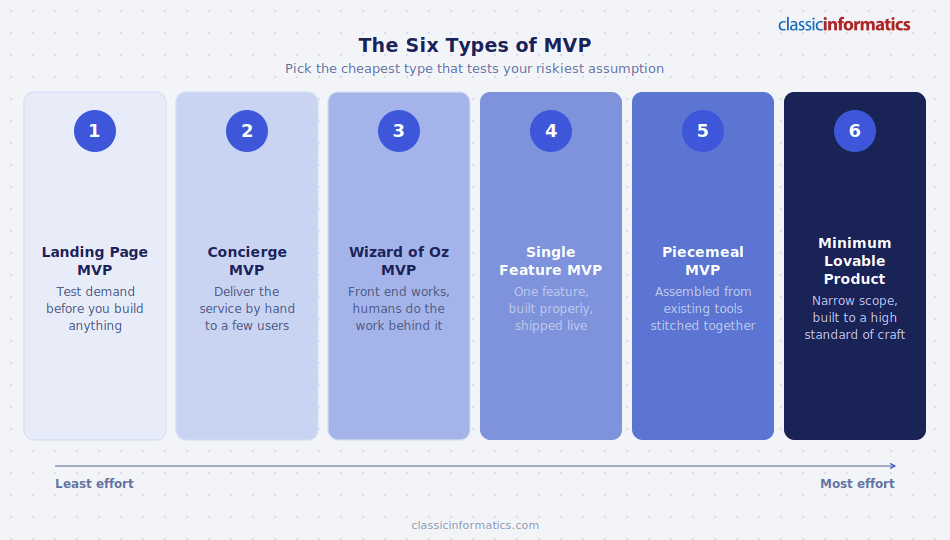
Landing page MVP
What it is: A single page describing the product as though it exists, with a sign-up or pre-order action. No product behind it yet.
When it makes sense: When your riskiest assumption is demand rather than feasibility. You want to know whether anyone will give you an email address or a card number for this promise.
What to watch for: Sign-ups measure interest in your copy, not your product. A page that converts well can still front a product nobody keeps using.
Decision signal: If you can describe the value in one sentence and you have no idea whether anyone wants it, build the landing page first. If you already have waitlist demand, skip it and build something functional.
Concierge MVP
What it is: You deliver the service manually to a small number of users while presenting it as a product. The users know it's early. They don't see the manual work.
When it makes sense: When the workflow is complex and you don't yet know which parts need automating. Doing it by hand teaches you the real process.
What to watch for: It doesn't scale, and it flatters your unit economics. What feels effortless for five users breaks completely at fifty.
Decision signal: If you're guessing at the workflow rather than the demand, run it manually for a month first. If the workflow is already well understood, automate and skip this.
Wizard of Oz MVP
What it is: A working front end backed by humans doing the work invisibly. Users believe the system is automated.
When it makes sense: When the interface is the risky part and the backend is expensive to build. You test the experience before committing to the engineering.
What to watch for: There's an honesty line here worth naming. Users shouldn't be misled about who or what is handling sensitive data, and in regulated categories this approach can create real compliance exposure.
Decision signal: If building the automation costs more than three months and you're unsure users want the output, fake the backend first. If the automation is the product's actual differentiator, build it.
Single-feature MVP
What it is: One feature, built properly, shipped to production. Everything else is deferred.
When it makes sense: When you're confident about the problem and uncertain about the solution. It's the default shape for most software MVPs.
What to watch for: Deciding which single feature counts as "the one" is harder than it sounds, and teams routinely pick the feature they're most excited to build rather than the one that carries the risk.
Decision signal: If you can name the one action a user must complete for the product to have delivered value, build only that. If you can't name it, you're not ready to scope.
Piecemeal MVP
What it is: The product assembled from existing tools stitched together. A form builder, a payments link, a spreadsheet, an automation layer.
When it makes sense: When speed matters more than ownership and the workflow can be approximated with what already exists.
What to watch for: Migration cost. Everything you build in someone else's tool gets rebuilt later, and the data rarely comes across cleanly.
Decision signal: If you need an answer inside four weeks and the workflow is standard, assemble it from tools. If the product's value depends on something no existing tool does, build it.
Minimum lovable product
What it is: A narrow product built to a genuinely high standard of craft, aimed at a small audience who will care about the polish.
When it makes sense: In crowded consumer categories where a functional-but-plain release gets ignored, and in premium segments where quality is the positioning.
What to watch for: It costs meaningfully more and takes longer, which partly defeats the point. The polish has to be load-bearing for the segment, not decorative.
Decision signal: If your users have five adequate alternatives and switch on experience, invest in craft. If they have no adequate alternative, ship function and iterate.
The MVP development process, stage by stage
The MVP development process runs through six stages. The first two decide the outcome and get the least time, which is the pattern behind most disappointing launches.
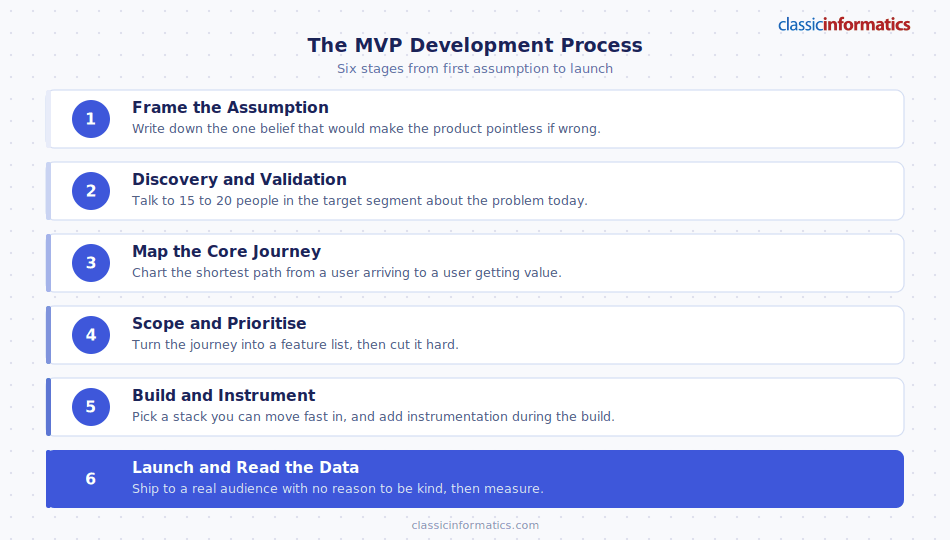
Stage 1: Frame the assumption. Before scoping anything, write down the single belief that, if wrong, makes the product pointless. Not five beliefs. One. Everything downstream is an argument about how to test it cheaply.
Stage 2: Discovery and validation. Talk to fifteen to twenty people in the target segment. Ask what they do today about this problem and what it costs them. Product validation at this stage is qualitative and cheap, and it routinely reshapes the assumption you wrote in stage one.
Stage 3: Map the core journey. Chart the shortest path from a user arriving to a user getting value. Every screen on that path is in scope. Every screen off it is not. A structured design thinking process helps here, particularly when the team disagrees about where value actually lands.
Stage 4: Scope and prioritise. Turn the journey into a feature list, then cut it. The detail on how to run this cut is in the next section, because it's where most MVPs go wrong.
Stage 5: Build and instrument. Pick a stack you can move fast in and change later. Choosing a tech stack for a startup matters less than teams think for an MVP and more than they think for what comes after. AWS's guidance to consider evolutionary architectures applies directly: architectural decisions made once and treated as permanent become the constraint that stops the product adapting later. Instrumentation goes in during this stage, not after launch.
Stage 6: Launch to a real audience and read the data. Ship to people who have no reason to be kind to you. Then measure, which is section eight.
The stage that gets compressed under deadline pressure is always stage two, and it's the one that determines whether the other five were worth doing. Full detail on execution sits in the deep-dive on how to build an MVP.
Worth seeing this run in a real engagement. When Classic Informatics built RoamingDuck, a travel planning MVP connecting travellers with experts and friends, the scope held to three things: itinerary building, budgeting, and document management. Social features, reviews, and booking integrations all sat outside version one, because none of them tested whether travellers wanted expert input on a trip plan. That's the cut working as designed.
How to decide what goes in the first release
Feature prioritisation frameworks are abundant and mostly unhelpful, because they rank features against each other when the real question is whether a feature tests your assumption at all.
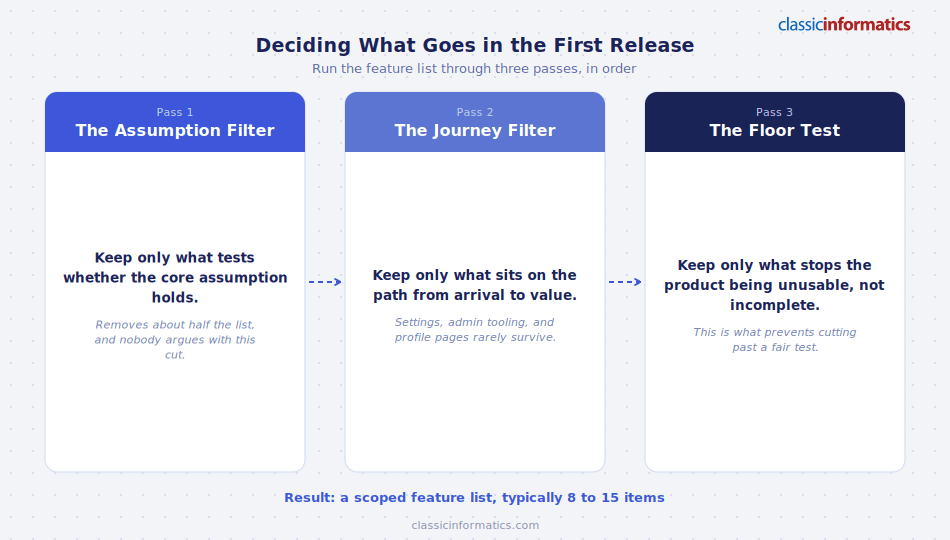
Run the cut in three passes.
Pass one: the assumption filter. Take your feature list and mark each item against the assumption from stage one, keeping only the ones whose absence would leave you unable to tell whether the assumption holds. Most items won't clear that. Cut them. This pass typically removes half the list and it removes the half nobody argues about, which is why it goes first.
Pass two: the journey filter. From what survives, keep only what sits on the core path from arrival to value. Settings pages, profile editing, notification preferences, and admin tooling almost never sit on that path. They feel mandatory because finished products have them. Your MVP is not a finished product.
Pass three: the floor test. Look at what's left and ask what would make the product unusable rather than incomplete. Authentication usually survives this. Password reset usually doesn't, because you can handle five resets manually. Payment survives if you're testing willingness to pay and doesn't if you're testing usage.
What comes out of three passes is your MVP features list, and it's normally between eight and fifteen items for a first release.
Two rules make the cut hold under pressure.
The first is that every deferred feature goes on a written list with a name attached. Features don't get cut, they get scheduled. A stakeholder who sees their request logged for version two argues far less than one who sees it deleted.
The second is that screen count is the number to watch, not feature count. Features are easy to underestimate and screens are not. A first release with more than twelve to fifteen screens has usually stopped being an MVP regardless of what the feature list says.
There's a version of this cut that goes too far, and it's worth naming. Stripping a product until it's genuinely unpleasant to use doesn't produce a clean test. It produces a test of user patience. The floor test exists to stop that.
What MVP development costs
MVP development cost lands somewhere between $20,000 and $150,000 for most software products, and the spread inside that range is driven by scope far more than by anything else.
Here's what actually moves the number.
| Cost driver | Effect on budget | What to do about it |
|---|---|---|
| Screen count | Largest single driver. Each screen carries design, build, and test cost | Cut screens before cutting anything else |
| Platform coverage | Web plus iOS plus Android roughly doubles a single-platform build | Pick one platform for version one |
| Third-party integrations | Payments, mapping, messaging, and identity each add build and testing time | Defer every integration not on the core journey |
| Design fidelity | A functional interface versus a crafted one is a meaningful multiplier | Match fidelity to the segment, not to preference |
| Compliance requirements | Regulated categories add architecture, audit, and documentation work | Scope compliance in from day one, never retrofit |
| Data complexity | Real-time, multi-tenant, or AI-driven features raise build and infrastructure cost | Question whether the MVP needs them at all |
On timeline, a well-scoped MVP takes six to sixteen weeks. Under six weeks usually means you assembled it from existing tools, which is a legitimate choice. Past sixteen weeks, the scope has almost certainly drifted past what an MVP should be, and that's worth treating as a signal rather than a schedule problem.
Two cost mistakes recur often enough to name.
The first is spending the entire budget on the build and leaving nothing for the learning. If the MVP ships and there's no money to run the test, iterate on the findings, and talk to users, the build was pointless. Reserve a meaningful share of the budget for what happens after launch.
The second is optimising the hourly rate rather than the scope. A cheaper team building fifteen unnecessary screens costs more than an expensive team building eight necessary ones, and it takes longer. The full breakdown, including regional and team-structure variables, sits in the deep-dive on MVP development cost.
Maintenance is the line most first budgets omit entirely. Expect ongoing infrastructure, monitoring, and fixes to run at a meaningful fraction of the original build cost annually, starting the week you launch.
How to measure whether the MVP worked
Decide what you're measuring before the first sprint. No other decision in the process moves the outcome as much, and it's routinely made after launch, when it's too late to instrument properly.
Start with the one metric that maps to your assumption. If the assumption is that busy operations managers will log a shift handover on their phone, the metric is handovers logged per manager per week. Not sign-ups, not sessions, not time on page. The specific behaviour that only happens if the assumption is true.
Then add three supporting signals.
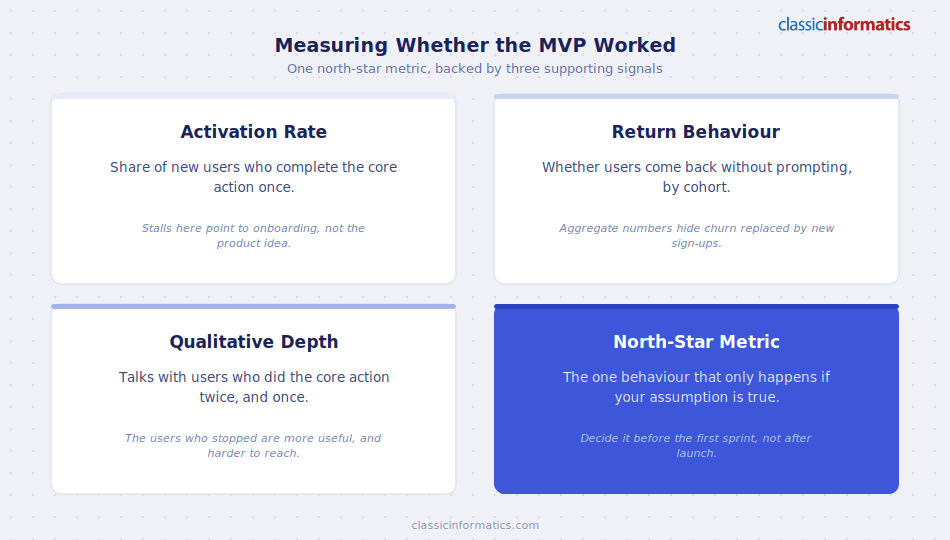
Activation rate. The share of new users who complete the core action at least once. If people sign up and never reach the value, the problem is onboarding or positioning, not the product idea.
Return behaviour. Whether users come back without prompting, measured by cohort rather than in aggregate. Aggregate active-user numbers hide the fact that you're replacing churned users with new ones.
Qualitative depth. Ten conversations with users who did the core action twice, and five with users who did it once and stopped. The second group is more useful and harder to reach.
For product market fit specifically, the most durable instrument is the question Sean Ellis popularised: how would you feel if you could no longer use this product. The threshold that emerged from benchmarking roughly a hundred startups is 40% answering "very disappointed." Superhuman's team documented using exactly this method to move their own score from 22% to 58%, by segmenting who said what and rebuilding around the disappointed group.
Worth being calibrated about that number. Forty percent is a directional benchmark from a specific sample, not a physical constant, and it behaves differently in consumer categories with broad audiences than in narrow enterprise ones. Treat it as a signal to keep iterating or start scaling, not as a pass mark.
AI has made the qualitative half of this faster and cheaper than it used to be, and there's a growing practice around validating product-market fit with AI that's worth understanding before you run your first round of interviews.
The failure to avoid is measuring what's easy. Sign-ups are easy. Page views are easy. Neither tells you whether the thing works.
Three ways MVP development goes wrong
Most MVPs don't fail on engineering. They fail on decisions made before anyone wrote code, and the same three patterns recur across engagements.
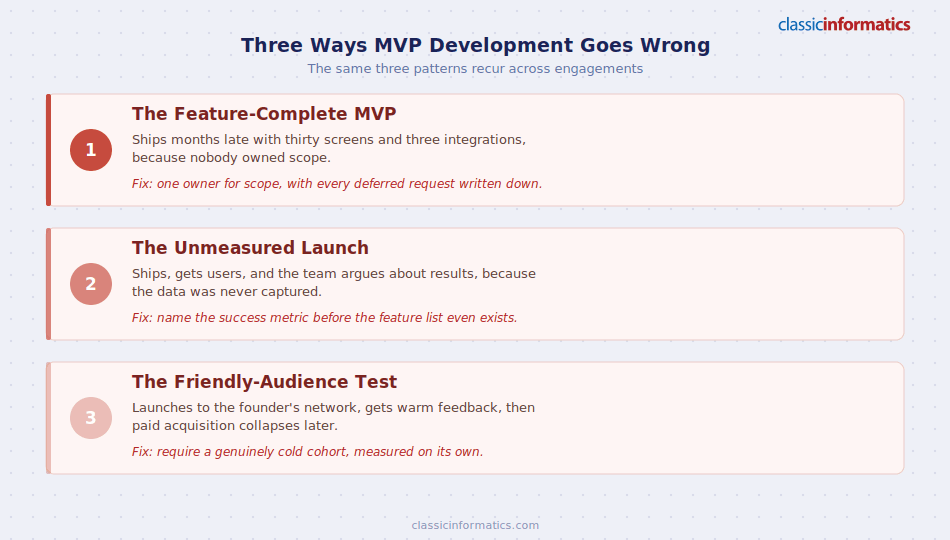
The feature-complete MVP
What it looks like: The release ships four months late with thirty screens, a settings module, an admin panel, and three integrations. Everyone involved describes it as an MVP. It isn't one.
Why it happens: Almost always organisational. There's no single owner of scope, so every stakeholder's request gets absorbed rather than adjudicated. Each individual addition sounds reasonable, which is exactly why the pattern survives review after review.
How to fix it: Give one person the authority to say no, and give them a written scope with a change process. Log every deferred request with the requester's name attached. The written list is what makes the refusal survivable politically.
The unmeasured launch
What it looks like: The MVP ships, gets some users, and the team argues about whether it worked. Nobody can settle the argument because the data to settle it was never captured.
Why it happens: Instrumentation gets scoped as a nice-to-have and dropped in the final sprint when the deadline tightens. It's the easiest thing to cut because nothing visibly breaks when it's gone.
How to fix it: Treat the measurement plan as a stage-one deliverable, alongside the assumption. Write down the metric before the feature list exists. In our experience, teams that name their success metric in the first week end up with a materially different feature list from teams that name it in the last week, and the difference usually favours the first group.
The friendly-audience test
What it looks like: The MVP launches to the founder's network, gets enthusiastic feedback, and the team scales up. Six months later the paid acquisition numbers are catastrophic and nobody can work out why.
Why it happens: Reaching a genuinely neutral audience is harder and slower than reaching a warm one, and under time pressure teams take the audience they can get. The feedback is real, it's just not representative.
How to fix it: Require a proportion of test users to have no relationship with anyone on the team. Run the numbers on that group separately. If the warm cohort activates at 60% and the cold cohort at 8%, you've learned something important that the blended number would have hidden.
There's a fourth pattern that's less a failure than a misjudgement: building an MVP when the real risk was technical. If your open question is whether the model is accurate enough or whether the integration is possible, a proof of concept answers it in three weeks for a fraction of the cost. Writing in Harvard Business Review, Tom Eisenmann and others have pointed at this category of well-executed MVP aimed at the wrong question.
What to build after the MVP
Validation is not a finish line. It's the point at which the questions change from "does anyone want this" to "can we serve them repeatably and profitably."
Three things typically need attention at once, and the order depends on what your MVP data showed.
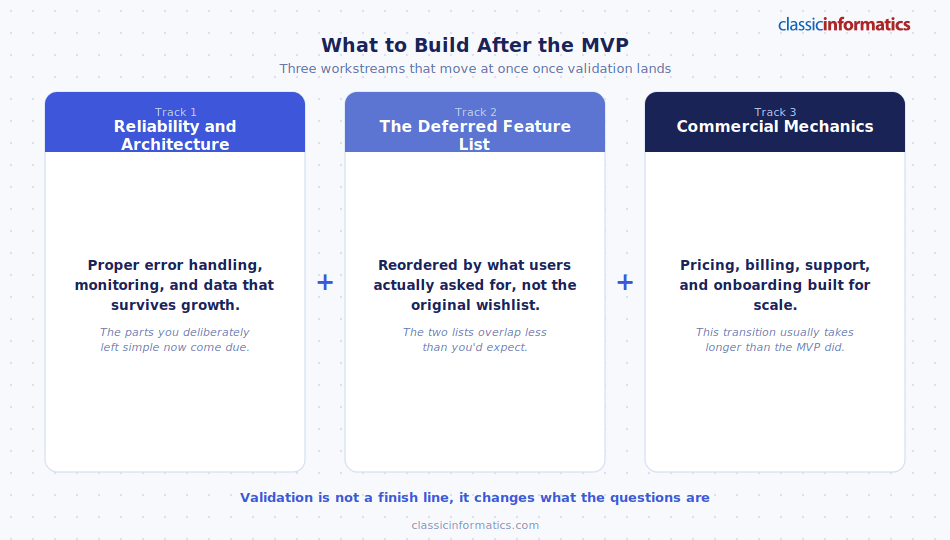
Reliability and architecture. MVP code is scoped for speed, which is correct. Once real usage arrives, the decisions you deferred come due: proper error handling, monitoring, data modelling that survives growth, and the parts of the architecture you deliberately left simple.
The deferred feature list. The list you kept during scoping now becomes the roadmap input, reordered by what users actually asked for rather than what stakeholders originally wanted. Those two lists overlap less than you'd expect.
Commercial mechanics. Pricing, billing, support, and onboarding at scale. This is the transition from MVP to minimum marketable product, and it usually takes longer than the MVP did.
The trap here is treating the MVP codebase as either sacred or disposable. Neither is right. Some of it is a solid foundation and some of it was scaffolding, and the engineering judgement is knowing which is which before you scale on top of it.
How AI changed MVP development
AI has genuinely compressed the build. Code generation, scaffolded infrastructure, and AI-assisted design mean a functional first release now takes weeks where it took months. That's real and it changes the economics.
What it hasn't compressed is the learning. Users still take weeks to form a habit. Cohort retention still needs cohorts. Fifteen customer conversations still take fifteen calendar slots. The bottleneck has moved from engineering to evidence, and most teams haven't adjusted their timelines to reflect that.
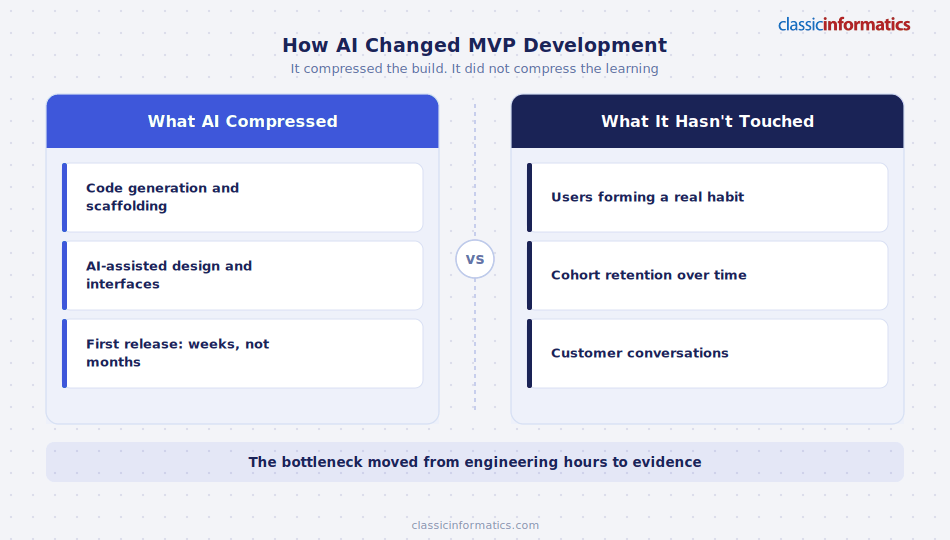
There's a second-order effect worth naming. When building is cheap, the cost of building the wrong thing drops too, which sounds good and mostly isn't. Cheap builds encourage teams to skip the assumption work entirely and just ship something, then ship something else. That's not iteration. That's guessing faster.
The teams doing this well have gone the other way. They spend more time on discovery precisely because the build is cheap, since discovery is now the expensive input rather than engineering hours.
Structurally, this connects to a broader shift. McKinsey's Global Tech Agenda 2026 found that top-performing companies are moving to product and platform operating models that tie delivery directly to strategy, with business and technology teams cocreating plans continuously rather than annually. MVP thinking is that model at its smallest scale.
Then there's the category of product where AI is the thing being validated. Building an AI product raises questions a conventional MVP doesn't: whether the model is accurate enough for the use case, whether users trust the output, and whether inference costs work at volume. The approach differs enough to be worth treating separately, which is covered in the guide to AI MVP development.
One limit worth stating plainly. Everything above holds for software products with a clear digital workflow. Hardware-dependent products, deeply regulated categories, and products whose value depends on network density all behave differently, and the compressed-build advantage matters much less in those.
Who should build your MVP
Three options, and the right one depends on what you already have rather than what you can afford.
In-house works when you have senior engineering leadership already and the MVP is core to a product you'll own long term. It's slowest to start and best for continuity.
Freelancers work for narrow, well-specified builds where you can supply the product direction yourself. It breaks down when the product needs design, engineering, and product thinking to coordinate, because coordinating them becomes your job.
A product partner works when you need the whole function at once and you need to start next month rather than next quarter. It costs more per hour than freelancers and less in total than building a team for a project of unknown duration.
Whichever route you take, the evaluation criteria are the same: has this team shipped a product in a comparable domain, can they show you the scope decisions they made and why, and will they push back when you ask for something that doesn't belong in version one. That last one matters most and gets asked least. The full evaluation framework sits in the deep-dive on choosing an MVP development partner, and if you want to see who's active in the space, the comparison of MVP development companies covers the current field.
MVP development services vary enormously in what's actually included. Some quote build hours only, leaving discovery, design, and post-launch iteration outside the number. Ask what the quote covers before comparing two of them.
Two more things worth checking before you sign anything. An MVP development agency structured around long retainers has a quiet incentive to keep scope growing, so ask how the engagement ends as well as how it starts. And if you're shipping to phones, confirm the team has done MVP app development before rather than adapting a web practice to mobile, because the release cycle and testing overhead differ enough to hurt a tight timeline.
MVP development services for startups also tend to bundle things a funded product team already has in-house, like product direction or brand work. Strip those out of the comparison so you're pricing the same thing twice over. Picking an MVP development company is mostly about matching what they include to what you're actually missing.
Classic Informatics has built first versions across travel, insurance, retail, fintech, and logistics. Addressya is a useful example of the range: a digital addressing platform that reached over 100,000 contacts across Uganda and Rwanda, built for markets where the conventional assumptions about addressing simply don't apply. Not every MVP is a SaaS dashboard, and the scoping logic has to flex accordingly. Our MVP development practice exists for exactly this stage.
MVP development rules of thumb
- Frame one assumption before scoping anything.
- Build the cheapest MVP type that tests that assumption.
- Cut by screen count, not feature count.
- Ship to an audience with no reason to be kind.
- Name the success metric before the first sprint.
- Reserve budget for the learning as well as the build.
- Log every deferred feature with a name attached.
- Treat sixteen weeks as a scope warning, not a schedule.
- Measure return behaviour by cohort, never in aggregate.
- Rebuild the scaffolding before you scale on it.
Let's Sum Up!
An MVP isn't a smaller product. It's an experiment that happens to ship, and the discipline is in deciding what question it answers before anyone opens an editor.
Get the assumption right and the feature list writes itself. Get it wrong and no amount of engineering quality saves the release, because you'll have built something excellent that teaches you nothing.
The teams that do this well aren't the ones with the best developers. They're the ones willing to defend a small scope through four rounds of stakeholder pressure, and willing to instrument the thing properly before launch rather than arguing about results afterwards.
Building a first version is hard, and most of the difficulty is decisions rather than code. Classic Informatics has spent 23+ years helping founders and product teams scope, build, and validate first releases across 30+ countries. If you're working out what belongs in version one, we're happy to talk it through.
Frequently asked questions
What is MVP development?
MVP development is the practice of building the smallest working version of a product that can test your riskiest assumption with real users. MVP stands for minimum viable product. The output is production software released to a real audience and instrumented so you learn something specific from how people behave. The emphasis sits on viable: it has to solve the core problem end to end, not partially.
What does MVP stand for in software development?
MVP stands for minimum viable product. In a software context it means one deployed application, one core workflow, one audience, and one question you're trying to answer. It's live production code rather than a demo, running on real infrastructure with real data. The term was coined by Frank Robinson in 2001 and popularised by Steve Blank and Eric Ries through the lean startup movement.
How long does MVP development take?
A well-scoped MVP typically takes six to sixteen weeks. Anything under six weeks usually means the product was assembled from existing tools rather than custom-built, which is a legitimate choice for standard workflows. Past sixteen weeks, the scope has almost certainly drifted beyond what an MVP should be. Treat that as a signal to re-examine the feature list rather than as a scheduling problem to solve with more developers.
What is the difference between an MVP and a prototype?
A prototype is a design artefact that tests comprehension: can someone look at this screen and understand what to do. An MVP is production software that tests demand: will someone return on Tuesday without being prompted. Prototypes go to a small test group and get thrown away. MVPs go to real users in a real market and become the foundation of the product. A prototype everyone loves in a usability session says nothing about demand.
How much does MVP development cost?
Most software MVPs land between $20,000 and $150,000. Scope drives the spread far more than hourly rates do. Screen count is the single largest cost driver, followed by platform coverage, third-party integrations, design fidelity, and compliance requirements. A cheaper team building fifteen unnecessary screens costs more overall than an expensive team building eight necessary ones. Budget separately for post-launch iteration, which first budgets routinely omit.
Do you still need an MVP if AI can build a full product quickly?
Yes, because AI compresses the build but not the learning. Users still take weeks to form habits, cohort retention still needs cohorts, and customer conversations still take calendar time. When building gets cheap, the risk shifts: teams skip the assumption work and ship repeatedly without learning anything. The teams handling this well spend more time on discovery, since evidence has replaced engineering hours as the expensive input.
What team do you need to build an MVP?
A minimum viable team is usually four to six people: one product owner who can decide scope, one designer who thinks in flows rather than screens, two or three engineers covering front and back end, and someone owning quality. What matters more than headcount is seniority. You need people experienced enough to make good cuts without being told, because scope discipline is what decides the outcome.
What comes after the MVP?
Three things need attention once validation lands: reliability and architecture work that was deliberately deferred, the logged feature list reordered by what users actually asked for, and commercial mechanics like pricing, billing, and support at scale. That transition is the move from MVP to minimum marketable product, and it usually takes longer than the MVP itself did. Judge which MVP code is foundation and which was scaffolding before scaling on it.