
Key Takeaways
- The cost of not modernising is almost always larger than the cost of doing it. Most of it is invisible.
- Not every system needs the same treatment. The 6 Rs match the right approach to each application in your portfolio.
- Modernisation programmes fail on execution, not technology. Scope underestimation, business disengagement, and big-bang thinking are the top killers.
- Your industry changes the playbook. Healthcare has HIPAA and EHR constraints. Manufacturing has OT/IT convergence. Generic frameworks need adapting.
- AI readiness is now the primary driver. Cloud migration used to be the destination. In 2026, it's just the prerequisite.
Every enterprise technology leader knows modernization matters. Most already have a list of systems that need attention.
It's common for a platform team to be spending more sprint time keeping old systems running than building anything new — and for that split to have been true for years without anyone putting a number on it.
This guide is written for the people who own that decision: CIOs, VPs of engineering, and the technology leaders building the business case for a multi-year modernization investment.
What's harder to answer, and more important, is what it's actually costing you to keep putting it off.
What is the Meaning of Application Modernization?
The term application modernization is used to mean almost anything. Cloud migration. Full rebuild. A new UI on an old system.
Application modernization is the process of updating existing software to make it more efficient, more maintainable, and capable of supporting what the business needs today and in the near future. It could mean breaking a monolithic platform into smaller, independently deployable services. It could mean migrating a legacy codebase to cloud infrastructure. It could mean replacing an ageing custom system with something purpose-built.
In enterprise contexts, it's most often called legacy application modernization or legacy system modernization, because the applications being updated were typically built years or decades ago and are no longer fit for what's being asked of them.
Understanding what is application modernization in practice means accepting this complexity from the start. You're not starting from scratch. You're working with what's already there: the data, the integrations, the users who depend on the system, and years of business logic embedded in code that's often only partially understood.
That's what makes it harder than greenfield development, and what shapes every decision you'll make.
Application Modernization vs. Digital Transformation
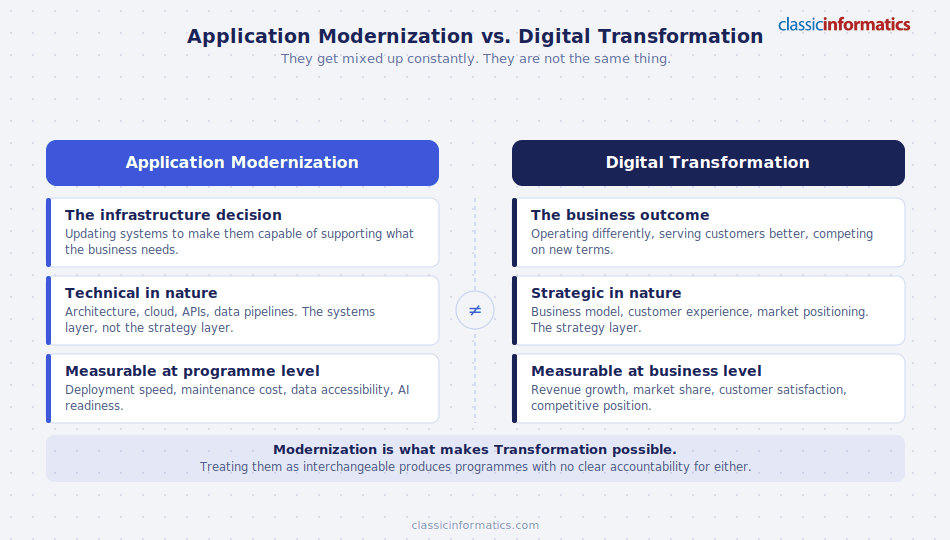
These two terms are used interchangeably a lot of times. But they're not the same thing.
Digital transformation is the business outcome: operating differently, serving customers better, competing on new terms. Application modernization is often what makes transformation possible. It's the infrastructure decision, not the business outcome itself. Treating them as interchangeable produces programmes with vague success criteria and no clear accountability for either goal.
Modernization vs. Maintenance
Patching a vulnerability, upgrading a dependency, adding a feature. That keeps things running. It doesn't change the underlying architecture, reduce long-term cost, or extend the strategic lifespan of the system.
Maintenance is operating what you have. Modernization is deciding whether what you have is still the right thing to operate.
Why Full Rebuilds Usually Backfire
When a system feels broken, the instinct is to scrap it and start over. That instinct is usually wrong.
A full rewrite carries the highest execution risk of any modernization option. You lose accumulated business logic embedded in the existing codebase, some documented, most not. You take a business-critical system offline during a transition that almost always takes longer than planned. And you go live with a system nobody has battle-tested yet.
The better question isn't "should we rebuild?" It's: for each system in your portfolio, what's the right level of change, given what it does for the business and what it costs to leave it alone?
The Real Cost of Doing Nothing
Nobody files a report on what a legacy system quietly costs. It doesn't appear as a line item. But it happened, and it cost something real.
That's what legacy systems actually cost. Not just the maintenance budget, though that's real and growing. It's the initiatives you didn't pursue, the features that took a quarter instead of a sprint, the AI projects that stalled because your data was locked inside something nobody fully understood anymore.
The global application modernization services market is expected to grow from $19.9 billion in 2024 to $39.7 billion by 2029. That growth isn't a technology trend. It's businesses finally doing the maths on what staying still is actually costing them.
The question most organisations ask is: "How do we modernize?" That's the right question, eventually. But the one that comes first, the one that makes everything downstream clearer, is this: "What is it costing us to leave things alone?"
This guide has answered the first question. It spends the rest of its length on the second.
What Legacy Systems Are Costing You
Technical debt is the word for it. But the word undersells what's actually happening.
Every year it goes unaddressed, the cost grows: in budget, in engineering speed, and in what your AI roadmap can realistically do. So what does that cost actually look like when you put a number on it?
Ward Cunningham, the software engineer who coined the term, described technical debt as a useful shortcut taken now that has to be repaid later. Like financial debt, it accrues interest. The shortcut that saved three weeks in 2016 might be costing months of engineering time every year now, because everything else in the system has been built around it.
It compounds quietly. Code written under deadline pressure and never refactored. Architectural decisions that made sense at smaller scale but now create bottlenecks. Dependencies on libraries that haven't been maintained in years. Features layered on top of features with no coherent design underneath, producing a codebase that's genuinely risky to touch because nobody's sure what else will break.
Less than 20% of software engineering leaders are effective at managing technical debt, yet 44% identify it as a top challenge, per Gartner. That gap is where a lot of digital initiative budgets quietly disappear.
The Hidden Costs
The direct costs are visible: maintenance contracts, ageing infrastructure, the overhead of keeping old platforms patched and compliant.
The indirect costs are larger and harder to see.
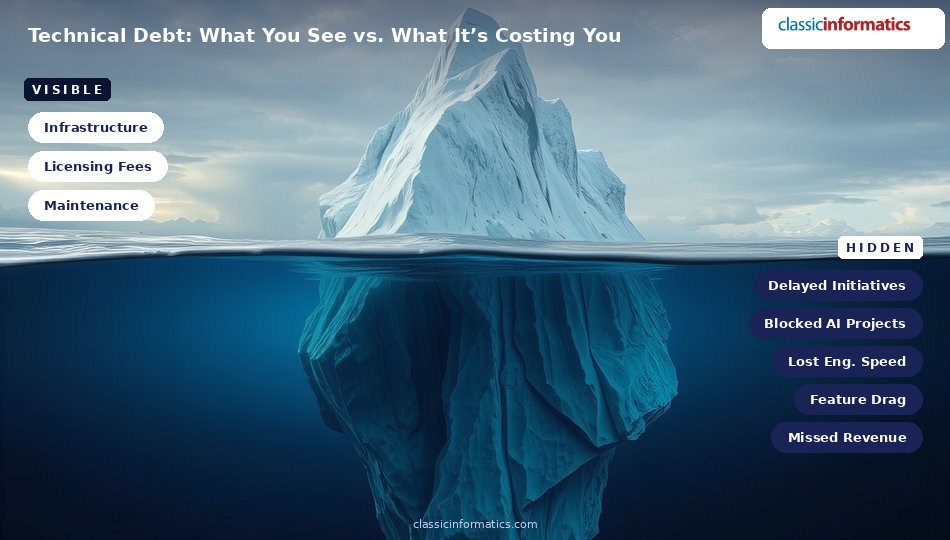
Every initiative that got delayed because IT's estimate came back longer than expected. Every feature that took a quarter when it should have taken a sprint. Every time your product or data teams asked for something that couldn't be surfaced cleanly because the system had no API and no documentation.
These are real costs. They just don't appear as line items.
The hardest to measure is the work that never got proposed. The AI initiative that never made it to a business case because everyone knew the data wasn't accessible. The integration that would've opened a new revenue stream but was scoped out because the existing system couldn't support it. Not a counterfactual. A cost. It just takes discipline to track.
How AI Changed the Equation
For most of the last decade, the cost of legacy debt could be absorbed. It slowed things down, but not badly enough to threaten anything strategic.
AI has changed that. Every significant AI initiative your business wants to run — from demand forecasting to predictive maintenance to automated compliance — depends on clean, accessible, real-time data.
Legacy systems weren't built to provide that. Data is locked in proprietary formats, there are no APIs, and batch exports are the only route out. That's not fast enough for the use cases that matter.
Gartner predicts that at least 30% of generative AI projects will be abandoned after proof of concept, with poor data quality cited as a primary cause. If your AI roadmap is stalling, the model probably isn't the problem. The data architecture is.
Managed Debt vs. Invisible Debt
Not all technical debt is a problem. Taking it on deliberately, shipping faster now with a clear plan to address it later, is a legitimate engineering call. The problem is invisible debt: accumulated without documentation, without awareness, and without any plan to resolve it.
The goal of modernization isn't zero debt. It's getting to a place where debt is visible, understood, and actively managed rather than hidden, compounding, and quietly shaping what your team can build.
The 6 Modernization Strategies (The 6 Rs)
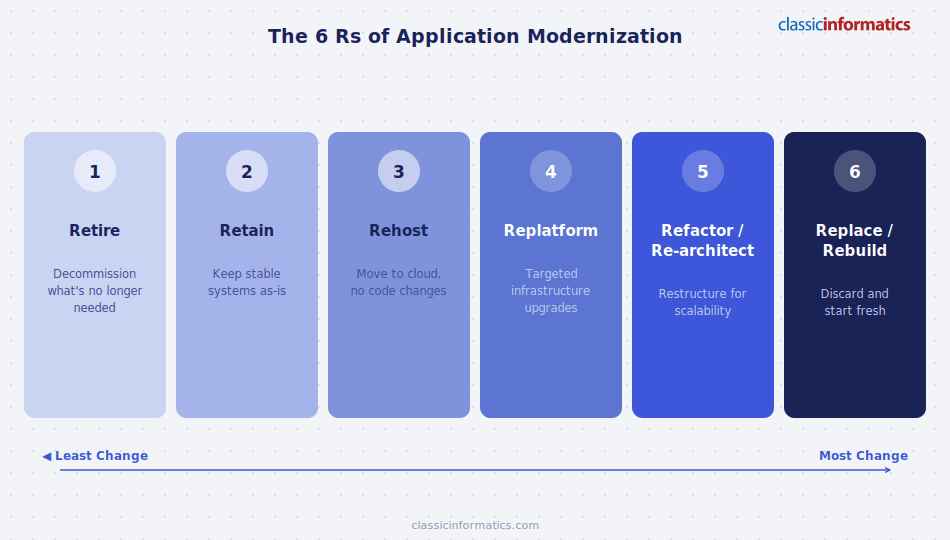
Not every application deserves the same treatment. Some should be retired. Some should be left alone. Some need a complete re-architecture. The discipline is matching the right approach to each system.
The most common mistake in modernization programmes isn't picking the wrong technology. It's picking one approach and applying it to everything.
The application modernization framework that holds up across enterprise portfolios is built around six distinct strategies, widely known as the 6 Rs of application modernization. They cover every decision you'll face across a mixed legacy portfolio.
That match is the entire discipline. Get it wrong and you pay for it twice — once in the wrong effort, once in redoing it.
| Approach | What Changes | Typical Timeline | Relative Cost | Execution Risk | Best When |
|---|---|---|---|---|---|
| Retire | Nothing — the system is switched off | Weeks | Low | Low | Nobody can name a business reason it still runs |
| Retain | Nothing, deliberately | N/A — reviewed on a set date | Low | Low | The system is stable and isn't blocking anything |
| Rehost | Where it runs, not the code | 4–8 weeks per application | Low–Medium | Low | You need cost and hardware risk off the table fast |
| Replatform | Targeted infrastructure upgrades | 2–4 months | Medium | Medium | The design is sound but the infrastructure generates overhead |
| Refactor / Re-architect | The application's internal structure | 6–18 months | High | High | The system is business-critical and under active development |
| Replace / Rebuild | The system itself | 9–24+ months | Highest | Highest | The existing system is beyond cost-effective repair |
Note: Different vendors define the Rs slightly differently. Some split "refactor" and "re-architect," others fold "retain" into "rehost." This guide uses the six-way split Classic Informatics applies across client portfolios, because it maps cleanly to distinct decision points rather than a technical taxonomy.
Retire: Switch It Off
What it is: Removing an application from the portfolio entirely rather than modernizing it.
After a thorough portfolio review, you'll probably find more retirement candidates than you expected. Systems that are redundant, unused, or that users have quietly stopped relying on. Retiring them removes maintenance cost, reduces your security surface, and simplifies everything that remains.
When it makes sense: When a system isn't supporting any active business function and nobody can point to a dependency that breaks if it's switched off.
Decision signal: If nobody can name a business reason the system still runs, retire it. If someone can — and can prove it with usage data — investigate that reason before you touch anything.
Retain: Leave It Alone, Deliberately
What it is: A conscious decision to make no changes, revisited on a set schedule.
Some systems are stable, low-risk, and not blocking anything important. Leaving them alone is a legitimate decision. The word "deliberately" matters. Retain needs to be a conscious call with a review date, not the outcome when nobody's looked at something in three years.
When it makes sense: When the system works, carries acceptable risk, and isn't in the way of anything on the roadmap.
Decision signal: If the system is stable, low-risk, and isn't blocking any initiative on your roadmap, retain it — with a review date on the calendar. If nobody's looked at it in years or it's quietly blocking other work, that's neglect, not a retain decision.
Rehost: Move Without Changing
What it is: Lifting the application to new infrastructure, usually cloud, without changing the application itself — commonly called lift and shift.
Same code, same architecture, same behaviour. What changes is where it runs.
Infrastructure costs come down. Hardware management disappears. You get the system off ageing on-premise kit.
When it makes sense: You need cost and hardware risk off the table fast.
What doesn't change: architectural debt, deployment speed, or any of the capabilities cloud-native infrastructure makes possible. A lift and shift is a fast, low-risk step. It's not a destination.
Decision signal: If your priority is getting off ageing infrastructure fast and cheaply, rehost. If the goal is deployment speed or data accessibility, rehost alone won't get you there.
Replatform: Targeted Improvements
What it is: Specific adjustments that take advantage of modern infrastructure without restructuring the core application.
Migrating to a managed cloud database, containerising for more reliable deployments, switching to a modern message queue. These are replatforming moves.
When it makes sense: It's the pragmatic middle ground. More valuable than a rehost, significantly less complex than a full re-architecture. A lot of your applications probably belong here — their underlying design is sound, but the infrastructure around them is generating unnecessary overhead.
Decision signal: If the application's design is sound but the infrastructure around it is generating overhead, replatform. If the architecture itself is the constraint, replatforming won't touch the real problem.
Refactor and Re-architect: Change What It Can Do
What it is: Restructuring the application's internal design to improve scalability, maintainability, and performance.
In practice, this usually means breaking a monolith into smaller, independently deployable services or restructuring the data layer for real-time access and clean API patterns.
When it makes sense: Use it when the application is business-critical, under active development, and the current structure is genuinely limiting what you can build.
It's the most complex and expensive option. It's also the one that changes what your business can actually do: faster deployments, better resilience, and the data accessibility your AI initiatives need.
Decision signal: If the application is business-critical, under active development, and the current structure is genuinely limiting what you can build, refactor. If it's stable and rarely touched, the cost isn't worth it yet.
Replace or Rebuild: Start Fresh
What it is: Replace swaps a custom-built system for a commercial product that now does the job adequately. Rebuild discards the existing codebase entirely.
Both are justified when the existing system is beyond cost-effective repair. Both carry the highest execution risk of any option. Neither should be the default, and neither should be ruled out without honest analysis.
Decision signal: If the existing system is beyond cost-effective repair and a commercial product or clean rebuild can do the job, replace or rebuild. If repair is still cheaper than replacement, it isn't time yet.
Start with an Honest Assessment
The 6 Rs don't work if you apply them without real data. Their value is in the discipline: assessing each application on its own terms, looking at business value, technical condition, cost to operate, and complexity to change, rather than letting inertia or enthusiasm make the call for you.
How to Build a Modernization Strategy
Most modernization programmes that fail weren't doomed by bad technology. They were doomed by treating a business decision like a technical project. No clear ownership. No baseline metrics. No honest sequencing.
A sound application modernization strategy is designed to survive contact with reality, not the version that looks clean in a slide deck.
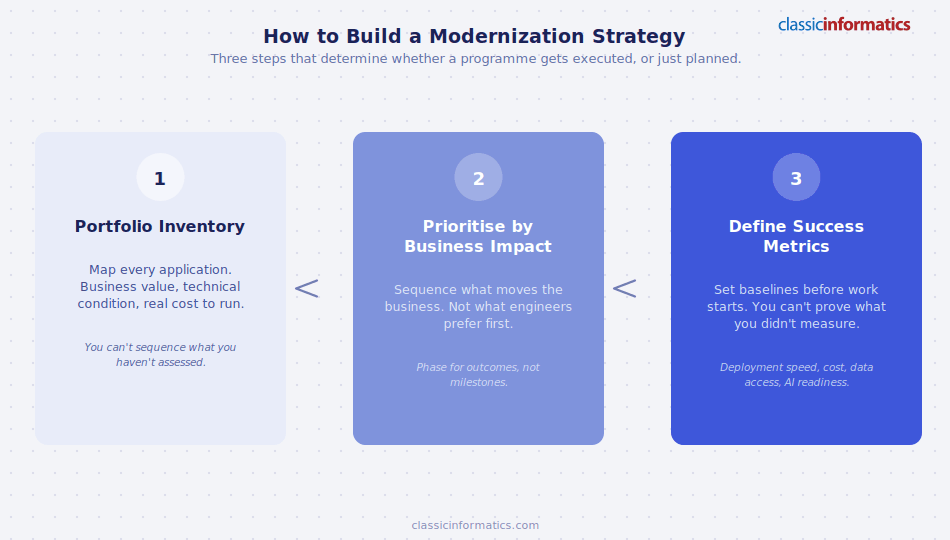
Step 1: Build a Portfolio Inventory
You can't make good decisions without an accurate picture of what you're working with. For most enterprises, that picture doesn't exist. Inventories are outdated, partially documented, or scattered across teams.
A useful inventory captures, for each application:
- What business function it supports and who depends on it
- How critical it is: what happens to operations if it fails?
- Its technical condition: age, stack, documentation quality, known debt
- Which other systems depend on it and how
- Any regulatory or compliance requirements attached to it
- Its real total cost of ownership: infrastructure, licensing, and the engineering time going into keeping it running
That last figure is usually underestimated by a factor of two or more.
Step 2: Prioritise by Business Impact
The systems your engineers most want to re-architect aren't always the ones that deliver the most business value. Keep the business outcome as the primary filter.
Prioritise based on three factors:
- Strategic importance: which systems directly support revenue or near-term business goals?
- Pain intensity: which systems are generating the most friction or blocking other work?
- Modernization complexity: lower-complexity efforts that still deliver real value build momentum before the harder work begins.
Don't try to modernize everything at once. That's how programmes create disruption without delivering value.
Step 3: Define What Success Looks Like
This is the step most programmes skip. It's also the one that most directly determines whether leadership keeps funding the work past the first year.
Set baselines before any build begins and define what "better" looks like in concrete terms:
- Deployment frequency: how often can new features be released today, and what's the target?
- Mean time to recovery: how quickly does the system recover after a failure?
- Engineering time split: what fraction of your team goes to maintenance vs. new development?
- Infrastructure cost per transaction: is cloud migration generating the unit economics it should?
- Data accessibility: can analytics and AI teams get what they need, when they need it?
These connect technical outcomes to business outcomes. They're the language your leadership team understands. Set them before the programme starts. Review them at every phase gate.
Turning Strategy into a Roadmap
A strategy tells you what to do. An application modernization roadmap tells you when, in what order, and with what dependencies accounted for. That distinction matters more than most teams realise, especially across programmes that run for multiple years.
Each phase of your roadmap should end with something the business can see, use, and measure. Phases that exist solely to complete infrastructure work with no visible outcome are how programmes quietly lose executive support.
A well-structured roadmap typically moves in three broad phases. Early phases focus on foundation and quick wins: retiring unused systems, rehosting applications off failing infrastructure, establishing cloud environments, clearing the most critical security debt.
Middle phases tackle the harder re-architecture work on business-critical systems. Later phases focus on optimisation and enabling the AI and data use cases that couldn't run on the old architecture.
- Map dependencies before you sequence. Your legacy portfolio isn't a collection of independent systems. Applications share databases, exchange data through batch feeds, and call each other's APIs, often without documentation. Modernizing one system without understanding what depends on it is one of the most reliable ways to create failures nobody predicted.
- Design the parallel state upfront. At some point, both the legacy system and the modernized system will run simultaneously. Data needs to stay in sync. Users need a migration path. Rollback has to be possible until the new system has proven itself under real load. Don't treat this as something to figure out at go-live. Design it as part of the programme from the start.
Cloud Modernization: What Actually Changes
"We're in the cloud" and "we're getting value from the cloud" are different statements.
The difference is architecture, not location — and it decides what you can build on top of the migration.
Moving an application to cloud infrastructure without changing it is fast and relatively cheap. This is the lift and shift approach. Infrastructure costs come down. Hardware maintenance disappears. You get the system off ageing on-premise kit.
But a cloud migration strategy that stops at lift-and-shift leaves most of the value on the table. The architectural problems that were limiting you before are still there. You've just moved them into a more modern environment. That's useful if your problem is cost and hardware risk. It's not useful if your problem is speed, scalability, or data access.
Enterprise workloads in public cloud grew from 52% to 54% year over year, according to Flexera's 2026 State of the Cloud Report — a slower climb than the adoption headlines suggest. Most of that growth is workloads getting moved, not workloads getting rebuilt. Rehosting and cloud-native are different destinations, and most legacy migrations stop at the first one.
What Cloud-Native Infrastructure Changes
The Cloud Native Computing Foundation defines a cloud-native application as one built to exploit the scalability, elasticity, and resilience of cloud computing — not simply an application that happens to run there.
A cloud-native application is built, or restructured, to use cloud services directly. Containerisation for consistent, portable deployments. Microservices architecture for independent scaling and deployment of individual components. CI/CD pipelines for fast, repeatable releases. API-first design for clean data access across systems.
These aren't just technical improvements. They change what your teams can do. A product team that ships weekly makes fundamentally different decisions than one shipping quarterly. An engineering team that can deploy one component without touching others takes on changes they'd previously avoided. A data team with clean API access to operational systems builds pipelines that were previously impossible.
Not every application needs microservices. A well-structured monolith on modern infrastructure is entirely adequate for many systems. The architecture should follow the business need.
Choosing a Cloud Platform
Most enterprise cloud application modernization programmes run on AWS, Microsoft Azure, or Google Cloud. The right choice depends on what you're already using more than anything else.
Azure integrates naturally with Microsoft infrastructure: Active Directory, SQL Server, the full Microsoft 365 estate. AWS has the broadest service catalogue and the largest partner ecosystem. Google Cloud has particular strength in data engineering, machine learning infrastructure, and Kubernetes.
Multi-cloud adds resilience but significantly increases operational complexity. Most enterprises get more from mastering one platform well before distributing workloads across providers.
What Application Modernization Delivers
Most business cases for modernization are built around what it costs to delay. That framing undersells what's available on the other side.
Here's what actually changes — for your engineering team, your customers, and your AI roadmap — when the benefits of application modernization start showing up in real numbers: more than most business cases capture. The application modernization benefits that matter most to the business aren't always the ones that appear first.
What Changes for Your Engineering Team
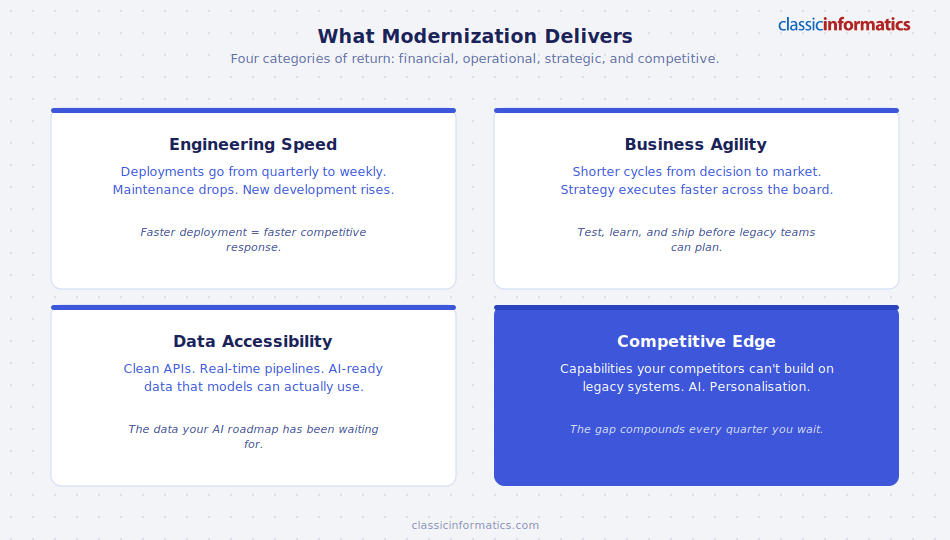
Deployment frequency goes up. Teams releasing quarterly can get to monthly or weekly. Mean time to recovery drops, because modern architectures isolate failures rather than let them cascade. The proportion of engineering time going to maintenance decreases as technical debt gets paid down, freeing capacity for work that actually moves the business forward.
A team that can release in weeks instead of quarters gives you a fundamentally different ability to respond to market conditions and customer feedback. That's not an IT metric. That's a competitive one.
What Changes for the Business
Faster deployment means your business units get new capabilities on shorter cycles. Decisions that previously required months of IT lead time can be explored, tested, and validated in weeks. That changes how strategy gets executed, not just how fast, but how confidently.
Data accessibility is usually the most consequential shift. Modernized architectures expose data through APIs and feed real-time pipelines, connecting operational data to the analytics and machine learning platforms that were blocked before.
Customer-facing quality improves too. Not through a redesigned interface, but through the underlying system reliability and responsiveness that the interface depends on.
The ROI That's Hardest to Measure
Direct savings are easy to document: infrastructure costs come down, licensing for legacy platforms reduces, engineering time going to maintenance decreases. These are real and worth capturing. But they rarely tell the full story.
The harder ROI to measure, and typically the largest, is the enabling value. A modernized data infrastructure enables a demand forecasting model that reduces inventory costs. A re-architected customer platform enables personalisation that improves conversion. An API-first architecture opens a revenue stream through third-party integration that simply wasn't possible before.
These outcomes are directly attributable to the modernization investment. But only if you defined baseline metrics before the programme started. Measuring digital transformation ROI properly means setting baselines before work starts and tracking against them at every phase gate. Without that, leadership loses confidence in the investment before the most significant returns arrive.
Translate technical metrics into business language when making the case upward. Deployment frequency becomes time from decision to market. Mean time to recovery becomes operational resilience. Data accessibility becomes AI initiatives now in production versus the ones that stalled.
AI Readiness
Gartner predicts that by 2028, 33% of enterprise software applications will include agentic AI capabilities - up from less than 1% in 2024. None of that is possible without the underlying infrastructure to support it.
AI needs modern infrastructure to work at scale: accessible data, clean APIs, architectures that support real-time data flows. For most enterprises, the case for modernization and the case for AI are the same case.
Legacy systems are the primary reason AI initiatives don't reach production. Not the models, not the teams, not the budget. The data architecture.
The application modernization trends reshaping enterprise IT in 2026 all point to the same conclusion: the definition of "done" has shifted from cloud-native to AI-ready. The pace of change here is shifting faster than most roadmaps account for. AI readiness has replaced cloud migration as the primary driver of modernisation investment. The strangler fig pattern has effectively replaced big-bang rewrites as the consensus approach.
FinOps has moved from an engineering discipline to a C-suite conversation. And data architecture has become the bottleneck that determines whether your modernised systems can actually support the capabilities you're building toward.
If your modernisation roadmap was scoped more than eighteen months ago, it's worth revisiting against where the industry has moved.
Why Modernization Programmes Fail
79% of application modernization projects have experienced significant failure and almost none of them fail because the technology was wrong. They fail because the programme was designed wrong.
McKinsey's transformation research puts the failure rate at roughly 70 percent for programmes generally, not just technical ones. The application modernization challenges that drive most of these failures cluster around the same programme design mistakes, reliably, across industries and organisation sizes.
Scope Gets Underestimated
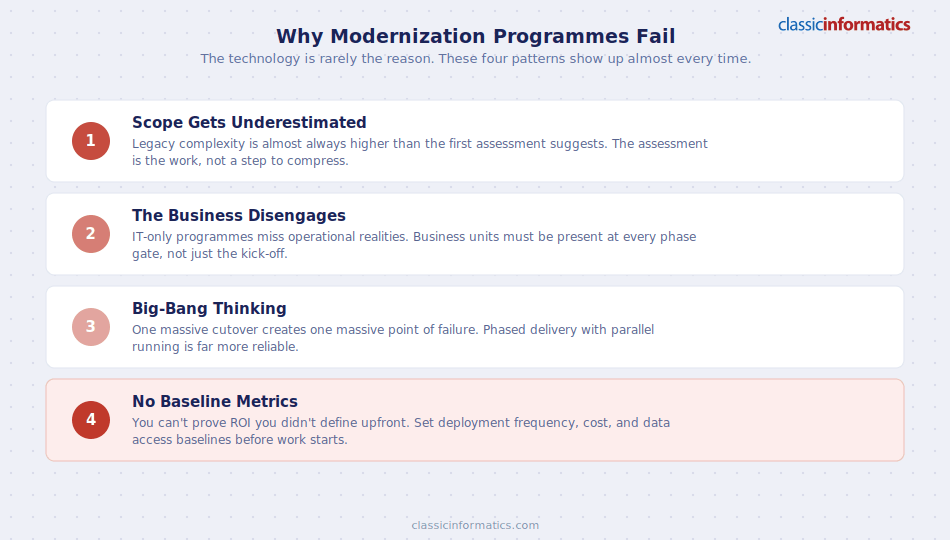
Legacy systems are almost always more complex than they appear from the outside. Hidden dependencies. Undocumented integrations. Business logic buried in code written by people who left the company a decade ago. These get consistently underestimated in planning, not from dishonesty, but because you genuinely can't know what's in a system until you're deep inside it.
The technical assessment phase isn't a step to compress to hit a project start date. It's the work that makes every downstream decision accurate.
The Business Disengages
When modernization gets handed entirely to IT, without genuine involvement from the business units that depend on the affected systems, you end up with technically modernized systems that don't support the operational realities that were never captured in any specification.
Your business needs to be a participant throughout. Not consulted at kick-off and informed at go-live. Present at every significant decision point.
Big-Bang Thinking
Trying to modernize a large portfolio in a single programme with a single go-live is high-risk in ways that are easy to underestimate until something goes wrong. When it does, there's no clean way to absorb it without threatening the whole programme.
Phased approaches that deliver visible, measurable value incrementally are significantly more likely to succeed. Not just because they're technically safer, but because they maintain executive support through the long middle of the programme, where the work is hardest and the results aren't yet visible.
Four More Failure Patterns
- Insufficient parallel planning. You design the build but don't design the migration. Data synchronisation, feature parity validation, user migration paths, rollback procedures — these need to be designed before the build starts, not worked out under pressure as go-live approaches.
- Knowledge loss. Programmes that don't invest in continuous documentation and knowledge transfer leave you dependent on the delivery partner indefinitely. Architecture decisions should be documented as they're made, not reconstructed from memory at the end.
- Architecture that outpaces the team. Adopting patterns your internal engineers don't have the skills to operate in production is a trap. Microservices, Kubernetes, event-driven design all require real operational expertise. A modernized system nobody on your team fully understands is fragile in a different way than before.
- Missing executive ownership. Multi-year programmes without clear executive sponsorship drift, especially across budget cycles. Someone needs to own the programme, defend the investment, and make tradeoff decisions when the unexpected surfaces.
Application Modernization in Practice
Every modernization programme looks the same on paper. The real differences show up when it hits a specific industry's constraints. Healthcare and manufacturing are where those constraints are sharpest and where the most common planning mistakes tend to cluster.
These two industries stand out for the same underlying reason: the systems being modernized are directly connected to operations where failure has consequences beyond IT. A database going down during a migration is an IT incident. A database going down during a migration in a hospital system is a patient safety incident. Those aren't the same conversation, and they shouldn't be planned the same way.
Healthcare
Healthcare software modernization runs under some of the tightest regulatory constraints of any sector. Systems handling patient data must comply with HIPAA in the US, GDPR in Europe, and a range of national frameworks that govern how data is stored, accessed, transferred, and retained.
Compliance isn't a checkpoint at the end of a modernization phase. It shapes the architecture of every layer.
The integration challenge is compounded by the Electronic Health Record (EHR) ecosystem. EHR platforms are deeply embedded in clinical workflows. They've been customised heavily over years. They connect to billing, pharmacy, diagnostics, scheduling, and insurance systems in ways that are often only partially documented.
Modernizing around an EHR without disrupting clinical operations requires careful, dependency-mapped sequencing that takes significantly longer than equivalent work in less regulated environments.
The most common mistake healthcare IT teams make is underestimating compliance review cycles. A step that takes two months in a standard enterprise environment can take six months in healthcare once audit, legal, and clinical sign-off are factored in. Build that into your programme from the start, not as contingency, as the baseline.
The compounding-compliance problem is easiest to see in a partnership that's run long enough to compound. When Classic Informatics was engaged by InterDent, a 250-clinic US dental group, in 2004, its practice management system handled clinical operations and nothing else — collections, payroll, and fee management had no supporting infrastructure, and data sat locked across 20+ source databases with no way to aggregate it.
Twenty years and three data-warehouse rebuilds later, each completed with zero data loss or reporting downtime, 80% of InterDent's revenue collection activity runs on tools Classic Informatics built — a direct result of treating compliance and data architecture as one continuous problem rather than a series of separate migration projects.
The full InterDent story is here.
Manufacturing
Manufacturing modernization has a dimension most other sectors don't face: operational technology (OT).
Manufacturing environments run physical control systems: PLCs, SCADA systems, industrial sensors, MES platforms, all built for reliability and longevity, not connectivity. These systems run on proprietary protocols. They were deliberately isolated from IT networks for stability and security reasons.
And they often hold the most valuable operational data in the business: production rates, equipment health, quality metrics. Data that's currently inaccessible to every analytics or AI tool you're trying to run.
The pressure to bridge OT and IT is coming from multiple directions at once. Real-time production visibility, predictive maintenance, supply chain integration, regulatory reporting. All of it depends on data currently locked inside systems that weren't designed to share it.
The approach has to be incremental. Establish a data collection layer that reads from OT systems without disrupting them. Build a structured data platform above it. Then enable analytics and AI workloads on top. You can't take the production line offline for a migration.
Austin Engineering ran into exactly this constraint at its Batam, Indonesia production facility. Every asset went through a 7-stage quality control process before shipment, but the process itself ran on disconnected Excel templates, manual signature chains, and printed reports physically shipped with each asset — a paper-based control layer sitting on top of a physical production line that couldn't stop for a migration.
Classic Informatics built AustinQC around Austin's existing inspection sequence rather than replacing it: seven spreadsheet templates became one digital workflow, the three-tier approval chain now runs digitally, and Airtable integration removed the manual re-entry step that used to sit between every stage.
Choosing an Application Modernization Partner
With thousands of top application modernization companies in the market, the wrong question to ask is "who can do this?" Every firm with a modernization practice will say yes.
The right question is: "Who has done this before, at this level of complexity, and what did it look like when something went wrong?" Because something always goes wrong. The assessment surfaces a dependency nobody knew about. A data migration takes three times as long as planned. A critical integration turns out to be entirely undocumented.
What separates good partners from adequate ones isn't whether these things happen. They happen everywhere. It's what happens next.
What to Look For
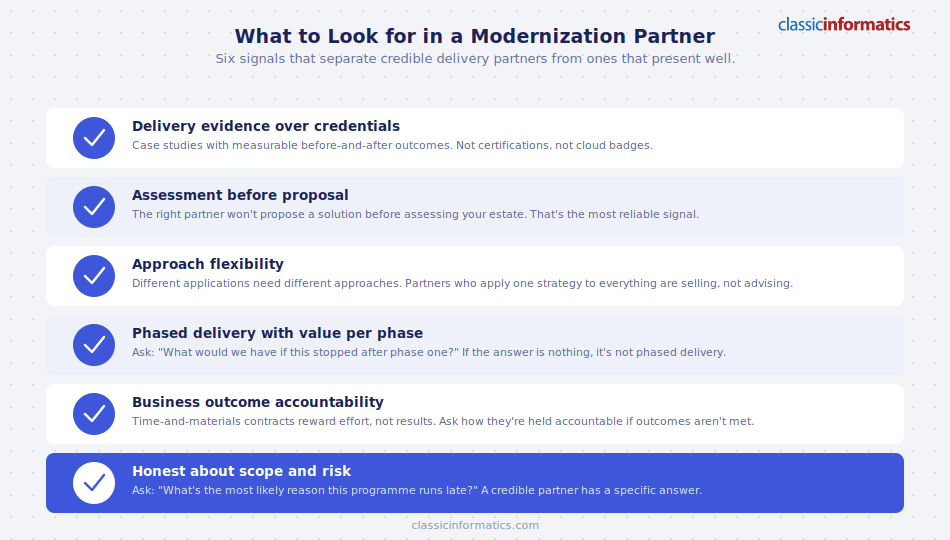
- A track record at comparable complexity. Don't ask for the firm's most impressive wins. Ask for the engagements most similar to yours in scale, constraint, and regulated environment. Then ask specifically about what happened when scope got complicated.
- Full-stack delivery capability. A modernization programme spans application architecture, cloud infrastructure, data migration, API development, security, testing, and DevOps. Partners who subcontract the hard pieces introduce coordination gaps that create problems in complex programmes.
- Business-outcome orientation. The best partners don't just execute technical specifications. They help you think through sequencing and tradeoffs in terms of what they mean for your operations and roadmap. If a partner talks only about technology and never about business impact, pay attention to that signal.
- Domain knowledge in your industry. Healthcare, financial services, insurance, and manufacturing carry regulatory and operational constraints that directly affect how programmes must be designed. Domain experience shortens the learning curve and prevents decisions that are technically sound but operationally wrong.
- A genuine commitment to knowledge transfer. A programme that leaves your team dependent on the delivery partner hasn't fully succeeded. Ask how knowledge transfer works: not as a handover event at the end, but as a continuous practice throughout.
Questions to Ask Before You Sign
- What does your technical assessment phase produce, and what does it typically surface that wasn't visible going in?
- Can you walk us through a programme that hit significant scope complexity? What happened, and how was it managed?
- Is data migration handled by your team, or subcontracted?
- How do you design the parallel operation period, when both old and new systems run simultaneously?
- What does our team own at the end: documentation, runbooks, operational capability?
- Who specifically would lead our programme, and what's their comparable experience?
What Classic Informatics Brings
Classic Informatics has been running enterprise legacy application modernization services for over 20 years.
Not transformation consulting. Not advisory work that stops at the strategy slide. Actual delivery: assessing legacy portfolios, re-architecting systems that businesses depend on, migrating data without losing what took years to accumulate, and building the infrastructure that makes AI initiatives executable rather than theoretical.
We start every modernization engagement with a technical assessment that surfaces what's actually there, not what the documentation says is there. That assessment drives the sequencing, the dependency mapping, and the risk decisions. It also produces the baseline metrics you'll need to measure ROI: deployment frequency before and after, engineering time going to maintenance versus new development, infrastructure cost per transaction, data accessibility for analytics and AI teams.
We scope those baselines at the start, not the end. Because the value of modernization is hardest to see when you're in the middle of it, and leadership needs to see it clearly at every phase gate.
Knowledge transfer is built into how we work, not added on at handover. Architecture decisions get documented as they're made. Your team operates what's been built, not just inherits it.
The Real Question, Revisited
This guide started with a question most teams skip: what's it costing you to leave things alone?
If you've read this far, you probably have a clearer answer than you did ten chapters ago. The cost isn't just the maintenance budget. It's the initiatives you're not pursuing, the data your AI team can't access, and the competitive gap that widens every quarter you wait.
The good news: you don't have to fix everything at once. The 6 Rs give you a framework for matching the right approach to each system. A phased strategy and roadmap give you a sequence that builds momentum rather than burning it. And the measurement discipline gives you a way to prove the value at every phase gate.
The teams that modernise well don't move fast. They move deliberately. They start with the system most likely to prove the model, not the most important one. They measure before they build. And they treat modernisation as a programme that evolves, not a project that ends.
At Classic Informatics, we help mid-to-large enterprises do that work — and then execute on what comes after it. If you're building a modernisation business case or trying to get a stalled programme moving, we're happy to compare notes on yours.
Frequently asked questions
What is application modernization in simple terms?
Application modernization is updating existing software so it can support what the business needs today, not just what it was built for originally. That can mean moving a system to the cloud without changing it, restructuring its internals into smaller services, or replacing it outright. The point isn't the technique — it's making the application capable of the availability, speed, and data access the business now depends on.
What are the 6 Rs of application modernization?
The 6 Rs are Retire, Retain, Rehost, Replatform, Refactor/Re-architect, and Replace/Rebuild — six strategies for deciding how much change each application in a portfolio needs, ranging from switching a system off to rebuilding it entirely. The framework's value is in applying it system by system, not picking one approach for the whole portfolio.
How much does application modernization cost?
Cost depends entirely on scope. A rehost of one application can run a few weeks and a modest infrastructure bill, while a full re-architecture of a business-critical platform typically runs 6 to 18 months at a much higher cost. Most enterprises underestimate a system's real total cost of ownership by a factor of two before a proper assessment corrects it.
How long does an application modernization programme take?
A single rehost can complete in 4 to 8 weeks. A full portfolio programme spanning multiple systems, dependencies, and a parallel-run period typically runs 12 to 24 months or longer. The honest answer depends on how many systems are in scope and how tightly they depend on each other — which is exactly what a portfolio inventory is for.
What's the difference between application modernization and digital transformation?
Application modernization is the infrastructure decision — updating the systems themselves. Digital transformation is the business outcome those systems make possible: operating differently, serving customers differently, competing on new terms. Modernization is usually the thing that has to happen first, and treating the two as interchangeable is what produces programmes with no clear owner for either goal.
Do we need to modernize before we can use AI?
In most cases, yes, to some degree. AI initiatives depend on clean, accessible, real-time data, and legacy systems typically lock that data in proprietary formats with no APIs. You don't need to modernize everything before starting an AI initiative, but the specific systems holding the data that initiative needs almost always require at least a replatform first.