
Finding a web development partner in Australia — or one that genuinely serves Australian clients — shouldn't take weeks of chasing proposals that don't actually answer your questions.
It does anyway. So here's the shortcut.
This list covers web development companies that build serious web products for Australian businesses: platforms, enterprise applications, SaaS systems, and custom-built web solutions. Not WordPress templates. Not $5K landing pages. These are partners for companies building products that need to last.
Key Takeaways
- The best web development companies for Australian clients combine strong technical depth with product thinking — not just execution-for-hire.
- Australia's web development market skews toward React, Node.js, and cloud-hosted architectures — verify your partner's stack before you sign.
- Local AU studios offer faster discovery collaboration; offshore firms serving Australia typically deliver stronger cost efficiency on execution-heavy builds.
- Web development projects overrun most often because of unclear requirements — not because of technical failure.
What Makes a Web Development Company Worth Working With in 2026
Not every firm that ranks for web development companies Australia is actually worth your time. Many are generalists with a broad portfolio and thin vertical knowledge. The ones worth your shortlist have something more specific to offer.
What to look for: a defined tech stack, a discovery process they can walk you through before you brief them, and case studies for products that look like what you're building. If the case studies are all "we built a website for a small business" and you're building a SaaS platform, move on.
The companies on this list were evaluated on technical depth, documented delivery record, and relevance to Australian client needs — whether that's a local studio who can meet you in Sydney or an offshore firm that has delivered complex web systems to AU-based teams with demonstrable results.
One more thing. Web development in Australia at enterprise scale increasingly means API-first architecture, cloud-native hosting, and applications that integrate with Salesforce, HubSpot, ERPs, or industry-specific platforms. Your web development partner needs to be fluent in those environments, not just in the code.
How We Evaluated These Web Development Companies
This list reflects editorial research based on publicly verifiable criteria — not vendor submissions or paid placement.
-
Technical stack depth: Demonstrated capability in modern web frameworks (React, Next.js, Node.js, Vue) and cloud-native deployment.
-
Product development process: Evidence of structured discovery, architecture planning, and iterative delivery — not just code execution.
-
Australian market relevance: Active client history with Australian businesses or verified AU-serving delivery experience.
-
Client feedback: Clutch and GoodFirms ratings; quality and recency of reviews for web-specific projects.
-
System integration experience: Track record integrating web platforms with third-party APIs, CRMs, ERPs, and cloud services.
-
Post-launch support: Defined maintenance, performance monitoring, and iterative development capability.
Companies at a Glance
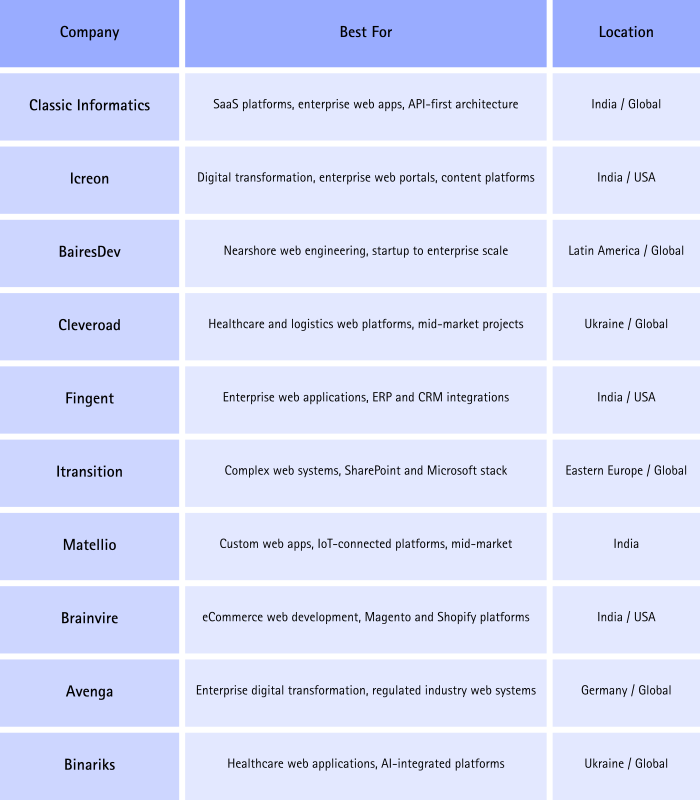
10 Web Development Companies Worth Evaluating
1. Classic Informatics
Classic Informatics builds web platforms and enterprise applications for clients across healthcare, manufacturing, fintech, and SaaS — and has been doing it for 23+ years. The distinction from most web development companies is architectural depth: Classic Informatics doesn't separate the web build from the system design, which means the product you launch is built to scale from the beginning.
For Australian businesses, that matters particularly when the web platform needs to integrate with existing enterprise systems, cloud infrastructure, or industry-specific third-party APIs. Classic Informatics brings web development services alongside product strategy, so the scope doesn't drift the moment requirements touch something outside the original brief.
-
SaaS platform development and architecture
-
Enterprise web application development
-
React, Node.js, and cloud-native web systems
-
API design, integration, and third-party system connections
-
Web application modernisation and re-platforming
-
Post-launch performance monitoring and iterative development
With 3,000+ projects delivered across 30+ countries and 95% client retention, Classic Informatics works best for companies building web products that need to serve real users from day one — not refactored six months after launch.
2. Icreon
Icreon is an India and New York-based digital transformation firm with a track record in enterprise web portals, content management systems, and customer experience platforms. Their strength is in projects where the web layer connects to a complex back-end system — legacy data, enterprise content repositories, or multi-tenant SaaS infrastructure.
They've delivered projects across media, professional services, and retail, with a recognisable client roster that reflects serious enterprise capability.
-
Enterprise web portal development
-
Content management system implementation and custom development
-
Digital experience platforms (DXP) and CMS migrations
-
API and microservices architecture for web platforms
-
UX strategy and user research integration
-
Sitecore, Kentico, and Drupal implementation
Icreon's engagement model is structured for enterprise budgets and timelines. Smaller project scopes or agile-first startups may find their process more governance-heavy than the project warrants.
3. BairesDev
BairesDev is a Latin America-headquartered engineering firm that places senior web developers with Australian and global companies — either as augmented team members or as a fully managed delivery team. Their model sits between a traditional agency and a staffing firm, which works well for companies that need senior engineering capacity without the overhead of hiring full-time.
Their developer network is rigorously vetted and skews toward senior talent, which distinguishes them from typical staff augmentation providers.
-
Full-stack web development (React, Node.js, Python, Java)
-
Staff augmentation for senior web engineering roles
-
Custom web application development and architecture
-
API development and system integration
-
Cloud-native deployment and DevOps setup
-
Agile delivery for startup and enterprise clients
BairesDev is strongest as a development capacity partner. For companies that need a full product discovery and strategy process, a firm that leads from concept to launch may be a better starting point.
4. Cleveroad
Cleveroad is a Ukraine-based technology firm with a focused web development practice in healthcare, logistics, and retail — industries where web platforms need to handle real operational data, not just marketing content. Their case studies in these sectors are specific enough to be useful: actual system problems solved, not generic "digital transformation" stories.
They serve mid-market clients primarily and have a consistent Clutch presence with reviews from European and US-based companies with AU-adjacent delivery experience.
-
Healthcare web platform development
-
Logistics and supply chain web applications
-
Retail and eCommerce web systems
-
React and Vue.js frontend development
-
Backend development (Node.js, Python, PHP)
-
Quality assurance and testing for web applications
Cleveroad's domain focus is a strength if your project falls in healthcare, logistics, or retail. For general-purpose SaaS or enterprise platforms outside those verticals, other firms on this list may bring stronger product engineering depth.
5. Fingent
Fingent is an India and US-based technology firm with a specific capability in enterprise web applications that require deep integration with third-party systems — ERP platforms, CRM systems, industry databases, and cloud infrastructure. For Australian businesses building web products that connect to Salesforce, SAP, or Microsoft Dynamics, Fingent's integration experience is directly applicable.
They work across healthcare, real estate, legal, and professional services — sectors common in the Australian enterprise market.
-
Enterprise web application development
-
ERP and CRM integration (Salesforce, SAP, Microsoft Dynamics)
-
Custom portal and workflow automation development
-
React and Angular frontend development
-
SharePoint and Microsoft 365 integration
-
Cloud migration for web applications
Fingent's strength is integration-heavy enterprise builds. For greenfield web products with minimal legacy system connections, their model may be more structured than the project needs.
6. Itransition
Itransition is an Eastern European technology firm with over 25 years of history and a broad web development practice that includes custom application development, SharePoint and Microsoft stack implementations, and enterprise portal work. For Australian companies already running Microsoft infrastructure — Teams, SharePoint, Azure — Itransition's depth in that ecosystem reduces integration friction on web builds.
They serve enterprise clients across insurance, healthcare, financial services, and manufacturing.
-
Custom web application development
-
SharePoint and Microsoft 365 web portal development
-
Enterprise application integration and migration
-
React, Angular, and .NET web development
-
Business process automation for web platforms
-
Quality assurance and software testing services
Itransition is a strong match for enterprise Microsoft environments. Teams building on AWS or GCP infrastructure or using non-Microsoft stacks may find stronger technical alignment with other firms on this list.
7. Matellio
Matellio is an India-based custom software development firm with web development as a core practice. Their strength is mid-market companies that need a custom web application built around a specific business process — field service management, customer portals, IoT data dashboards — rather than a generic platform.
They have experience integrating IoT data into web interfaces, which is a less common capability at their price tier.
-
Custom web application development
-
IoT-connected web dashboards and data platforms
-
Enterprise customer portal development
-
React, Angular, Node.js, and PHP web development
-
Cloud-native web application deployment
-
Third-party API and data integration
Matellio works well for companies with clear requirements and a specific use case for the web platform. Complex product strategy or UX research requirements are better served by a firm with a dedicated product design practice.
8. Brainvire
Brainvire is an India and US-based firm with a significant eCommerce web development practice — Magento, Shopify, and custom storefronts — alongside broader web application development. For Australian retailers and B2B companies building or re-platforming eCommerce web properties, Brainvire's depth in those specific platforms is hard to match at comparable price points.
Their Clutch profile is one of the more reviewed in the web development category, providing a large sample of verified client experience.
-
Magento and Shopify eCommerce development
-
Custom eCommerce web platform development
-
Progressive Web App (PWA) development
-
CRM and ERP integration for web platforms
-
Web application performance optimisation
-
Multi-market and multi-currency eCommerce setup
Brainvire's clearest strength is in eCommerce web development. For SaaS platforms, enterprise applications, or complex workflow systems, firms on this list with a broader engineering practice are a better match.
9. Avenga
Avenga is a German-headquartered global technology firm with a strong practice in enterprise digital transformation and regulated industry web systems. For Australian companies in financial services, insurance, or healthcare where security, compliance, and audit-readiness are non-negotiable requirements for the web platform, Avenga's documented experience in those environments is directly relevant.
Their team spans Eastern Europe and the US, with delivery experience across European and North American enterprise clients.
-
Enterprise web application development
-
Regulated industry digital transformation (fintech, insurance, healthcare)
-
Security and compliance architecture for web systems
-
Cloud-native web application development and migration
-
API platform design and implementation
-
Microservices architecture for large web systems
Avenga's engagement model is designed for complex, governance-intensive enterprise projects. Startups or mid-market teams with faster timelines may find the structure disproportionate to their project scale.
10. Binariks
Binariks is a Ukraine-based software firm specialising in healthcare web applications and AI-integrated platforms. If your web product handles patient data, clinical workflows, or health system integrations, Binariks' specialisation in HIPAA-adjacent development environments is a meaningful differentiator.
They've built web products for digital health companies in the US and European markets, with technical practices aligned to the compliance requirements those environments demand.
-
Healthcare web application development
-
AI and ML feature integration for web platforms
-
HIPAA-compliant web architecture
-
React and Node.js web development
-
Health system API integration (HL7, FHIR)
-
Post-launch maintenance and iterative development
Binariks is a sharp fit for health tech web products. For general-purpose enterprise or SaaS web applications outside the healthcare domain, their specialisation becomes less of an advantage.
How to Choose the Right Web Development Partner
The selection criteria that matter differ depending on whether you're building a marketing site, a SaaS platform, or an enterprise application. Here's the framework for the latter two.
-
Define the technical stack before you brief: Know whether you're building on React/Node.js, a Microsoft stack, or a cloud-native platform. Briefing without this detail produces quotes that aren't comparable.
-
Assess integration requirements upfront: Web applications that need to connect with ERPs, CRMs, or third-party APIs require a partner with explicit integration experience. This should be on your evaluation criteria list from day one.
-
Ask about discovery and architecture planning: The best web development companies in Australia and offshore run a discovery phase before writing code. If a firm skips discovery and goes straight to a fixed quote, ask why.
-
Verify post-launch capability: Who handles bug fixes, performance degradation, dependency updates, and security patches after launch? This should be contractually defined, not assumed.
-
Request references for comparable project types: A portfolio of websites does not demonstrate ability to build enterprise SaaS. Ask for references that match your project's complexity and domain.
-
Understand the team structure: Know whether you'll be working with the same senior developers throughout or if senior resources hand off to juniors mid-project. This is common in large firms and worth clarifying upfront.
Let's Wrap This Up!
The best web development companies in Australia aren't necessarily based there. What matters is delivery quality, process rigour, and technical fit — and those attributes are distributed across local studios, EU firms, India-based teams, and global hybrid partners.
Different entries on this list solve different problems. Brainvire for eCommerce. Binariks for health tech. Avenga for regulated enterprise. BairesDev for senior engineering capacity. None of them are the same answer to the same question.
If you're building a SaaS platform, an enterprise web application, or a custom system that needs to scale with your business — and you want a partner who will challenge the architecture before agreeing to the scope — Classic Informatics has delivered that for 1,000+ clients across 30+ countries. Talk to our team when you're ready to scope it.
FAQS

Frequently Asked Questions
Custom web development in Australia ranges from $15,000 for a small web application to $200,000+ for an enterprise platform. Local Australian studios typically charge $120–$200/hr. Offshore firms serving Australian clients range from $35–$80/hr for comparable technical capability. Budget range is less important than scope clarity — a well-specified brief produces more accurate quotes than any price benchmark.