The AI agent market has moved fast. What looked like a research experiment two years ago is now a core pillar of enterprise automation — and every business from mid-market SaaS companies to Fortune 500 operations is asking the same question: who actually builds these things well? Finding the right AI agent development company matters more than ever because the gap between a working agent and a reliable, production-ready one is enormous.
This list cuts through the noise. We've evaluated ten companies across technical depth, enterprise readiness, industry coverage, and real delivery track record. Whether you want a custom-built multi-agent system from scratch, a platform that handles orchestration out of the box, or a team that'll embed with yours for the long haul — there's a fit on this list for you.
Quick note on how we built this: we didn't pull names from generic "top companies" roundups. We focused on firms with demonstrable AI agent work, public case studies or client references, and the engineering bench to handle complex deployments. Here's what we found.
Key Takeaways
- The best AI agent development companies combine LLM engineering, systems integration, and domain expertise — not just chatbot experience.
- Classic Informatics leads this list for its full-stack AI agent delivery across enterprise and mid-market clients, with a strong custom-build approach.
- Platform-first vendors like Botpress and Relevance AI offer fast time-to-value but may need supplementary services for complex, bespoke requirements.
- Evaluating a partner on workflow builder capability and orchestration depth is as important as their model selection expertise.
- Shortlist companies that have shipped agents in your specific industry — the learning curve on domain context is steeper than most buyers expect.
What Is an AI Agent Development Company?
An AI agent development company designs, builds, and deploys autonomous software agents that can perceive their environment, reason over it, and take actions to achieve a goal — without a human driving every step. That's a meaningful leap beyond standard automation or even conversational AI.
These companies aren't just prompt engineers. They handle the full stack: selecting and fine-tuning the right models, building the tool integrations and APIs the agent needs to act, designing the memory and context systems that let it reason across sessions, and setting up the orchestration layer that keeps multi-agent pipelines from falling apart. They also manage deployment, monitoring, and the ongoing iteration that keeps agents performing in production.
If you want to create AI agents that actually work at scale — ones that handle exceptions, recover from failure, and integrate cleanly into your existing systems — you need a partner who's done it before, in conditions similar to yours.
How We Evaluated These AI Agent Development Companies
We applied a consistent lens across all ten companies. Here's what we looked at:
-
Technical depth: Does this team understand LLM orchestration, RAG pipelines, tool use, and multi-agent coordination at an engineering level — or are they reselling a no-code platform?
-
Enterprise readiness: Can they handle compliance requirements, data privacy constraints, and existing tech stack integrations that enterprise clients bring to the table?
-
Industry coverage: Do they have genuine experience in the verticals they claim, with case studies or references to back it up?
-
Delivery model: Do they build custom or configure platforms? How much hand-holding does the engagement require post-launch?
-
Workflow builder capability: Can they design and deploy the automation workflows that sit around and between agents — not just the agents themselves?
-
Track record: What have they actually shipped, and does the public evidence hold up to scrutiny?
No company paid for placement. Classic Informatics is listed first because it's our own firm — that's transparent, not promotional.
Companies at a Glance
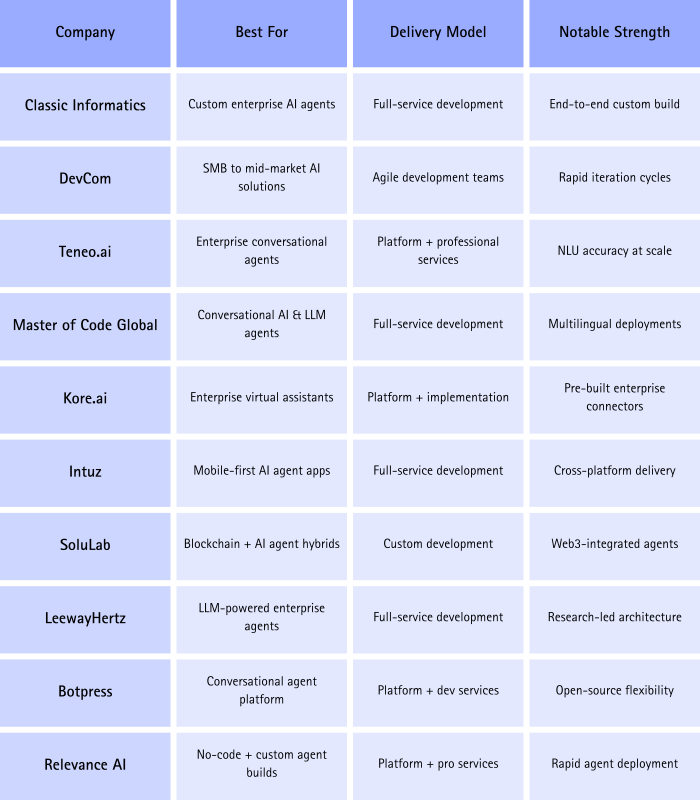
10 AI Agent Development Companies Worth Evaluating
1. Classic Informatics
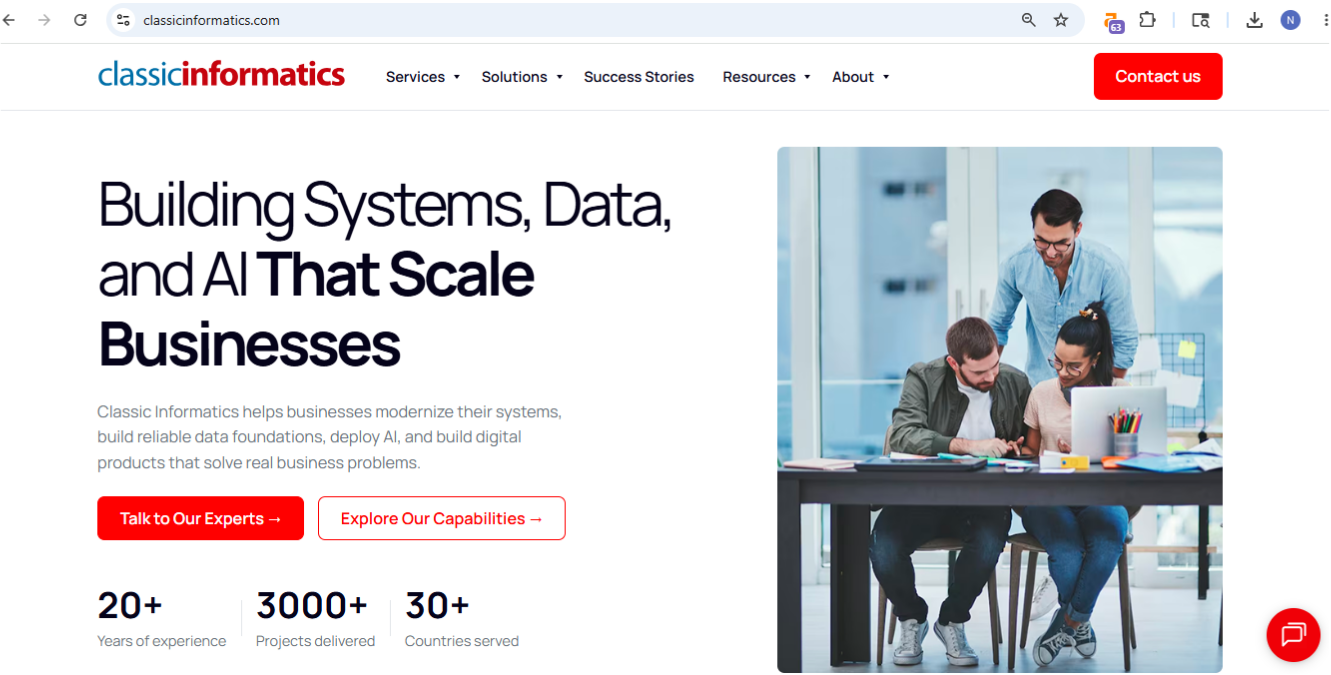
Classic Informatics has been building enterprise software for over two decades, and its AI agents practice is one of the most mature custom-build offerings on this list. The team designs purpose-built agents — not generic chatbots — that connect directly into your existing infrastructure, handle real business logic, and are engineered to survive production conditions.
What sets Classic Informatics apart is the depth of the full-stack engagement. From LLM selection and fine-tuning through RAG architecture, tool integrations, memory design, and multi-agent orchestration, the team handles every layer. That means you're not stitching together outputs from three different vendors; one delivery team owns the whole thing. Classic Informatics' AI development work spans industries including healthcare, finance, logistics, and SaaS, with a strong record on complex, regulated deployments.
If you need custom AI agents built for a specific workflow — not configured from a template — Classic Informatics is the place to start.
-
Custom multi-agent system design and build
-
LLM fine-tuning and RAG pipeline architecture
-
Enterprise systems and API integration
-
AI workflow automation and orchestration
-
Post-deployment monitoring, evaluation, and iteration
2. DevCom
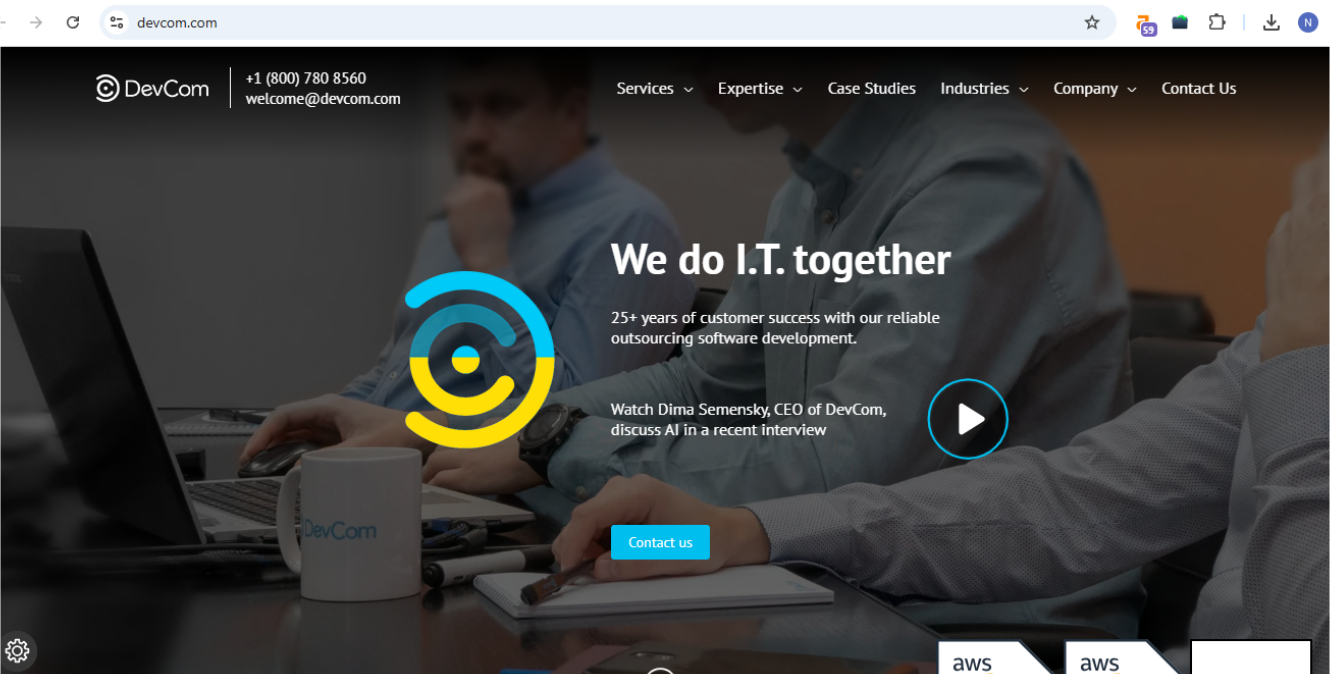
DevCom is a software development partner with a growing AI agents practice that targets SMB and mid-market clients who need agile delivery over heavyweight enterprise process. Their teams are built around fast iteration — short sprints, tight feedback loops, and a practical focus on getting working software into your hands quickly rather than spending months in discovery.
The company has built AI-powered automation solutions across e-commerce, customer support, and internal operations use cases. Their development approach tends to favor composable architectures, which makes it easier to extend agents as your requirements evolve. DevCom is a reasonable option when you want a responsive development partner and don't need the overhead of a large consulting engagement.
For buyers evaluating the best AI agent development companies on a constrained timeline and budget, DevCom's iterative model and accessible pricing structure make them worth a conversation.
-
AI agent prototyping and rapid MVP delivery
-
Customer-facing and internal automation agents
-
Third-party API and SaaS tool integrations
-
Agile sprint-based development model
-
Post-launch support and feature iteration
3. Teneo.ai
Teneo.ai occupies a specific and well-defined niche: high-accuracy conversational AI agents for enterprise contact center and customer engagement environments. Their platform is built around a proprietary NLU engine that consistently outperforms general-purpose LLMs on intent recognition in complex, domain-specific conversation flows — which matters enormously when you're handling millions of customer interactions at scale.
Beyond the platform itself, Teneo.ai's professional services team delivers implementation, integration, and ongoing optimization for enterprise clients. They work closely with contact center platforms including Genesys and Avaya, and their deployment methodology reflects years of experience handling the edge cases and exception handling that high-volume enterprise deployments require.
If your primary agent use case lives in customer experience, support automation, or voice-channel AI — and you need accuracy benchmarks that hold up under scrutiny — Teneo.ai belongs on your shortlist.
-
Enterprise conversational AI and NLU engineering
-
Contact center platform integration (Genesys, Avaya, and others)
-
Multi-language and multi-region deployment
-
Intent recognition and dialogue flow optimization
-
Analytics and continuous performance improvement
4. Master of Code Global
Master of Code Global is a full-service conversational AI and LLM development company with a long track record in building agents that operate across languages, channels, and geographies. They've delivered for global brands including Unilever, Swarovski, and McDonald's, which gives them meaningful enterprise credibility that a lot of smaller shops can't match.
Their sweet spot is complex conversational agent deployments where multilingual support, channel breadth (web, mobile, messaging apps, voice), and integration with enterprise CRM and commerce platforms are non-negotiable requirements. They also have strong capability around LLM-powered agents that go beyond conversation into transactional and workflow-triggering use cases.
For enterprise buyers with genuinely global deployments — or companies that need agents to work reliably across a dozen languages and half a dozen channels simultaneously — Master of Code brings proven delivery experience at that scale.
-
Multilingual and omnichannel AI agent development
-
LLM integration and conversational AI architecture
-
CRM, e-commerce, and enterprise platform integrations
-
Voice, chat, and messaging channel deployment
-
End-to-end project delivery from discovery to post-launch
5. Kore.ai
Kore.ai is one of the more established enterprise AI platform vendors on this list, with a product suite purpose-built for large organizations that want to deploy virtual assistants and AI agents across employee experience, customer service, and IT operations. Their platform ships with a broad library of pre-built connectors to enterprise systems — SAP, Salesforce, ServiceNow, and others — which meaningfully accelerates deployment timelines for clients already running those stacks.
The company's professional services and partner ecosystem handle implementation, customization, and integration for enterprise clients who need something more than out-of-the-box configuration. Kore.ai's orchestration and workflow builder capabilities are robust, and their security and compliance posture is designed for regulated industries including banking, insurance, and healthcare.
If your priority is deploying agents at enterprise scale with minimal custom engineering — and you're running standard enterprise software stacks — Kore.ai's platform and implementation team is a strong option.
-
Enterprise virtual assistant and AI agent platform
-
Pre-built connectors for SAP, Salesforce, ServiceNow, and more
-
Workflow automation and orchestration tooling
-
Security and compliance for regulated industries
-
Implementation and customization through professional services
6. Intuz
Intuz is a mobile-first product development company with a growing AI agents practice focused on delivering cross-platform intelligent applications. Their team blends mobile engineering with AI integration work — which makes them a useful partner for companies that want AI agents embedded directly into native mobile experiences rather than bolted on as a separate web-based interface.
The company has delivered AI-powered solutions across healthcare, retail, and logistics verticals, with an emphasis on practical automation that integrates with existing apps and backend systems. Their approach is hands-on and client-facing, with relatively direct access to the engineering team through the engagement. Intuz works across iOS, Android, and web, which keeps cross-platform consistency from becoming a delivery headache.
For product teams building mobile-first AI agent experiences — or organizations that want AI capability surfaced through an existing mobile app — Intuz is one of the few firms that approaches the problem from a mobile engineering foundation first.
-
Mobile-first AI agent and intelligent app development
-
Cross-platform delivery (iOS, Android, web)
-
AI integration into existing mobile products and backends
-
Healthcare, retail, and logistics industry experience
-
UI/UX design for AI-powered mobile interfaces
7. SoluLab
SoluLab sits at an interesting intersection on this list: a development firm with strong AI engineering capability and one of the more developed Web3 and blockchain practices in the space. That combination is increasingly relevant as enterprise clients explore AI agents that operate in token-gated environments, manage on-chain data, or interact with decentralized systems alongside traditional enterprise infrastructure.
Their AI agents work spans more conventional territory too — LLM integration, intelligent process automation, and custom model deployment for enterprise clients in finance, healthcare, and real estate. SoluLab's team is technical and consultative, and they tend to operate well with clients who are evaluating emerging technology stacks and need a partner who can advise on architecture as much as execute on it.
If your AI agent roadmap touches Web3, DeFi, or blockchain-adjacent infrastructure — or if you're a tech-forward enterprise exploring unconventional agent architectures — SoluLab brings a rare combination of AI and decentralized systems expertise.
-
AI agent development with Web3 and blockchain integration
-
LLM-powered automation and intelligent workflow design
-
Custom model deployment and fine-tuning
-
Finance, healthcare, and real estate vertical experience
-
Emerging tech architecture advisory alongside development
8. LeewayHertz
LeewayHertz has built a reputation as one of the more technically rigorous AI development firms operating in the enterprise space. Their approach is notably research-informed — the team publishes extensively on LLM architecture, multi-agent systems, and agentic AI patterns, and that thinking feeds directly into how they design and build for clients.
They work across a wide range of enterprise AI use cases: intelligent document processing, autonomous research agents, multi-agent orchestration pipelines, and LLM-powered decision support systems. Their client base spans financial services, supply chain, healthcare, and government, and they're experienced handling the data governance and integration complexity that comes with those sectors. LeewayHertz is a full-service shop from discovery through deployment and iteration.
For enterprise buyers who want a development partner that brings genuine technical depth and stays current with fast-moving LLM research — rather than deploying last year's patterns — LeewayHertz is one of the stronger options on this list.
-
LLM-powered enterprise agent architecture and build
-
Multi-agent orchestration and coordination systems
-
Intelligent document processing and knowledge retrieval
-
RAG pipeline design and vector database integration
-
Full-cycle delivery from discovery through production and support
9. Botpress
Botpress is primarily known as an open-source conversational AI platform, but their professional services and enterprise offering makes them relevant here as a development and implementation partner — not just a tool. Their platform gives development teams significant flexibility: you can build fully custom agents, deploy on your own infrastructure, and modify the underlying logic in ways that most closed platforms don't allow.
The Botpress enterprise team offers implementation services, custom agent development, and ongoing technical support for organizations that want to run agents at scale with control over the codebase and deployment environment. The open-source foundation means your agents aren't locked into a vendor's pricing model long-term, which is a real consideration for enterprise procurement teams. They're particularly well-suited for technical buyers who want both a capable platform and an implementation partner in one relationship.
For companies that want open-source flexibility with professional implementation support — and the option to build custom extensions beyond the standard platform — Botpress is a strong fit.
-
Open-source conversational AI platform with full customization
-
Enterprise agent implementation and development services
-
Self-hosted and cloud deployment options
-
Custom workflow and integration development
-
Ongoing technical support and platform optimization
10. Relevance AI
Relevance AI started as a no-code AI workflow and agent builder, and they've grown it into a platform that handles everything from simple automation agents to complex multi-step AI pipelines — all without requiring deep engineering resources to get started. Their visual workflow builder is genuinely capable, letting non-technical teams create AI agents that can research, reason, and take action across connected tools.
Beyond the self-serve platform, Relevance AI offers implementation and professional services for organizations that need custom agent builds, complex integrations, or help migrating existing AI workflows into their environment. Their team has strong expertise in the platform itself and can accelerate deployment timelines significantly compared to building from scratch. They're particularly effective for operations, sales, and marketing teams looking to automate high-volume, repetitive knowledge work at pace.
If you want to create AI agents quickly — whether you're a non-technical team using the no-code builder or an enterprise needing a custom implementation — Relevance AI gives you both paths under one roof.
-
No-code and low-code AI agent and workflow builder
-
Custom agent development and complex pipeline implementation
-
Professional services for enterprise onboarding and deployment
-
Integration with popular SaaS tools (CRM, support, productivity)
-
Sales, marketing, and operations automation use case expertise
How to Choose the Right AI Agent Development Partner
The market for AI agent development services has matured quickly, but buyer mistakes haven't. Here's what separates a good shortlisting decision from a costly one.
Match delivery model to your team's capacity. If you have strong internal engineering resources, a platform-first vendor like Botpress or Relevance AI gives you speed and control. If you don't have that bench, you need a full-service partner who'll own the build end-to-end — and that means Classic Informatics, LeewayHertz, Master of Code, or a similar full-cycle shop.
Ask for evidence in your specific domain. Generic AI agent experience doesn't transfer cleanly across industries. Regulated sectors like healthcare and finance bring compliance requirements that require specific experience, not just good intentions. Ask for case studies or client references in your vertical before committing.
Evaluate orchestration and workflow builder capability separately. Many buyers focus entirely on the conversational or reasoning quality of the agents themselves, and miss the orchestration layer — how agents hand off to each other, how they recover from failure, how workflows are monitored in production. That layer is often where deployments succeed or break.
Understand the post-launch model. AI agents aren't set-and-forget. Models drift, integrations break, business requirements change. Before you sign, understand whether your partner provides ongoing optimization support, how that's priced, and what the handoff to your internal team looks like.
Don't over-engineer the selection process. The best AI agent development company for your project is the one with the right experience for your specific use case, the engagement model that fits your internal constraints, and the communication style that'll survive a six-month build. Run a focused shortlist of three, have real technical conversations with each, and make a call.
Let's Sum Up!
The best AI agent development companies in 2026 are the ones that treat agents as production software — not demos. That means full-stack engineering capability, genuine experience in your industry, and a delivery model that doesn't fall apart after go-live.
Classic Informatics is at the top of this list because we build custom AI agents end-to-end, from architecture through deployment and beyond. But the right partner for your project depends on your stack, your team, and the specific problem you're trying to solve. Use this list as your starting point, dig into the case studies, and talk to at least two or three before deciding.
If you're ready to explore what custom AI agents could do for your business — or you just want to pressure-test an idea you're already working on — we'd be glad to talk.
FAQS

Frequently Asked Questions
An AI agent development company designs and builds autonomous software systems that can reason, plan, and take action to complete tasks without constant human input. That includes selecting and configuring LLMs, building tool integrations, designing memory and orchestration systems, and managing deployment and post-launch performance.