Last Updated: June 2026
Every vendor pitch you've sat through this year used "AI" and "machine learning" as if they were the same word. They're not — and the difference affects what you buy, what you build, and what you can realistically expect either one to do.
The short version: machine learning is one way of achieving artificial intelligence — the most common way, but not the only one. AI is the goal; machine learning is a method.
That one sentence settles most of the confusion. The rest of this post fills in what each term actually covers, where deep learning and generative AI fit, and real examples you're already using — probably before breakfast.
Key Takeaways
- AI is the broad goal of machines performing tasks that require intelligence; machine learning is a method for achieving it.
- Machine learning is a subset of AI: every ML system is AI, but not every AI system uses ML.
- Deep learning sits inside machine learning, and generative AI (like ChatGPT) sits inside deep learning.
- You already use machine learning daily — recommendations, fraud alerts, navigation ETAs, and spam filters all run on it.
- For businesses, the distinction matters for scoping: rule-based automation, ML prediction, and generative AI solve different problems at different costs.
What Is Artificial Intelligence?
Artificial intelligence is the broad field of building systems that perform tasks normally requiring human intelligence — understanding language, recognizing images, making decisions, solving problems. That's the umbrella term, and it's deliberately wide.
AI doesn't require learning. Some AI systems follow explicitly programmed rules: a chess engine evaluating positions with hand-coded logic, or an expert system that walks a decision tree to approve a loan. Nobody "trained" those systems on data — engineers wrote the rules. They're still AI.
That's the piece most explanations skip, and it's why the terms blur. When people say "AI" today they usually mean the learning kind. Which brings us to the subset doing most of the heavy lifting.
What Is Machine Learning?
Machine learning is a subset of AI in which systems learn patterns from data instead of following hand-written rules. You don't tell an ML model what spam looks like — you show it a million emails labeled spam or not-spam, and it works out the patterns itself.
Machine learning comes in three broad flavors:
-
Supervised learning trains on labeled examples to predict outcomes — fraud or legitimate, churn or renew, cat or dog.
-
Unsupervised learning finds structure in unlabeled data — clustering customers into segments nobody pre-defined.
-
Reinforcement learning learns by trial, error, and reward — how systems master games, robotics control, and ad-bidding strategies.
So is machine learning a subset of AI? Yes, fully. Every machine learning system is an AI system. The reverse isn't true — and that asymmetry is the entire "ai vs machine learning" debate in one line.
The Difference Between AI and Machine Learning, Side by Side
The difference between AI and machine learning is scope: AI names the goal, machine learning names a technique. Here's the comparison that makes it stick:
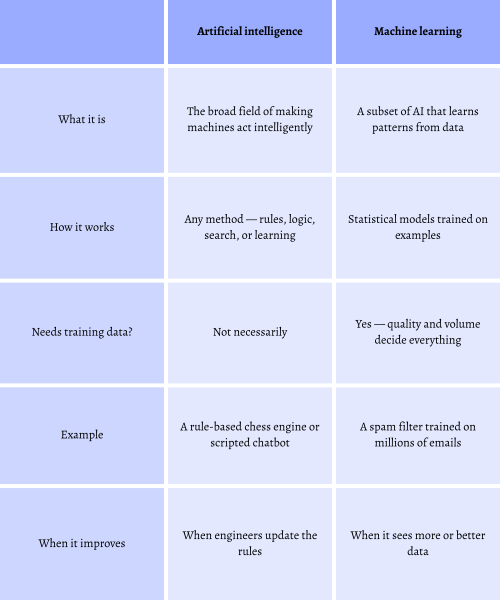
When you're evaluating artificial intelligence vs machine learning for a project, the table collapses into one question: can you write the rules down? If yes, classic AI automation may be enough. If the rules are too fuzzy to articulate — what makes a transaction "suspicious"? — that's machine learning territory.
And where do the newer terms fit in this picture?
AI vs Machine Learning vs Deep Learning vs Generative AI
Think of it as nested circles. The ai vs machine learning vs deep learning relationship goes like this: deep learning is machine learning that uses many-layered neural networks, which excel at messy, unstructured data — images, audio, and language.
Generative AI sits one circle deeper still. Instead of just classifying or predicting, it generates new content: text, images, code. ChatGPT, Claude, and Midjourney are deep learning systems trained on enormous datasets, fine-tuned to produce rather than merely recognize.
So in the generative ai vs machine learning comparison, there's no versus at all — generative AI is machine learning, of a particularly capable and particularly resource-hungry kind. The distinction that matters for your budget: traditional ML models predict within domains you define (churn scores, demand forecasts) and are cheap to run; generative models handle open-ended language and content tasks and cost meaningfully more per query.
Enough taxonomy. What does any of this look like in the wild?
Machine Learning Examples You Already Use
The machine learning examples below aren't future scenarios — they're things that happened to you this week:
-
Recommendations. Netflix, Spotify, and Amazon rank what you see using models trained on behavior like yours. Spotify's Discover Weekly is a supervised learning system wearing headphones.
-
Fraud detection. Your bank's instant "was this you?" text comes from a model scoring each transaction against your patterns in milliseconds.
-
Navigation ETAs. Google Maps and Uber predict arrival times by learning from millions of past trips, traffic flows, and even food-prep times.
-
Spam and phishing filters. Trained continuously on new attack patterns — rules alone stopped working a decade ago.
-
Medical imaging. Radiology models flag likely tumors on CT scans for review, catching cases fatigued human eyes miss.
And the artificial intelligence examples that aren't machine learning? Rule-based workflow automation, scripted IVR phone menus, and classic game engines — useful, predictable, and much cheaper to build when the rules really are knowable.
What the Difference Means for Your Business
Here's where the distinction earns its keep: it scopes your project. McKinsey's State of AI research finds that 78% of organizations now use AI in at least one business function — but the ones seeing returns matched the technique to the problem instead of buying "AI" as a monolith.
A practical sorting rule:
-
Rules are knowable and stable → classic automation. Cheapest, most predictable.
-
You need predictions from your data → traditional machine learning. Churn, demand, risk scoring, maintenance windows. This is where AI/ML development projects typically deliver the fastest measurable ROI, and where custom AI model development beats off-the-shelf when your data or domain is unusual.
-
The task involves open-ended language or content → generative AI. Powerful, and worth piloting where the economics make sense.
One honest caveat from our own engagements at Classic Informatics: the technique is rarely the blocker. Data readiness is. Models trained on fragmented, untrustworthy data produce fragmented, untrustworthy predictions — which is why an AI readiness assessment before model-building saves most teams a failed first project.
Let's Sum Up!
AI vs machine learning — or machine learning vs AI, whichever way you typed it — isn't a rivalry. It's a hierarchy. Artificial intelligence is the umbrella goal, machine learning is the data-driven method that dominates it today, deep learning powers the breakthroughs in language and vision, and generative AI is the newest, loudest resident of the innermost circle.
For you, the payoff is sharper questions. Not "should we do AI?" but "is this a rules problem, a prediction problem, or a generation problem?" Answer that, and the technology choice mostly makes itself.
We've spent years at Classic Informatics helping enterprises answer exactly that question — and building the data foundations and models that follow. If you're sorting out which of your use cases need machine learning and which just need good rules, we're happy to think it through with you.

FAQS

Frequently Asked Questions
No. Machine learning is a subset of artificial intelligence — one method of achieving it. AI covers any system performing tasks that require intelligence, including rule-based systems that never learn. Machine learning specifically means systems that learn patterns from data. All ML is AI; not all AI is ML.