Legacy System Modernization: What Works and What Doesn't

Somewhere in your application portfolio, there's a system everyone refers to in lowered voices.
The original developer left in 2018. And the documentation says "see Phil" and Phil retired last year. The code still runs payroll.
That's legacy system in a nutshell — a working system nobody fully understands, that nobody wants to touch, that the business can't live without. Gartner reckons 60 to 80 percent of most enterprises' IT budgets goes to keeping systems like this alive.
The good news: there's a way out. The bad news: most of the ways out don't work very well.
In this article, we’ll tell you exactly what does.
Key Takeaways
- Legacy system modernization isn't one project. It's a portfolio decision applied across dozens of applications, often over years.
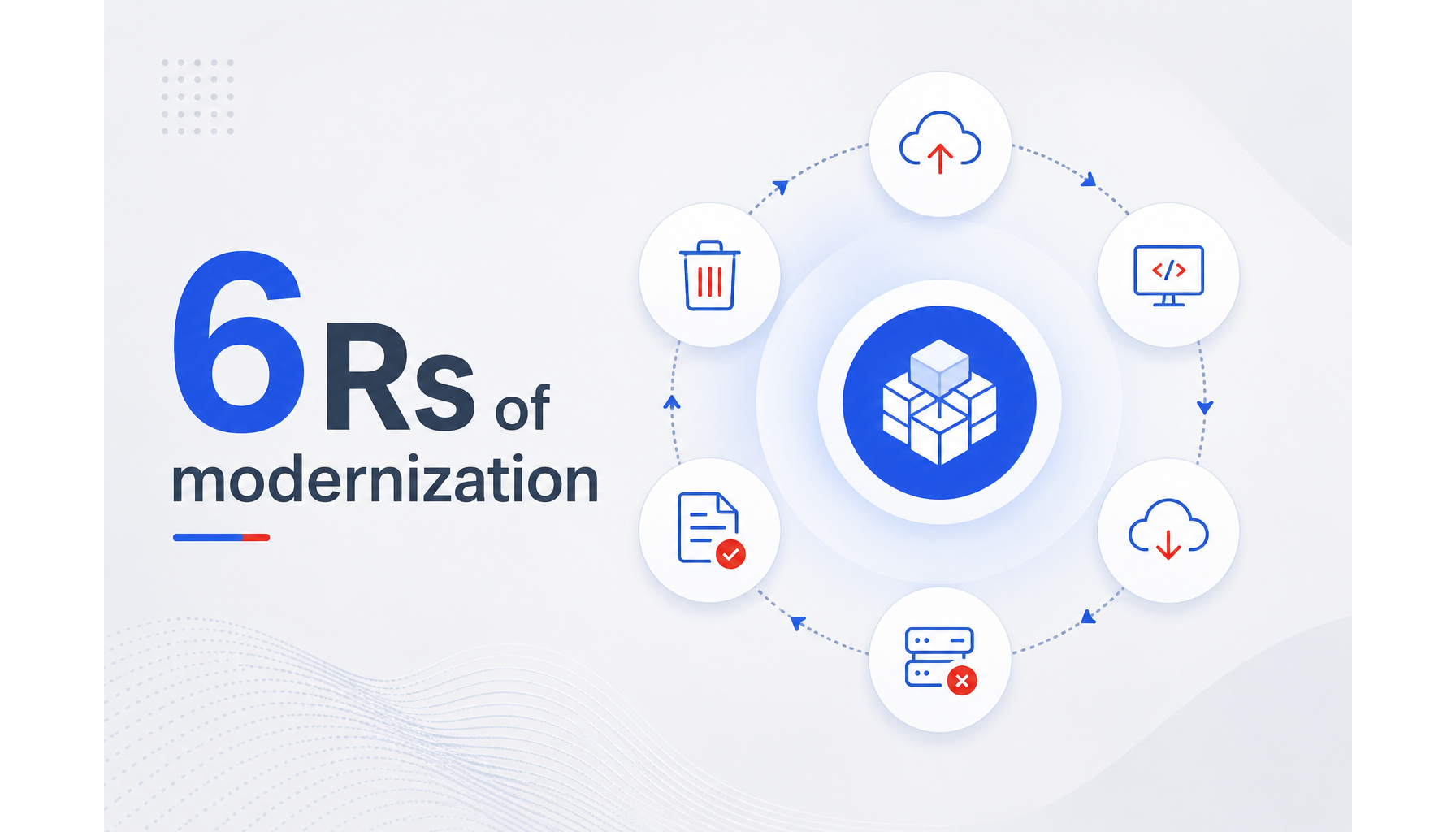
- The most common approaches — rehost, replatform, refactor, re-architect, rebuild — map cleanly to the 6 Rs framework.
- The pattern that works best: incremental modernization tied to business outcomes, not big-bang rewrites that promise transformation.
- The pitfall that kills most projects: treating modernization as a technology problem instead of a change management one.
- Successful projects share four traits: scoped phases, parallel running, embedded business owners, and willingness to retire instead of rewrite.
What Legacy System Modernization Means
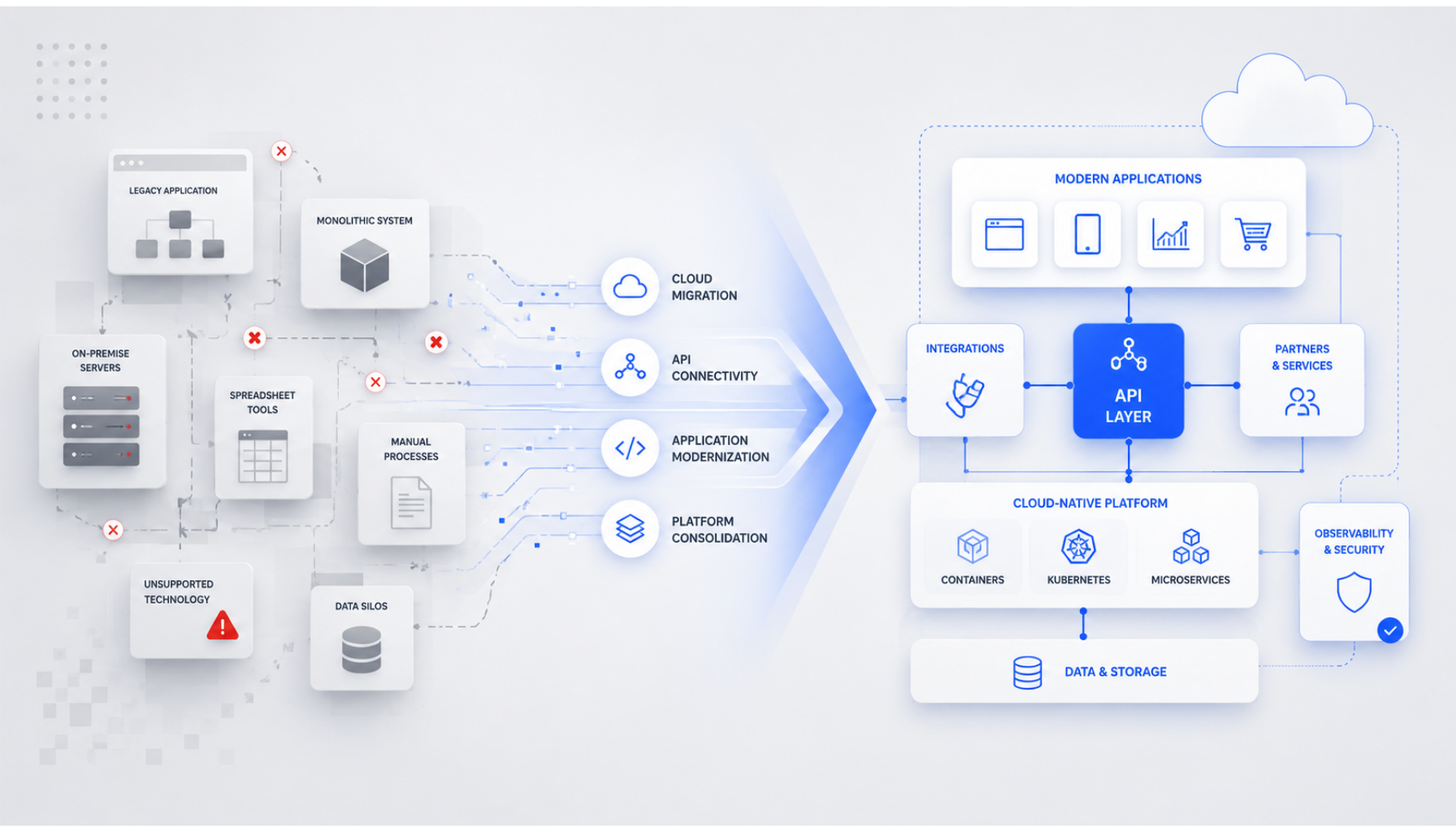
Legacy system modernization is the process of updating outdated software, infrastructure, or architectures so they meet current business, technical, and security needs.
It's one specific form of application modernization — the form that deals with the systems most enterprises wish they could pretend don't exist.
The "legacy" part is doing a lot of work in that sentence. A 1995 mainframe is legacy. So is a 2018 Node.js monolith if it can't be deployed without a senior engineer holding everyone's hand for two hours.
A useful working definition: a system becomes legacy the moment it costs more to keep running than it returns in business value, or the moment its limitations start blocking decisions you'd otherwise make.
Three signals tell you you're looking at one:
- Maintenance is eating capacity. When your engineering team spends most of its time keeping a system alive instead of building on top of it, that's legacy.
- Knowledge is leaving. The original developers have retired, moved on, or are about to. Nobody fully understands how the system actually works.
- The system is blocking strategy. You want to do something the business needs (real-time analytics, an AI feature, faster releases) and the system won't let you.
Hit any two of those and you're in modernization territory. Hit all three and the question isn't whether to modernize. It's how fast you can start.
The Approaches That Work
Most legacy system modernization approaches map to one of six options. The same framework drives most legacy system modernization strategies you'll see in 2026, from "Big Four" consultants to in-house engineering org playbooks. Here's how each one tends to land in real legacy work.
-
Rehost is the lift-and-shift move. Useful as a first step off ageing hardware, dangerous as the whole strategy. It buys you time and lower infrastructure costs, but doesn't fix structural problems. Best for non-strategic systems where you just need to get off a data centre.
-
Replatform sits in the sweet spot for most legacy systems. Move to managed cloud services, update the runtime, modernise the database without rewriting the application. Modest investment, real gain. Underused because it doesn't feel like "real modernization," but it's where 40 to 60 percent of the value usually lives.
-
Refactor and re-architect are the right choice when the system is strategic and the architecture is the actual problem. Breaking up a monolith. Moving to event-driven patterns. Introducing API layers. High effort, high value, high scope-creep risk. Only attempt this if the team has done it before, or has senior architectural leadership.
-
Replace and rebuild are last-resort options. Replace when a SaaS product can do 80 percent of what the legacy system does. Rebuild only when refactoring would cost more than starting over, and even then, expect timelines to slip by 30 to 50 percent. Most rebuilds that come in on time were scoped extremely carefully or were smaller than they looked.
-
Retire is the one approach nobody likes to recommend but everyone should consider. A typical enterprise has 15 to 30 percent of running applications that could be decommissioned without anyone noticing. Retiring is faster than modernizing and almost always cheaper.
-
Retain isn't no decision. It's the deliberate one. Some systems are working, not blocking anything, and not worth touching this year. Retain with a review date. Don't retain forever.
In practice, most legacy modernization portfolios use four or five of the six. The teams that get this right pick approach-by-application, not approach-by-portfolio.
The Patterns That Successful Projects Share
Across hundreds of legacy modernization case studies, four patterns show up in the projects that actually deliver.
1. Scoped, time-boxed phases
Big-bang modernization fails. Almost always. The biggest predictor of success is whether the project was broken into phases with hard time boxes, 3 to 6 months each, each delivering a measurable business outcome.
The best modernization phases share three traits: each one is independently valuable (you could stop after phase one and still have shipped value), each one is small enough to fit in a single budget cycle, and each one's success creates the political capital for the next.
2. Parallel running, not flip-the-switch
Successful migrations almost never go live with a "switchover." The old system keeps running while the new one is brought up alongside it. Traffic is shifted incrementally (1 percent, 10 percent, 50 percent) with the ability to roll back at every step.
This is unglamorous, slow, and expensive. It's also why successful projects ship without making the news for the wrong reasons.
3. Embedded business owners
The patterns above don't work without business ownership. Every modernization phase needs a named business owner — not just an engineering lead — who can answer "is this delivering what we promised?" in plain language.
When modernization is owned by IT alone, it gets cut at the first budget review. When it's owned jointly with the business, it survives leadership changes, funding pressure, and the inevitable scope debates.
4. Pay down technical debt during the work
The teams that do legacy system modernization well treat it as the moment to also reduce technical debt. Migration is when codebases are open, dependencies are visible, and rewrites are already happening. Paying down debt during the move costs almost nothing extra. Doing it later, after the migration is "done," is much more expensive.
The Pitfalls That Derail Most Projects
If the four patterns are what works, here's what doesn't. The list below covers the most common challenges in legacy system modernization, drawn from the failure modes that show up across hundreds of enterprise projects.
-
Treating it as a technology problem. Most legacy modernization fails on change management, not engineering. Users hate the new system. Business processes need rework. Training is treated as an afterthought. The system ships and nobody uses it. The technology part of modernization is usually the easier half.
-
Underestimating the data migration. The application is one thing. The data underneath it (schemas built up over 20 years, transformations nobody documented, downstream dependencies on specific field formats) is where most projects actually get stuck. Budget for data migration to take longer than you think. Then double it.
-
Believing the vendor's timeline. Every legacy modernization vendor will tell you they can do it in 12 months. Most can do it in 24. Some take 36 or more. Build the slippage in upfront and you'll deliver on a plan you can actually defend. Don't, and you'll be the third CTO to try this and fail.
-
Skipping the assessment. A spreadsheet listing 200 applications with "modernize / retain / retire" labels is not an assessment. A real assessment maps each system's business criticality, technical health, integration complexity, security exposure, and cost-of-doing-nothing. Without that depth, every system looks equally urgent and nothing gets prioritised. The full discipline of this work lives inside any serious application modernization strategy.
-
Refusing to retire. The biggest blocker isn't usually technology or budget. It's the manager who owns App X and doesn't want to be the one who switched it off. Strong portfolio governance solves this. Weak governance lets dead applications run forever.
Confusing "modernized" with "rebuilt." Some legacy systems just need new infrastructure and managed services around them — not a rewrite. Defaulting to rebuild is how modernization budgets blow up. The discipline of choosing the right approach per application matters more than the engineering work itself.
How to Get Started Without Stalling
The teams that successfully modernize don't start with a sweeping plan. They start with one application.
Pick something contained. Small enough to finish in a quarter, visible enough that finishing it builds confidence, similar enough to your harder problems that the lessons transfer.
Avoid the most critical system. Avoid the most political one. Pick the one that proves the model works. This is one of the most reliable legacy system modernization best practices in any playbook.
Once that's shipped, the political capital is there to take on the next. Phase two scales the pattern. Phase three makes modernization a continuous practice, not a project with an end date.
Let’s Pack Up!
Legacy system modernization isn't a project. It's a discipline.
The teams that do it well don't argue about which approach is best in the abstract. They look at each application, pick the right approach for that one, time-box the work into phases, run the old and new systems in parallel, and treat the people side as seriously as the technology. They also have the discipline to retire what shouldn't be modernized at all.
The teams that do it badly try to fix everything at once, fall in love with a single approach, treat data migration as a footnote, and end up rebuilding systems they should have retired.
If you're sitting on a portfolio of legacy systems and trying to figure out where to start, the answer is almost always: pick one. Make it succeed. Then build the model from there.
Want help modernizing your legacy system? At Classic Informatics, we help mid-to-large enterprises pick the right approach per system and ship the work in phases that actually finish. If you've got a list of legacy systems and you're not sure where to start, let's have a conversation.
 FAQS
FAQS
Frequently Asked Questions
Legacy system modernization is the process of updating outdated software, infrastructure, or architectures to meet current business and technical needs. It typically involves rehosting, replatforming, refactoring, rebuilding, or retiring older applications. The goal isn't to update everything but to apply the right approach to each system based on its strategic value and technical health.