Last updated: June 2026
Do you have a system in your stack that everyone's scared to touch?
That fear has a formal name: unmanaged technology risk. And it compounds quietly — every postponed upgrade, every workaround, every "we'll fix it next quarter" adds to a balance that eventually comes due, usually at the worst possible moment.
Technology risk management is the discipline that stops that from happening. This post covers what it is, the types of technology risk worth tracking, a five-step assessment process, and the five decisions that create most of the risk in the first place.
Key Takeaways
- Technology risk management means identifying, assessing, and reducing the risks your systems create for the business, not just for IT.
- The biggest risks are usually boring: outdated systems, untested investments, and inflexible architecture rather than dramatic cyberattacks.
- A technology risk assessment follows five steps: inventory, identify, score, treat, and monitor on a recurring cycle.
- Technical debt consumes a large share of IT value; McKinsey research puts it at a significant portion of technology estates.
- Most technology risk traces back to five avoidable decisions, which makes prevention cheaper than remediation.
What is technology risk management?
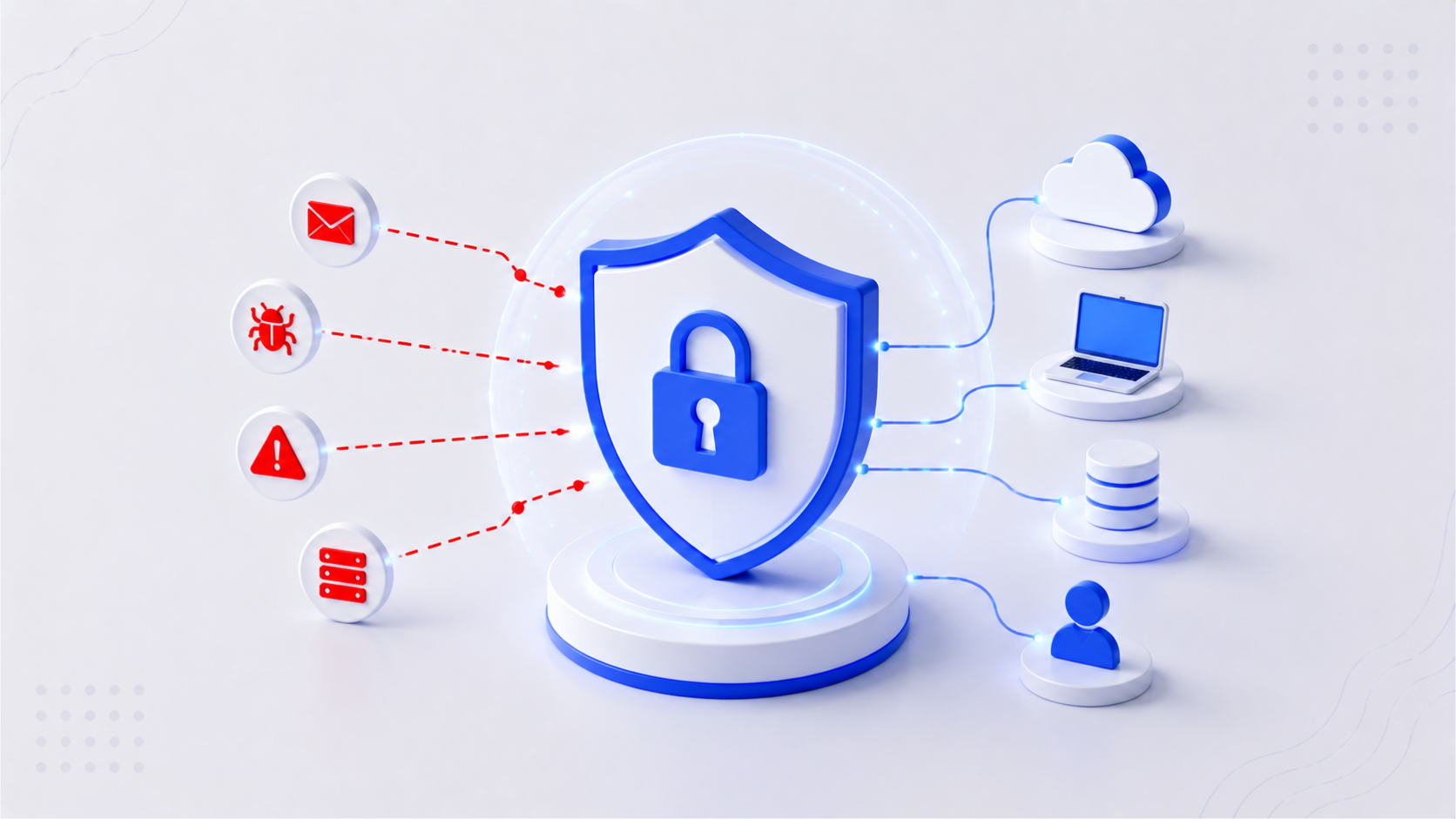
Technology risk management is the process of identifying, assessing, and reducing the risks that your technology systems pose to business operations, finances, compliance, and reputation. It treats technology failures as business problems with business costs, not as IT inconveniences.
That last part matters more than it sounds.
When a legacy system goes down for a day, nobody files the loss under "IT". It shows up as missed orders, idle teams, and customers who quietly tried a competitor. Information technology risk management exists to surface those costs before the outage does.
Frameworks like the NIST Risk Management Framework and ISO 31000 formalise the discipline for regulated industries. But the core logic works for any company: know what you run, know how it can hurt you, and fix the worst exposures first.
So what does "hurt you" actually look like?
The main types of technology risk
Technology risks fall into six broad categories. Most companies track the first one obsessively and underweight the other five:
- Security risk. Breaches, ransomware, unauthorised access. The one with headlines.
- Obsolescence risk. Systems past vendor support, frameworks nobody maintains, the platform whose last expert retires next year.
- Operational risk. Outages, data loss, failed deployments, and the single points of failure nobody documented.
- Vendor risk. A supplier sunsetting the product you built workflows on, or a licence model change that doubles your costs.
- Compliance risk. Systems that can't meet the audit trail, data residency, or privacy obligations your regulators expect.
- Strategic risk. Architecture so rigid it blocks the business from moving — the quietest risk and often the most expensive.
Here's the uncomfortable bit: five of the six get worse with age, on their own, without anyone making a mistake.
That's why McKinsey's tech debt research found technical debt amounts to a substantial share of the technology estate at most companies — value locked up in keeping ageing systems alive instead of building anything new.
How to run a technology risk assessment
A technology risk assessment is a structured review of your systems to identify what can fail, how likely it is, and what failure would cost. Run it in five steps:
1. Inventory what you actually run
List every system, who owns it, what business process depends on it, and what it talks to. Most organisations discover systems they forgot they had — and those are usually the risky ones.
2. Identify the risks per system
For each system, ask four questions: What happens to the business if this fails for a day? Is it still vendor-supported? Who's the last person who understands it? Could it pass our next audit?
3. Score by likelihood and impact
Plot every risk on a simple grid: how likely it is to materialise within 18 months, and what it would cost if it did. Resist the temptation to over-engineer this. A 3x3 grid that gets used beats a 10-factor model that doesn't.
4. Treat the top-right quadrant
High-likelihood, high-impact risks get one of four treatments: fix (modernize or replace the system), transfer (insurance, vendor SLAs), reduce (redundancy, monitoring, access controls), or accept (documented, with a named owner who re-reviews it).
5. Monitor on a cycle
Technology risk is a moving target. Quarterly reviews for critical systems, annual for the rest. Any technical risk management process that runs once and gets filed is theatre.
That's the process. But where does the risk come from in the first place?
The 5 technology decisions that create most of the risk
This blog began life a decade ago as a list of bad technology decisions, and the funny thing is — the list barely needed updating. The same five decisions still generate most technology risk today.
1. Staying on obsolete technology too long
Every system has a point where maintaining it costs more than replacing it. Past that point, you're paying premium prices for rising risk: no vendor patches, shrinking talent pools, and integrations that break with every external change.
The fix isn't panic replacement. It's a per-system legacy modernization decision — modernize, replace, or consciously retire — made before the system forces the decision for you.
2. Betting big on unproven technology
The mirror image of risk number one. Committing serious budget to a technology you haven't tested at small scale converts hope into exposure.
The discipline is simple: pilot first, with real workloads and a defined success metric, then scale what survives contact with production. Six months of watching how a technology behaves for others is rarely six months wasted.
3. Treating IT as separate from the business
When technology decisions get made without business context — or business decisions get made without technology input — risk accumulates in the gap.
The companies that manage technology risk well put it on the same agenda as financial and operational risk, reviewed by the same leadership. If your risk register has no technology entries, that's not because you don't have any.
4. Building inflexible infrastructure
You can't predict your future requirements. You can choose architecture that doesn't punish you for guessing wrong.
Rigid, monolithic, single-vendor infrastructure turns every business change into a renovation project. Flexible foundations — modular systems, open standards, sensible cloud migration — turn the same changes into configuration. The choice between SaaS vs on-premise deployment is part of the same calculation: who carries the maintenance risk, you or the vendor?
5. Treating implementation as the finish line
No technology investment is "done" at go-live. Systems need patching, monitoring, capacity planning, and humans who own them.
The riskiest systems in most stacks aren't the old ones — they're the abandoned ones: deployed, declared successful, and left unowned. Every system in your inventory needs a name beside it. No name, no accountability, no early warning.
Make risk management a habit, not a project
One pattern separates companies that handle technology risk well from those that don't: cadence.
Risk-mature teams review their technology portfolio the way finance reviews budgets — on a schedule, with owners, against numbers. Risk-immature teams review technology after incidents. Same activity, very different price.
And if your assessment surfaces a backlog of red-quadrant systems, that's not a failure. That's the honest starting point for a digital transformation plan with actual priorities, instead of one driven by whichever vendor called last.
Let's Sum Up!
Technology risk management isn't about predicting the future — it's about making sure no single failure, vendor decision, or ageing system can knock the business over. Inventory what you run, score what can hurt you, fix the worst first, and review on a cycle. And remember that most technology risk is manufactured by five avoidable decisions, which means most of it is preventable.
If your risk assessment keeps surfacing the same legacy systems in the red quadrant, that's usually where we come in. Classic Informatics has spent 23+ years helping businesses modernize the systems that keep showing up in audit findings — system by system, with the business case attached. Talk to our modernization team whenever you're ready.

FAQS

Frequently Asked Questions
Technology risk management is the process of identifying, assessing, and reducing the risks that technology systems pose to business operations, finances, compliance, and reputation. It covers security, obsolescence, operational, vendor, compliance, and strategic risks, and treats technology failures as business problems with measurable business costs.