
Key Takeaways
- A SaaS product serves many customers from one shared system. That single fact drives almost every decision in the build.
- The biggest early decision is how far you separate each customer's data. It gets expensive to change once you have customers.
- Start with an MVP that tests one thing. Skipping that step is where most SaaS budgets go wrong.
- Build security and compliance in from the start. Adding them after launch costs several times more.
- Expect three to five months for an MVP, and six to twelve months for a full build.
- Pick in-house, a partner, or a mix based on your stage. Revisit that choice every year.
Most guides to SaaS development read like a checklist: plan, build, launch, done. That's not how it actually goes.
The architecture decisions made in month one, how you isolate customer data, what gets built versus configured, whether the product is multi-tenant from day one, are the ones still shaping your infrastructure bill and your engineering roadmap three years later. Global software spending is projected to hit $1.44 trillion in 2026, growing 15.1 percent year over year, and most of that growth is going to products built on decisions nobody revisited after the first six months.
This guide walks through SaaS development as a sequence of decisions rather than a checklist. Multi-tenancy architecture and how the tenant boundary gets encoded, realistic cost bands by build stage, the team model that fits each stage, and what changes once a product has real users and needs to scale rather than just launch.
It's for the founder deciding whether to build in-house or bring in a partner, and for the engineering lead who has to make the architecture calls stick. Both decisions depend on each other more than most teams admit up front.
What Is SaaS Development?
SaaS development is the process of building software that's hosted, updated, and maintained centrally rather than installed on a customer's own servers. Customers pay a subscription fee for access, and the provider handles hosting, uptime, security patches, and feature updates. Nobody installs anything locally, and nobody manages a server to keep the product running.
That's the definition. The interesting part is what it implies architecturally.
A SaaS product almost always serves multiple customers, or tenants, from a shared codebase and often shared infrastructure. That's different from traditional, on-premise software, where a customer buys a license and runs the application on their own hardware. It's also different from a single custom-built application delivered to one client. The multi-tenant model is what makes SaaS economical at scale: one engineering team supports thousands of customers instead of maintaining thousands of separate deployments.
Most SaaS products also fall into one of two categories, and the distinction matters for how you scope the build. Horizontal SaaS serves a function (accounting, scheduling, communication) across every industry. Vertical SaaS serves one industry deeply (a scheduling tool built specifically for dental practices, say) and typically commands higher retention because the workflow fit is tighter and switching costs are higher. If your idea is industry-specific, don't force it into a horizontal shape to chase a bigger market. Narrower usually wins in SaaS.
None of this is unique to SaaS as a category. What's specific to SaaS development is that these decisions get made once, early, and are expensive to unmake. That's the subject of the next section.
SaaS Architecture and Multi-Tenancy Models
The single architecture decision that costs the most to reverse later is how you isolate tenant data. Get this wrong and you're not refactoring a feature. You're rebuilding the foundation while customers are actively using the product on top of it.
There are three tenancy models, and each trades isolation for cost differently.
| Tenancy model | Isolation level | Typical infra cost per tenant | Added build time vs pool | Best for |
|---|---|---|---|---|
| Silo | Highest: dedicated database and stack per tenant | Highest, scales roughly linearly with tenant count | 4–8 weeks | Regulated industries, enterprise contracts requiring dedicated environments |
| Pool | Lowest: shared database, logical separation only | Lowest, near-flat as tenants grow | Baseline | Early-stage products, high tenant volume, thin margins per customer |
| Bridge | Mixed: shared compute, isolated data per tenant | Moderate, grows with storage rather than compute | 3–6 weeks | Products serving a mix of SMB and enterprise customers on one platform |
Note: the silo, pool, and bridge naming follows the AWS Well-Architected SaaS Lens isolation taxonomy. Other providers describe the same three shapes with different labels, and plenty of real products run different models in different layers rather than picking one. The build-time figures are Classic Informatics estimates from our own engagements, not published benchmarks.
Silo Model: Dedicated Database Per Tenant
Each tenant gets a dedicated database, and sometimes a fully separate application stack. This is the clearest security story you can tell an enterprise buyer, and it's the simplest to reason about during an audit.
Where it makes sense: healthcare, financial services, government, or any buyer that contractually requires dedicated infrastructure.
What to watch for: the model doesn't scale operationally past a certain tenant count without heavy automation. Manually managing hundreds of near-identical stacks is its own engineering burden.
Decision signal: if your buyer's procurement process asks whether another customer's data ever touches shared infrastructure, silo is close to mandatory. If nobody asks that question, it's probably overkill for where you are.
Pool Model: Shared Database, Logical Separation
Every tenant shares the same database and application instance, with isolation enforced entirely in the application layer, typically a tenant ID on every row. This is the cheapest model to run and the fastest to onboard new customers into.
Where it makes sense: early-stage products validating demand, or any product where per-tenant margins are thin enough that dedicated infrastructure isn't viable.
What to watch for: a tenant ID stored only as a database column is a fragile isolation boundary. One incorrect query can return another tenant's data, and the AWS Well-Architected SaaS Lens treats tenant isolation as a foundational requirement precisely because that failure mode is common and expensive when it happens.
Decision signal: if you're pre-product-market fit and every customer is on a similar plan, pool buys you speed. If even one prospective customer needs contractual data isolation, don't force them onto a pooled model to save engineering time now.
Bridge Model: Shared Compute, Isolated Data
A hybrid: shared compute and application layer, but tenant data is isolated at the storage layer rather than fully pooled or fully siloed. It's more engineering work up front than pool, and cheaper to operate at scale than silo.
Where it makes sense: products that need to serve both self-serve SMB customers and larger accounts with tighter compliance requirements, on one platform.
What to watch for: the added complexity shows up in your identity layer. Tenant context has to be enforced consistently across every service, not bolted on wherever it's convenient.
Decision signal: if your pricing tiers already imply different isolation guarantees (an enterprise tier that promises dedicated resources, a starter tier that doesn't), bridge is usually the right shape rather than running two entirely separate systems.
In our experience, the identity layer is where this decision gets hard to reverse, not the database. If tenant context lives in a shared authentication middleware from day one, changing the isolation model later is a configuration change. If it was inferred from a subdomain here and read from a header there, retrofitting a unified model means touching every request path in the system.
When Classic Informatics built a multi-tenant SaaS vulnerability management platform for a UK cybersecurity provider, the platform had to serve that provider's own network of managed service providers, each running centralised vulnerability and penetration testing management for their own clients. A tenant hierarchy like that puts the isolation question at the centre of the design rather than at the edge of it, because the platform has to hold a boundary between MSPs while still functioning as one product.
Beyond tenancy, the tech stack itself matters less than most first-time builders assume. React, Vue, and Angular on the front end, and Node, Django, or Laravel on the back end, are all defensible choices with mature ecosystems. What matters more is picking a stack your team already knows well over one that's marginally trendier, since SaaS UX design and engineering velocity both suffer when a team is learning a framework and building a product at the same time.
Build, Buy, or Customize: Where to Start
Off-the-shelf tools stop working the moment your workflow becomes the product, not a feature bolted onto someone else's platform.
That's the honest test for whether you need custom SaaS development at all. A surprising number of businesses that think they need a custom build actually need a well-configured combination of existing tools: a CRM, a workflow automation platform, and some middleware gluing them together. That's cheaper, faster, and lower-risk than a custom build, and it's worth saying plainly even though it's not the answer that leads to an engineering engagement.
The case for custom development gets stronger as three things become true at once: your workflow is genuinely differentiated (not just differently branded), your data model doesn't fit cleanly into existing tools' schemas, and the workflow itself is the product you intend to sell, not an internal process you're trying to make more efficient.
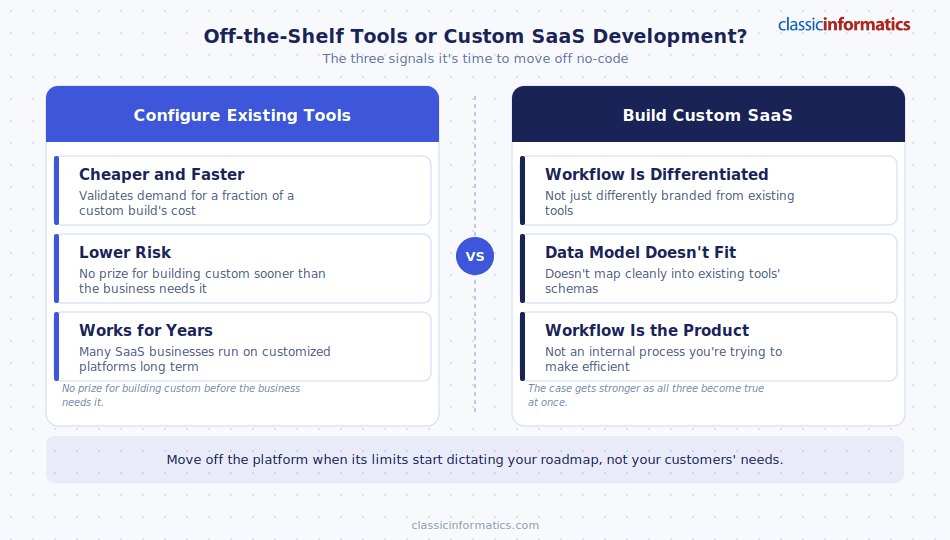
Worth steelmanning the other side here. Plenty of successful SaaS businesses run on customized off-the-shelf platforms for years before any custom development, and there's no prize for building custom sooner than the business needs it. A no-code or low-code platform can validate demand for a fraction of a custom build's cost, and the honest advice is to stay on one for as long as it holds.
The signal that it's time to move off one isn't a feature request. It's when the platform's limitations start dictating your product roadmap instead of your customers' needs.
The SaaS Development Lifecycle, From MVP to Full Build
An MVP's job isn't to be a smaller version of the final product. It's to answer one question as cheaply as possible: will someone pay for this.
That reframe matters because most SaaS builds that go over budget didn't fail at execution. They failed at scope, building toward a full vision instead of the narrowest version that tests the core assumption. The SaaS development lifecycle runs through a few distinct stages, and treating them as genuinely separate decisions, rather than one continuous build, is what keeps early costs down.
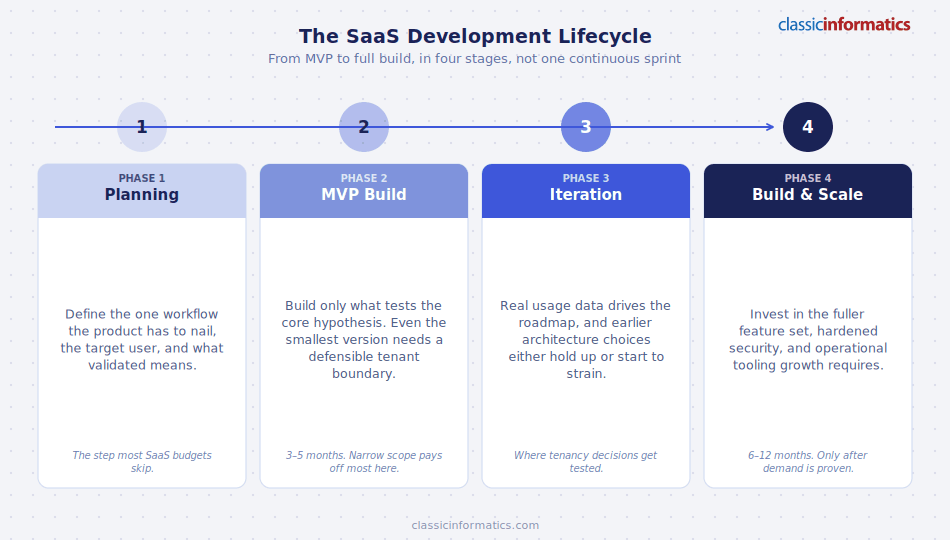
Planning. Define the one workflow the product has to nail, the target user, and what "validated" actually means before writing a line of code. Skipping this step is the single most common reason MVP scope creeps.
MVP build. Build only the features required to test the core hypothesis with real users. SaaS MVP development differs from a generic minimum viable product in one specific way: even the smallest version still needs a defensible tenant boundary, because you can't test a multi-tenant product with a single-tenant prototype. This is the stage where a narrow scope pays off most. A three-month MVP that proves demand is worth more than a nine-month build that launches to silence.
Iteration. Once real usage data exists, the roadmap should follow it. This is also the stage where the tenancy and architecture decisions from earlier either hold up or start showing strain, which is exactly why they're worth getting right before this point rather than during it.
Full build and scale. Only once the MVP has demonstrated real demand does it make sense to invest in the fuller feature set, hardened security posture, and operational tooling a growing customer base requires.
A narrowly scoped MVP is almost always the faster and cheaper path to a real answer, not a compromise on the way to one. Teams that skip straight to a full build because they're confident in the idea tend to discover the same lessons an MVP would have surfaced, just at three to five times the cost.
These four stages are the shape of the lifecycle, not the instructions for running it. The step-by-step version, what to build in which order and what to defer, is covered separately in how to build a SaaS product. This guide stays on the decisions that sit underneath those steps.
Building the Team: In-House, Partner-Led, or Blended
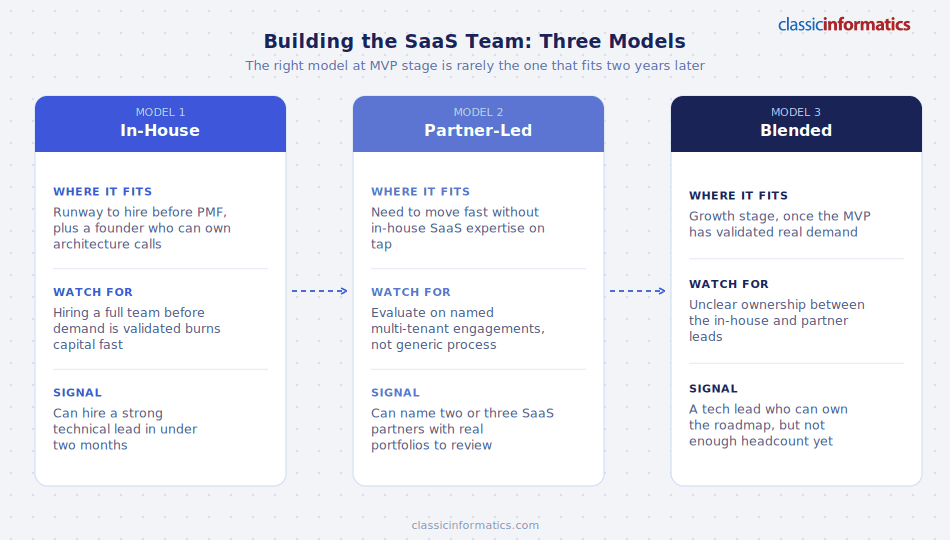
The team model that's right at MVP stage is rarely the one that's right two years later.
At MVP stage, speed and low fixed cost usually matter more than anything else. That argues for either a small in-house team if you already have the technical co-founder to lead it, or a focused engagement with an outside SaaS development consulting partner who has actually shipped multi-tenant products before, rather than a generalist shop learning SaaS patterns on your budget.
In-House SaaS Development Team
Full control over priorities and institutional knowledge that stays inside the company.
Where it makes sense: you have runway to hire before you have product-market fit, and the founding team includes someone who can make architecture calls without external validation.
What to watch for: hiring a full team before validating demand is one of the more common ways early capital gets burned.
Decision signal: if you can hire a strong technical lead in under two months and fund a small team for at least a year, in-house is workable at MVP stage. If hiring is going to take longer than the MVP build itself, it's the wrong sequencing.
Partner-Led SaaS Development
A SaaS development company brings the multi-tenant architecture patterns and SaaS-specific experience that a first-time build often lacks, and can move faster because the team has done this before. Most SaaS outsourcing decisions are really scoping decisions in disguise: what you hand over matters more than who you hand it to.
Where it makes sense: you need to move quickly, you don't yet have in-house SaaS expertise, or you want architecture decisions reviewed by people who've seen where they go wrong before.
What to watch for: evaluate a partner on named SaaS engagements and how they talk about tenancy and scaling, not on generic project management process. Ask directly how they approach the build-versus-buy question. If every answer is "we'll build it custom," that's a signal worth noting.
Decision signal: if you can describe two or three SaaS product development companies with real multi-tenant SaaS portfolios and can review their architecture decisions in a discovery call, a partner engagement is a reasonable starting point. Look specifically for a team that treats SaaS application development as its own discipline rather than a variation on generic web development, since the tenancy and compliance decisions earlier in this guide are exactly where generalist teams tend to underestimate the work.
Blended In-House and Partner Teams
A core in-house team (often just a technical lead and product owner) paired with a partner team handling the build.
Where it makes sense: growth stage, once the MVP has validated demand and the roadmap needs both speed and long-term institutional continuity.
What to watch for: unclear ownership between the in-house lead and the partner team's technical lead is the most common failure mode here. Define who owns architecture decisions before the engagement starts, not partway through it.
Decision signal: if you have a technical lead who can own architecture and roadmap but don't yet have the headcount to execute at the speed the market demands, blended is usually the right shape.
None of this is really about doing the work in-house or handing it to a partner. It's about matching team structure to what the product actually needs at its current stage, and revisiting that match at least once a year.
SaaS Security and Compliance Requirements
A compliance audit requested six months post-launch is far more expensive than the same controls designed in from the start.
That's not a scare tactic. It's a sequencing problem. Retrofitting audit logging, encryption key management, and access controls into a system that wasn't built with them in mind means touching code paths across the entire application, not adding a module. Building them in from the first sprint costs a fraction as much and rarely delays a launch by more than a few weeks.
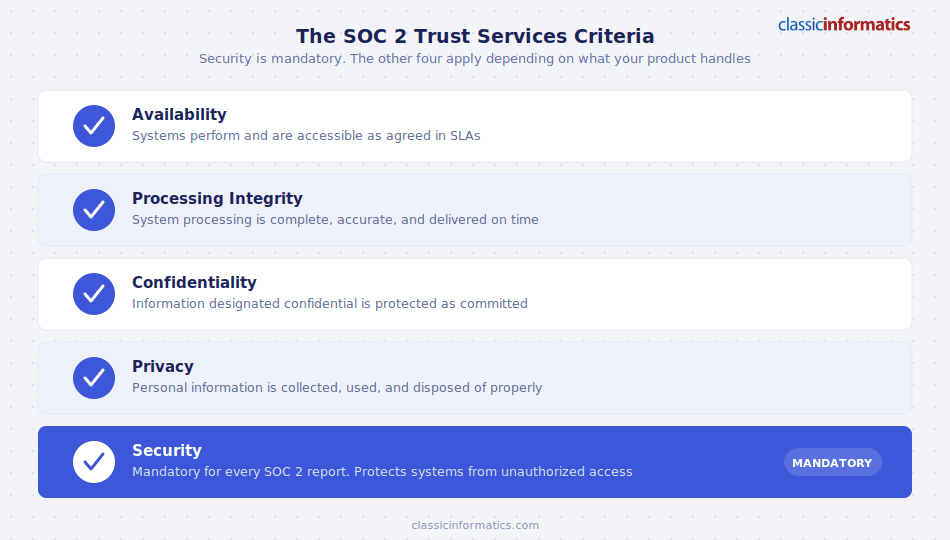
The starting point for most B2B SaaS products is SOC 2, the AICPA's Trust Services Criteria framework covering security, availability, processing integrity, confidentiality, and privacy. Security is the only mandatory category. The other four apply depending on what data your product handles and what your customers' procurement teams require.
Two industries add requirements on top of that baseline, and it's worth knowing which one applies before architecture decisions get locked in. SaaS for healthcare products handling patient data need HIPAA-aligned controls layered onto the base SOC 2 posture, which typically pushes the tenancy decision toward silo or bridge rather than pool. SaaS for fintech products handling payment or financial data face PCI-DSS requirements and, depending on jurisdiction, additional regulatory reporting obligations that shape both the data model and the audit trail from day one.
The practical takeaway is the same regardless of vertical: decide which compliance framework applies before the tenancy model is finalized, not after. The two decisions are connected, and making them in the wrong order is how teams end up rebuilding.
How AI Is Changing SaaS Build Decisions in 2026
Some categories that needed a full engineering team in 2023 are now a configuration decision inside an existing platform.
That's a real shift, not a talking point. Gartner's research on agentic AI puts up to $234 billion of enterprise application SaaS spending at risk of disruption from agentic AI by 2030, as AI agents complete tasks across systems directly, reducing the need for the traditional, interface-heavy SaaS product sitting in between.
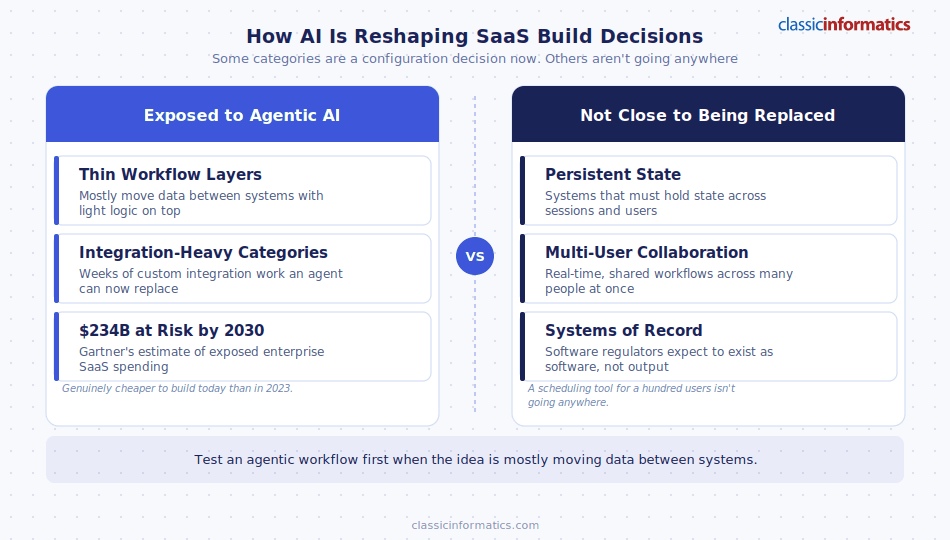
It's worth taking the counter-position seriously rather than dismissing it. Plenty of SaaS categories are not close to being replaced by an agent: anything requiring persistent state, multi-user collaboration, or a system of record that regulators expect to exist as software, not as an agent's ephemeral output. A scheduling tool used by a hundred people across a dental practice chain isn't going anywhere just because an AI agent can draft an email.
What is changing is the calculus for a specific category of SaaS idea: thin workflow layers that mostly move data between two systems and apply light business logic on top. That category is genuinely cheaper to build today, since an AI agent with the right tool access can often replace what used to require weeks of custom integration work. If your SaaS idea is closer to "connect system A to system B with some rules in between" than to "own a genuinely new data model," it's worth testing whether an agentic workflow gets you most of the way there before committing to a full custom build.
This also reshapes what "custom SaaS development" means in practice. A growing share of new products approach building an AI-first SaaS product from the outset rather than bolting AI features onto an existing product later, which is a materially different set of architecture decisions from the ones this guide's earlier sections describe for a traditional build.
Three Ways SaaS Builds Go Wrong
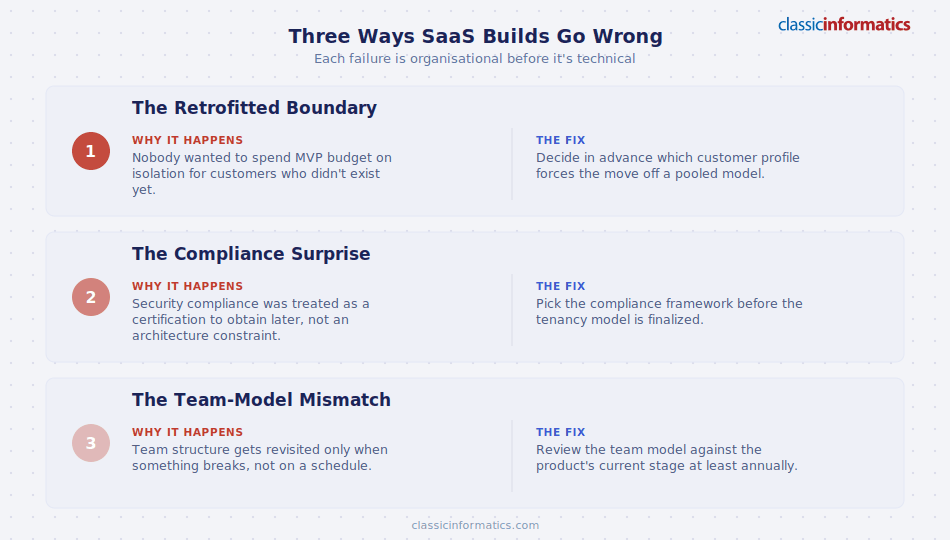
Most SaaS builds that fail don't fail at coding. They fail in one of three recognisable ways, and each one is organisational before it's technical.
The Retrofitted Boundary
A product ships on a pooled model with tenant IDs enforced in application code, then signs a customer whose procurement team requires contractual data isolation. The fix touches every query path in the system.
Why it happens: nobody wanted to spend MVP budget on an isolation model for customers who didn't exist yet, which is a reasonable decision made without a trigger point attached to it.
How to fix it: decide in advance which customer profile forces the move off pool, and treat that first enterprise conversation as the trigger rather than a nice problem to have.
The Compliance Surprise
Six months post-launch, a deal stalls because the buyer wants a SOC 2 report the product was never built to support. Audit logging, key management, and access controls all get retrofitted at once, under deal pressure.
Why it happens: the founding team treated SaaS security compliance as a certification to obtain later rather than an architecture constraint to design around.
How to fix it: pick the framework before the tenancy model is final, per the security section above. The controls cost far less designed in than bolted on.
The Team-Model Mismatch
The SaaS development team that built the MVP is still structured the same way eighteen months later, while the product now needs platform work, a support function, and a roadmap that outlives any one contract.
Why it happens: team structure gets revisited when something breaks, not on a schedule.
How to fix it: review the model against the product's current stage at least annually, using the decision signals in the team section rather than headcount as the trigger.
What SaaS Development Costs at Each Stage
SaaS cost estimates that ignore build stage are close to meaningless. An MVP and a scaled platform aren't the same cost question, and quoting one number across both stages is how budgets go wrong before a line of code gets written.
The ranges below are drawn from the product engagements Classic Informatics has delivered rather than from published market data, and they're deliberately wide. Treat them as a starting bracket for a conversation, not a quote.
| Stage | Typical timeline | Cost range | What drives the range |
|---|---|---|---|
| MVP | 3–5 months | $40,000–$90,000 | Core feature count, tenancy model chosen, team location |
| Full build | 6–12 months | $100,000–$300,000+ | Feature depth, integrations, compliance requirements |
| Scale-stage additions | Ongoing | $15,000–$60,000 per quarter | New tenant tiers, performance work, expanded integrations |
The single biggest lever inside any of these ranges is scope discipline, not team rate. A tightly scoped MVP built by a mid-cost team routinely lands cheaper than a loosely scoped MVP built by a discount team, because scope creep costs more in rework than a modest difference in hourly rate ever does.
Compliance requirements move the number more than most first-time founders expect. A SOC 2-ready architecture, built in from the start per the previous section, typically adds a modest amount to MVP timeline and cost. Retrofitting the same controls after launch routinely costs several times more and risks a customer-facing security incident in the gap. This is the same sequencing argument from the security section, showing up again as a line item.
For a full breakdown of what shapes SaaS development cost at a more granular level, including per-role cost estimates and how team location affects the total, that's covered in depth in the dedicated guide.
From Launch to Scale: Retention, Iteration, Growth
Launch is the point where the cheapest mistakes become the most visible ones.
Everything that felt like a minor shortcut during the MVP build (a pooled architecture that was fine at fifty tenants, a manual onboarding process that worked at ten customers) starts to strain the moment growth actually happens. The good news is that this is a known pattern, not a surprise every SaaS team has to discover independently.
The metric that matters most after launch isn't new customer acquisition. It's net revenue retention: how much revenue you keep and grow from existing customers, independent of new sales. McKinsey's analysis of more than 100 B2B SaaS companies found that top-quartile performers on net revenue retention traded at a median enterprise-value-to-revenue multiple of 24x, compared with 5x for bottom-quartile peers. That gap exists because a product that expands within its existing customer base is proving something a growth chart built entirely on new logos can't: that the core workflow is sticky enough to keep earning its subscription.
Getting there means treating post-launch work as its own discipline, not something that wraps up once launch is behind you. The teams that scale well tend to do three things consistently: they instrument the product to see which features drive retention rather than guessing, they price and package in a way that gives customers a natural path to expand rather than a flat fee with no upside, and they revisit the architecture decisions from the first sections of this guide once real usage patterns emerge, rather than assuming the original tenancy model will hold indefinitely.
None of that happens automatically. It happens because the team treats scale as a deliberate second phase of the build, with its own priorities, rather than an extension of the launch sprint.
SaaS Development Decisions at a Glance
Every decision in this guide, collapsed to one line each, in the order you'll face them:
- Choose pool when speed matters most and no customer contractually requires isolation.
- Choose silo when a buyer's procurement process asks where their data physically sits.
- Choose bridge when one platform has to serve both self-serve and enterprise tiers.
- Build custom when the workflow is the product, not when the tooling is merely annoying.
- Scope the MVP to one question, not one smaller version of the full vision.
- Pick the compliance framework before the tenancy model, never after.
- Go in-house when you can hire a technical lead faster than you can build.
- Go partner-led when the architecture patterns matter more than institutional continuity.
- Test an agentic workflow first when the idea is mostly moving data between systems.
- Measure net revenue retention after launch, not new logo count.
Let's Sum Up!
SaaS development isn't one decision. It's a sequence: how you isolate tenant data, whether to build custom or configure existing tools, what team model fits the current stage, and how security gets designed in rather than bolted on. Get the early ones right and the later ones get easier. Get them wrong and every subsequent stage costs more to fix than it would have cost to build correctly the first time.
Agentic AI is changing what counts as worth building custom, and that shift is still unfolding through 2026 and beyond. The fundamentals in this guide, tenancy, sequencing, security-by-design, team fit, don't change with it. They're the part of SaaS development that stays true regardless of which tools get cheaper next.
Classic Informatics has built multi-tenant SaaS platforms across cybersecurity, healthcare, and financial services, including the architecture decisions this guide walks through from the inside of a real engagement. If you're weighing a custom SaaS build against your other options, including whether SaaS vs on-premise is even the right frame for your product, that's a conversation worth having before the architecture gets locked in, not after.
Frequently asked questions
What's the difference between single-tenant and multi-tenant SaaS architecture?
Single-tenant, or silo, architecture gives each customer a dedicated database and sometimes a dedicated application stack, maximising isolation at higher infrastructure cost. Multi-tenant, or pool, architecture has all customers share the same database and instance, isolated logically rather than physically. Most products land on a bridge model between the two, isolating data per tenant while sharing compute, because it serves both SMB and enterprise tiers on one platform.
How long does it take to build a SaaS product?
A tightly scoped MVP typically takes three to five months. A full-featured build with integrations and compliance requirements usually takes six to twelve months. The range depends far more on scope discipline than on team size: a narrowly defined MVP that tests one hypothesis moves faster than a loosely scoped one, regardless of how many engineers are assigned to it or what they cost per hour.
How much does SaaS development cost?
An MVP typically runs $40,000 to $90,000 over three to five months. A full build runs $100,000 to $300,000 or more depending on feature depth and compliance requirements. Scope discipline moves the number more than team rate does, since rework caused by an unclear MVP scope usually costs more than a modest difference in hourly rate ever saves. These are Classic Informatics estimates, not market benchmarks.
Should I bring in a development partner or build SaaS in-house?
It depends on stage. In-house works well once you have a technical lead who can make architecture calls and the runway to fund a team before product-market fit. A development partner suits teams that need SaaS-specific experience and faster time to market. Many products land on a blended model at growth stage, once an in-house lead can own the roadmap but headcount can't yet deliver it.
What security standards does a SaaS product need?
Most B2B SaaS products target SOC 2, built on the AICPA's Trust Services Criteria, with security as the only mandatory category. Healthcare products add HIPAA-aligned controls, and fintech products add PCI-DSS plus jurisdiction-specific reporting obligations. Designing these controls into the architecture from the first sprint costs far less than retrofitting them after launch, when a stalled deal is usually what forces the work.
Is AI making it easier to build a SaaS product?
For some categories, yes. Thin workflow layers that mostly move data between systems are increasingly replaceable by agentic AI configurations rather than custom code, and Gartner estimates up to $234 billion in enterprise SaaS spending is exposed to this shift by 2030. Products built on a genuinely differentiated data model, or requiring persistent multi-user state, are far less affected.
What are the top 5 SaaS companies?
By revenue, the largest SaaS businesses are typically Microsoft, Salesforce, Adobe, Oracle, and SAP, though rankings shift depending on whether you count total company revenue or cloud subscription revenue alone. For anyone building a product, the more useful comparison set is usually the vertical competitors in your own category, since their pricing and feature depth tell you far more than the horizontal giants do.