Business Analytics: The Essentials Of Data-Driven Decisions

Last Updated: June 2026
Your company already collects more data than it uses. Most do. The gap between "we have the data" and "we made a better decision because of it" is exactly what business analytics exists to close.
But the term gets thrown around loosely — sometimes meaning dashboards, sometimes data science, sometimes a degree program. So let's pin it down, walk through the four types of business analytics, and look at real examples of what it changes in practice.
Key Takeaways
- Business analytics is the practice of turning data into decisions — not collecting data, not building dashboards, deciding.
- The four types — descriptive, diagnostic, predictive, and prescriptive — answer what happened, why, what's next, and what to do.
- Analytics pays off by function: pricing, churn, demand forecasting, and customer feedback are the fastest-return starting points.
- Tools don't create data driven decision making; trustworthy data and clear business questions do.
- Start with one decision you make repeatedly, instrument it, and expand — not with a platform purchase.
What Is Business Analytics?
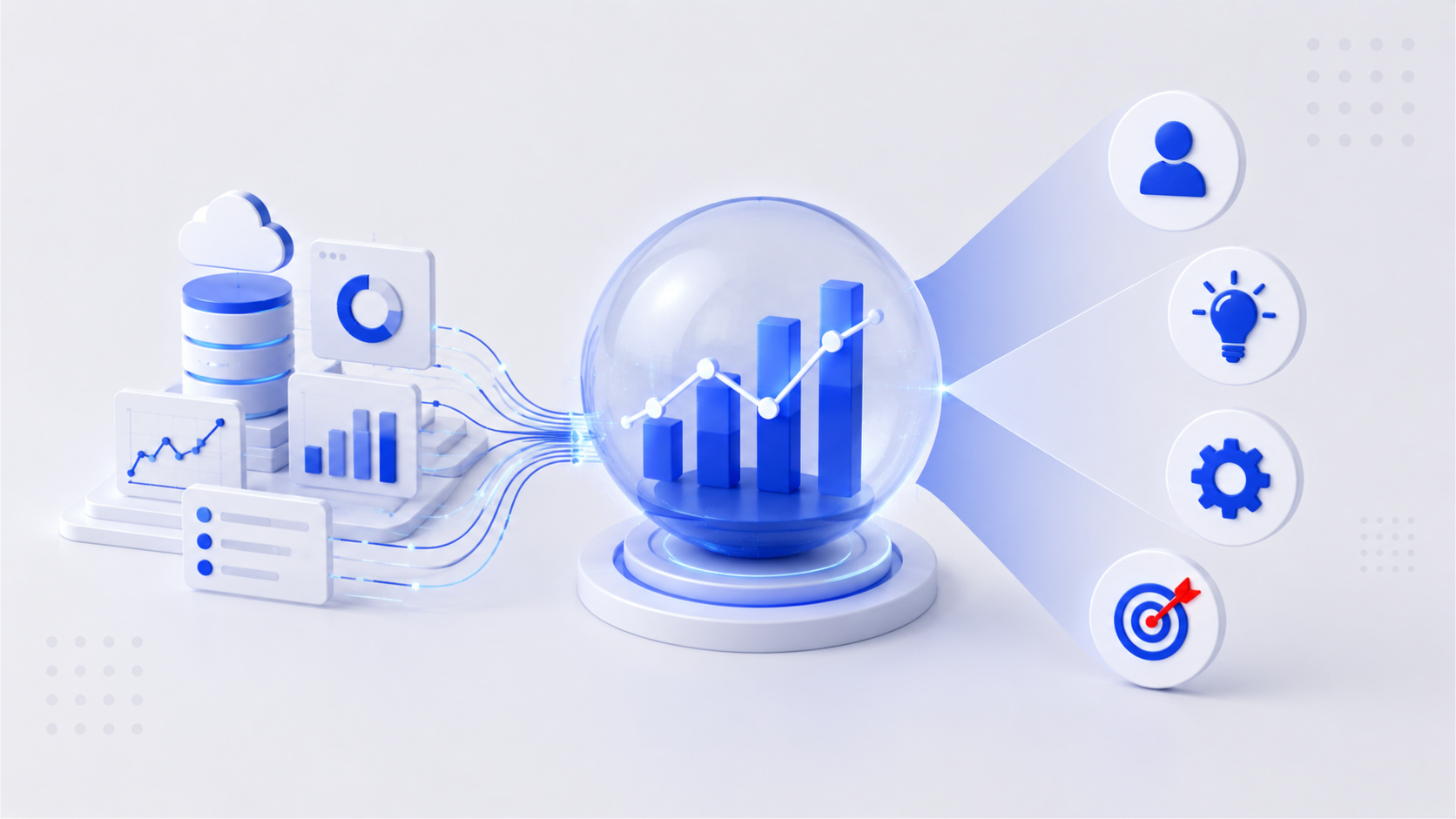
Business analytics is the process of using data, statistical methods, and increasingly AI to answer business questions and drive decisions. That's the whole definition. Everything else — warehouses, dashboards, models — is plumbing in service of better decisions.
It helps to separate it from its neighbors, because the terms blur:
-
Business intelligence and analytics overlap, but business intelligence reports on what's happening (dashboards, scheduled reports), while business analytics asks why and what to do next.
-
Business data analytics is sometimes used interchangeably — same discipline, with emphasis on the data engineering underneath.
-
Data science builds the custom models and experiments; business analytics applies them to operational decisions.
Does the distinction matter in practice? Yes — because companies that stop at business intelligence get rearview mirrors. The value compounds when you move up the chain. McKinsey research found that organizations using customer analytics extensively are 23 times more likely to outperform competitors at acquiring customers.
So what does "moving up the chain" actually look like?
The Four Types of Business Analytics
The four types of business analytics form a ladder. Each answers a harder question than the one before it, and each builds on the data discipline of the previous step.
1. Descriptive analytics — what happened?
Descriptive analytics summarizes historical data: revenue by quarter, churn by cohort, downtime by line. It's the foundation everything else stands on. If your descriptive numbers aren't trusted ("the dashboard says something different every time"), nothing above this layer will be either.
2. Diagnostic analytics — why did it happen?
Diagnostic analytics digs into root causes. Sales dropped 12% — was it one region, one product, one channel? This is where analysts earn their keep, connecting datasets that weren't designed to talk to each other.
3. Predictive analytics — what will happen?
Predictive analytics uses historical patterns to forecast outcomes: which customers will churn, which machines will fail, what demand looks like next quarter. Machine learning lives mostly here.
4. Prescriptive analytics — what should we do?
Prescriptive analytics recommends actions: reorder this much stock, offer this discount to this segment, schedule maintenance Tuesday. It's the most valuable layer and the most dependent on everything below it being right.
Here's the thing — most companies aren't blocked at prescriptive. They're blocked at descriptive, because the underlying data can't be trusted yet. (More on that in a minute.)
Business Analytics Examples by Function
What do business analytics examples look like outside a textbook? Pick a function and there's a decision being made better:
-
Pricing and revenue. Retailers run price-elasticity models to set markdowns by store and week instead of nationally — diagnostic plus prescriptive analytics working together.
-
Customer retention. SaaS teams score churn risk from product usage and support signals, then trigger interventions before the renewal date, not after.
-
Operations and supply chain. Manufacturers forecast demand and component lead times to cut inventory carrying costs without stockouts.
-
Customer experience. Feedback platforms like Zonka Feedback — an AI-powered customer feedback and survey platform built by Classic Informatics — turn survey responses and CX signals into analytics teams can act on, closing the loop between what customers say and what the business changes.
-
Finance. Rolling forecasts replace static annual budgets, re-predicting cash position as actuals land.
Notice what these share: a recurring decision, a measurable outcome, and data that already exists. That's the template.
How Business Analytics Drives Data Driven Decision Making
Data driven decision making is the discipline of basing recurring decisions on evidence rather than instinct — and analytics is its engine. The loop looks like this:
-
Define the decision. Not "understand our customers" — "decide which accounts get a renewal call this month."
-
Identify the data that informs it. Usage data, support tickets, payment history. Audit what exists before collecting anything new.
-
Analyze and model. Start with descriptive baselines; add predictive scoring only once the basics are trusted.
-
Act and measure. A decision that doesn't change behavior is a report. Track whether the analytics-informed choice beat the old default.
-
Refine. Feed outcomes back into the model. This is where the compounding happens.
The honest caveat: none of this works on a shaky foundation. If your data is fragmented across systems that disagree with each other, fix that first — that's a data strategy problem, and pretending otherwise is how analytics initiatives stall. The same goes for ownership and quality rules, which is what a data governance framework is for.
What About Business Analytics Software?
Business analytics software matters less than vendors want you to believe — and the right choice depends on where you are, not which logo is trendiest.
A realistic way to think about the landscape:
-
BI and visualization tools (Power BI, Tableau, Looker) for descriptive and diagnostic work. Most companies start, and many should stay, here.
-
Cloud data platforms (Snowflake, Databricks, BigQuery) as the engine underneath once data volume and team size outgrow spreadsheets-plus-dashboards.
-
AI-assisted analytics, now built into most major platforms, letting business users ask questions in plain language — useful, but only as trustworthy as the data underneath.
The selection criteria that actually matter: does it connect to your existing systems, can your team realistically use it without a six-month enablement project, and does it scale with your data rather than your vendor's pricing imagination?
Tools are the easy part. The hard part is the data foundation and the operating habit — which is exactly where business intelligence consulting earns its fee: not picking software, but sequencing the foundation, the metrics, and the adoption so the software gets used.
Let's Sum Up!
Business analytics isn't a platform you buy or a team you hire. It's the practice of making your recurring decisions answerable to evidence — descriptive analytics to know what happened, diagnostic to know why, predictive to see ahead, and prescriptive analytics to choose the next action.
Start small and concrete: one decision, one dataset, one measurable outcome. Then expand.
We've helped enterprises across manufacturing, healthcare, and SaaS build exactly that progression at Classic Informatics — from untangling the data foundation to standing up analytics that teams actually trust. If you're somewhere on that ladder and the next rung looks fuzzy, we're happy to take a look with you.
 FAQS
FAQS
Frequently Asked Questions
Business analytics is using your company's data to make better decisions. It covers summarizing what happened (descriptive), explaining why (diagnostic), forecasting what's next (predictive), and recommending actions (prescriptive). The goal is always a decision — not a dashboard, a report, or a model for its own sake.