Last Updated: June 2026
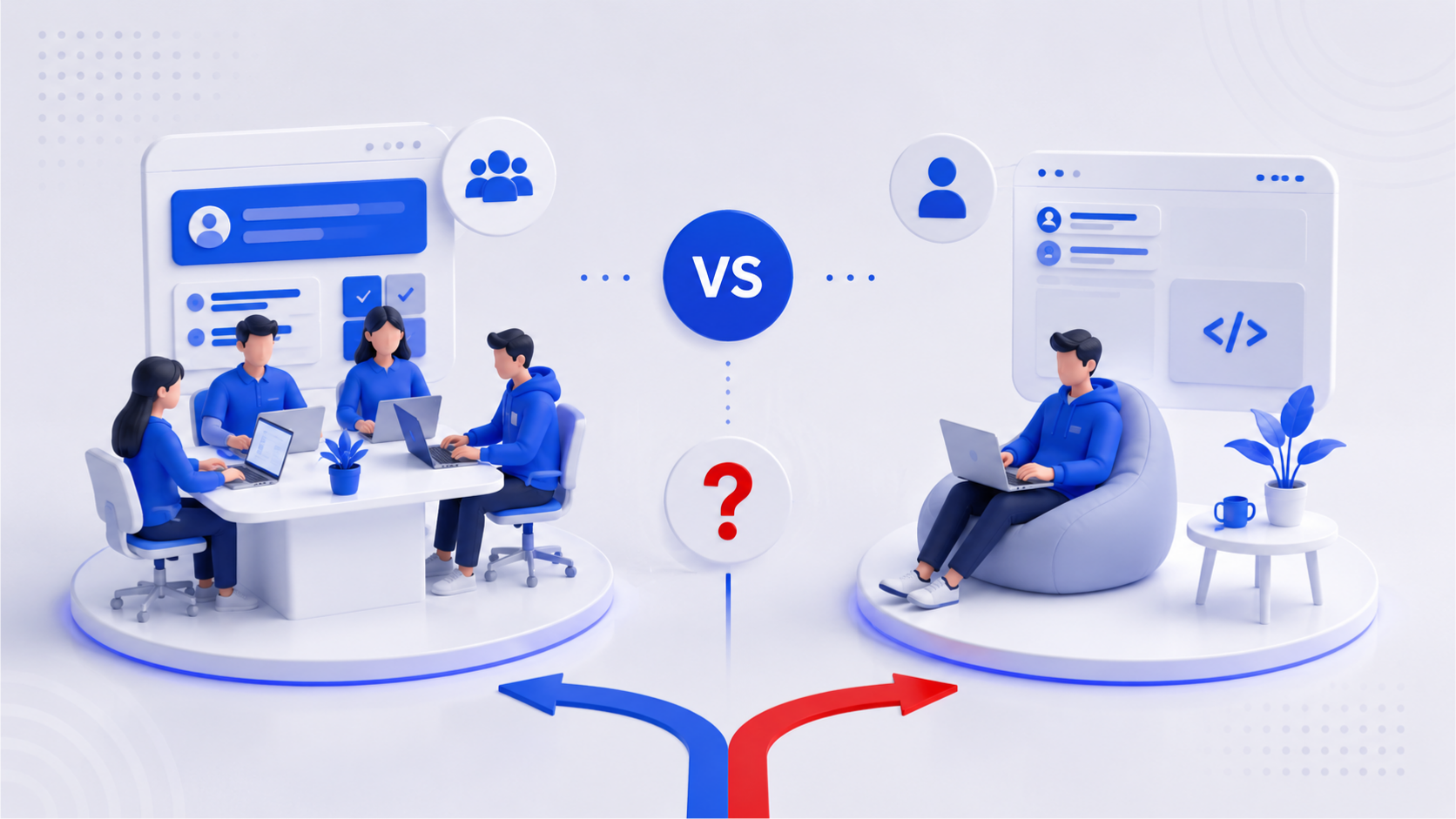
You need more engineering capacity. That part's settled. The real question is what kind: a dedicated development team that embeds with your product for the long haul, or freelancers who jump in, ship, and move on?
Pick wrong and you don't just lose money. You lose months — onboarding people who leave, re-explaining context that was never written down, or paying full-time rates for work that needed two weeks of specialist attention.
The answer isn't "freelancers are cheaper" or "teams are safer." It depends on what you're building, how long you'll build it, and how much context the work requires. This post breaks down both models so you can decide with evidence instead of instinct.
Key Takeaways
- A dedicated development team works only on your product, retains context, and scales with your roadmap over time.
- Freelancers win on speed and cost for short, well-scoped tasks with clear boundaries and minimal context.
- Knowledge retention is the hidden differentiator: teams compound product understanding; freelancers take it with them.
- Multi-quarter roadmaps, compliance needs, and AI initiatives favor a dedicated team; prototypes and skill gaps favor freelancers.
- Most companies that scale successfully blend both — a stable core team plus specialists for spikes.
What Is a Dedicated Development Team?
A dedicated development team is a group of engineers who work exclusively on your product, managed as an extension of your own organization. You get the commitment of in-house hires without running recruitment, payroll, and retention yourself.
That exclusivity is the whole point of the dedicated team model. The engineers attend your standups, follow your release process, and stay through quarter after quarter. Their understanding of your architecture, your customers, and your past decisions compounds.
A dedicated software development team usually includes more than developers. Depending on scope, you'll have a tech lead, QA engineers, a DevOps engineer, and sometimes a designer or business analyst — assembled around your roadmap, not around a single task.
Compare that with hiring in-house: McKinsey research found that roughly 36% of employed Americans now work independently, which means the full-time talent pool keeps shrinking while demand for engineers keeps growing. Dedicated development team services exist precisely because hiring five senior engineers yourself can take six months you don't have.
So where do freelancers fit in?
What Freelancers Do Well
A freelance software developer is the fastest route from "we need this built" to "it's built" — when the work is small, clear, and self-contained.
Freelancers shine at:
-
Well-scoped, short-term work. A two-week integration, a UI refresh, a data pipeline fix. Defined start, defined end.
-
Niche expertise on demand. A Kubernetes specialist for a migration, a fine-tuning expert for one model, a penetration tester before launch.
-
Prototypes and experiments. Testing an idea before you commit a roadmap to it.
-
Burst capacity. Extra hands before a launch, without growing the payroll.
The constraint is structural, not personal. Even an excellent freelancer juggles multiple clients, holds product context only as long as the contract lasts, and works outside your security and review processes unless you actively pull them in.
For a one-off task, none of that matters. For an eighteen-month product roadmap, all of it does.
Dedicated Development Team vs Freelancers: The Real Differences
Here's how the two models actually compare, dimension by dimension:
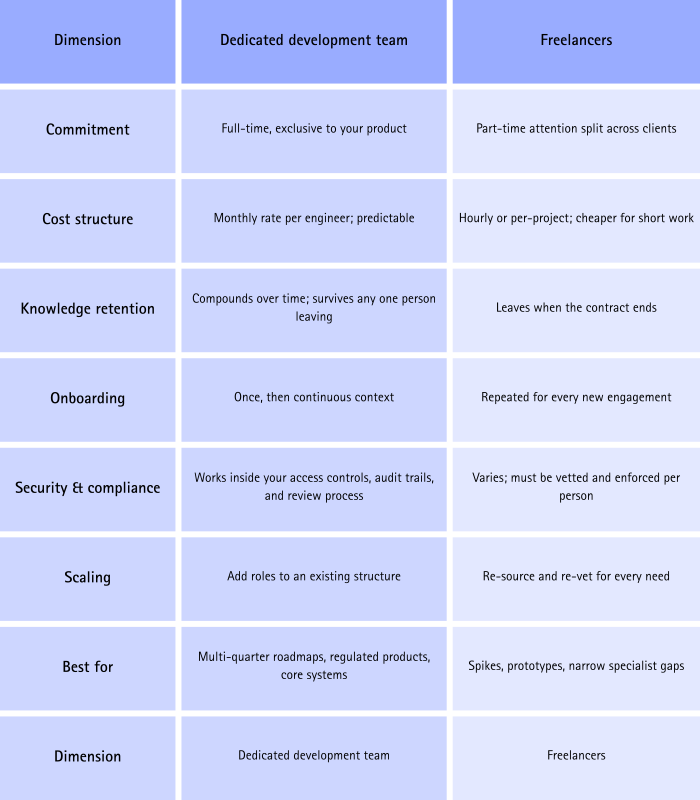
Notice the pattern? Freelancers optimize for the transaction. A dedicated team optimizes for the relationship — and software products are relationships with very long memories.
When Should You Hire a Dedicated Development Team?
You should hire a dedicated development team when the work ahead is measured in quarters, not weeks. The signals are usually obvious in hindsight:
Your roadmap extends past six months. Long-term work rewards context. An engineer who watched your architecture evolve makes better decisions than one reading your docs for the first time.
You're in a regulated industry. Healthcare, insurance, and fintech products need consistent access controls, audit trails, and review discipline. That's far easier to enforce with dedicated software developers operating inside your processes than with rotating contractors.
You're building AI into the product. AI features aren't one-off tasks. They need data work, evaluation, iteration, and maintenance — a standing capability, not a gig.
Velocity, not headcount, is the bottleneck. If features take twice as long as they should, the fix is rarely one more contractor. It's a stable team that stops re-learning the codebase every month.
This is also where engagement models overlap. A dedicated team is one form of IT outsourcing, and it pairs naturally with a decision to outsource product development end to end — the difference is how much ownership you keep in-house versus hand to the partner.
When Freelancers Are the Smarter Choice
Don't hire a standing team for work that doesn't need one. Freelancers are the better call when:
-
The work fits inside one or two sprints and won't recur.
-
You need a skill once — a security audit, a specific integration, a model evaluation.
-
You're pre-product-market-fit and burning runway on an idea you might abandon.
-
Your core team is solid and you just need surge capacity for a deadline.
Honestly, the failure mode here isn't choosing freelancers. It's choosing freelancers for core product work and then wondering where the institutional knowledge went.
What Does a Dedicated Development Team Cost?
A dedicated development team typically costs $4,000–$12,000 per engineer per month depending on seniority and location, while freelancers run $30–$150+ per hour depending on specialization. The comparison that matters isn't the rate — it's cost per outcome.
A freelancer at $80/hour who needs 20 hours of context before producing anything useful costs you $1,600 in pure onboarding — every engagement. A team that already holds the context spends those hours shipping. Over a year of continuous work, the team model usually wins on total cost; over a three-week project, it never does.
When you evaluate dedicated development team services, watch for three things: whether you can scale the team up or down without contract renegotiation, whether you get direct access to engineers (not just a project manager), and whether the partner invests in understanding your business or just executes tickets.
And what if you need both?
The Hybrid Answer Most Scaling Companies Land On
You don't have to pick a side. The pattern we see most often at Classic Informatics: a stable dedicated core that owns architecture, releases, and product context, plus freelance specialists pulled in for spikes — exactly the model behind successful efforts to hire remote developers at scale.
The core team gives you continuity and accountability. The specialists give you flexibility. The mistake is inverting it: a freelance core with no continuity, patched by occasional full-timers who can't hold the whole picture.
If your product is the business, the people building it shouldn't be optional.
Let's Sum Up!
The dedicated development team vs freelancers question comes down to duration and context. Short, scoped, low-context work: hire a freelance specialist and enjoy the speed. Long-term, high-context, compliance-sensitive product work: hire dedicated developers who'll still be there — and still remember why the payment service is structured that way — four quarters from now.
We've spent 23+ years at Classic Informatics building dedicated teams for SaaS companies, healthcare platforms, and manufacturers across 30+ countries, with 95% client retention doing it. If you're weighing the models for your own roadmap, we're happy to talk through what a right-sized team would look like — no pressure, just a clear answer.

FAQS

Frequently Asked Questions
A dedicated development team is a group of engineers, and often QA and DevOps specialists, who work exclusively on your product through an external partner. They follow your processes, attend your standups, and retain product knowledge over time — like in-house hires, without the recruitment and payroll overhead.