"Full-stack" gets treated like a skill level, as if hiring a full-stack developer means you found someone who's mastered everything. That's not quite it.
What you're actually paying for is coordination: one developer, or one team, who can move across frontend, backend, and infrastructure without handing your project between three specialists who never quite sync up. That's exactly why so many startups and mid-market companies now hire full stack developers instead of building out a full specialist bench from day one.
But the same label that describes strong, coordinated engineering also describes a common shortcut: developers who've spread themselves across five frameworks without going deep in any of them. Which one you get depends entirely on the company you choose, not the job title on their homepage.
This list breaks down ten full-stack development companies worth evaluating, what each one actually does well, and how to tell a team you can build on from one that's just a job posting in disguise.
What Most Buyers Get Wrong About Hiring Full-Stack Developers
What full-stack actually buys you is coordination. One developer, or one team, owns the frontend, backend, and everything connecting them, instead of you managing the handoff between three separate specialists who don't talk to each other enough.
That's valuable.
It's also exactly where things go wrong when the "full-stack" label means shallow competence spread thin across five frameworks, rather than real depth in the two or three technologies your product actually needs.
The good full-stack companies on this list have senior engineers who specialize deeply and collaborate broadly. The weaker ones just save you a job posting.
How We Evaluated These Full-Stack Development Companies
Every company below was assessed against the same criteria, based on verified client feedback and publicly available project history.
-
Technical breadth and depth: Whether the team shows real expertise across frontend, backend, and infrastructure, not just surface familiarity with a long list of frameworks.
-
Client reviews and reliability: Verified feedback on Clutch and GoodFirms, with particular attention to delivery timelines and communication quality.
-
Industry experience: Whether the company has shipped genuinely comparable products, not just similar-sounding ones.
-
Team structure and scalability: Whether they can staff a project appropriately as it grows without diluting quality.
-
Post-launch support: Whether the relationship extends past the initial build into ongoing maintenance and iteration.
10 Full-Stack Development Companies Worth Evaluating
1. Classic Informatics
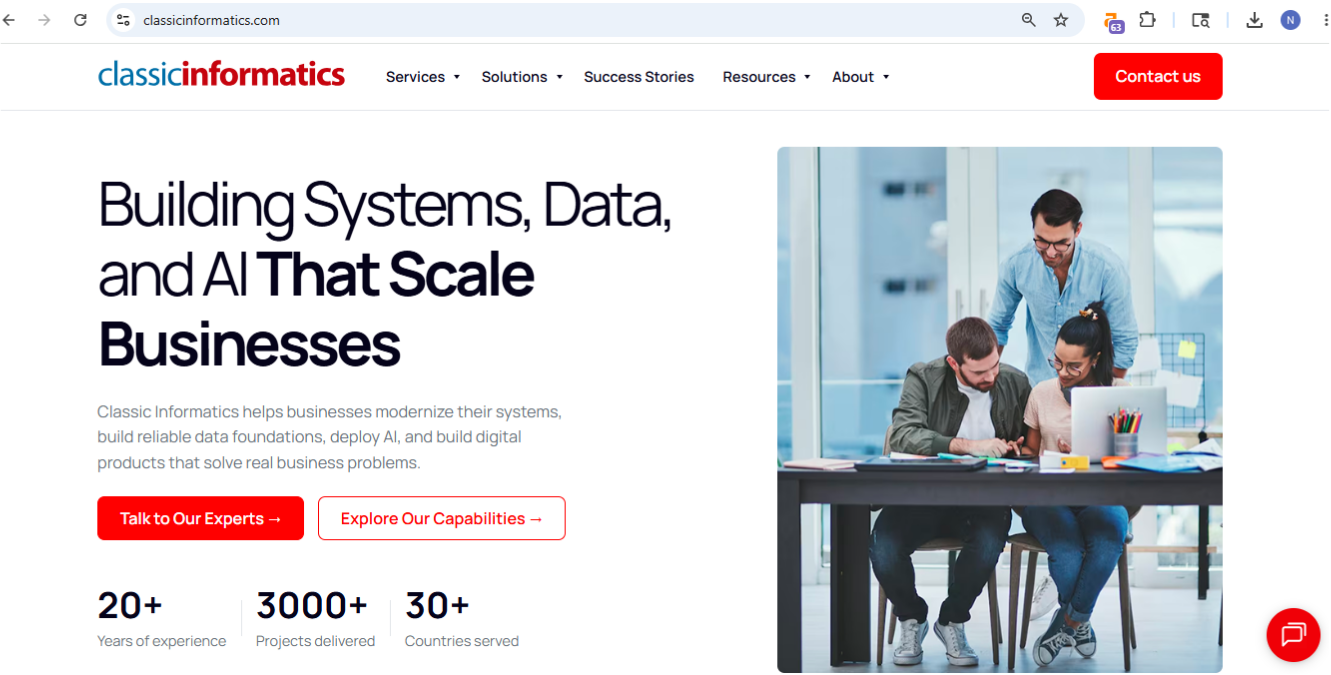
Classic Informatics works best for startups and mid-market companies building SaaS platforms, AI-powered applications, and enterprise systems that need to hold up past the MVP stage.
The team's approach centers on balancing delivery speed with architecture that doesn't need a rewrite eighteen months later — a distinction that matters more once a product has real users depending on it. Rather than treating full-stack work as generalist coverage, engineers specialize by layer while working as one coordinated team, so you get depth without losing the single-point-of-contact advantage full-stack hiring is supposed to provide.
-
SaaS platform architecture and development
-
AI-powered application development
-
Enterprise workflow and modernization-led product engineering
-
Mobile and web full-stack delivery
-
Dedicated team and managed project models
If your priority is a product that can scale past its first year without a foundational rebuild, this combination of depth and coordination is built for exactly that outcome.
2. Bacancy Technology
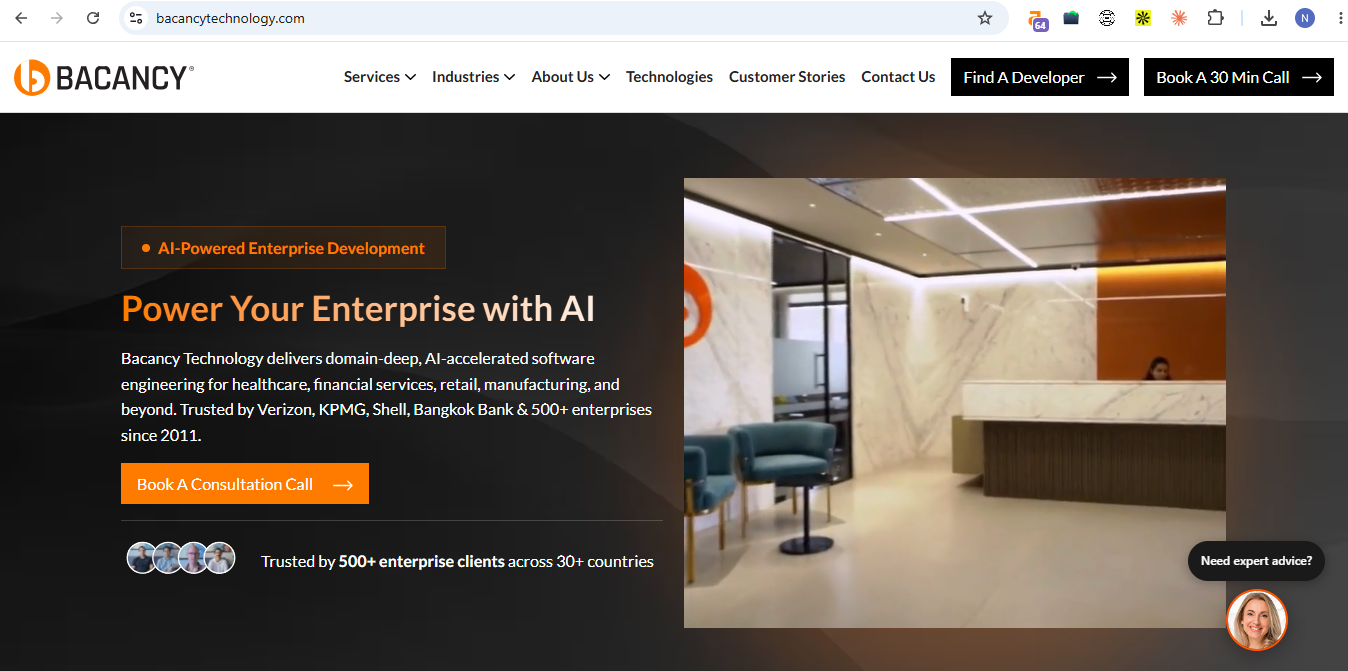
Bacancy Technology works best for enterprises that need to scale a full-stack team quickly ramping up dedicated developers or cross-functional teams enabling them to adapt development capacity based on evolving project needs.
The team follows an agile development approach, enabling faster delivery cycles, adaptability to changing requirements, and consistent project outcomes. With a strong emphasis on quality and reliability, the company has established itself as a trusted technology partner for organizations looking to build or modernize their digital products.
- Full-stack web and application development
- Mobile app development
- AI and machine learning integration
- SaaS Development Support
- Cloud-based deployment
If you want one accountable partner across the full product lifecycle rather than a series of handoffs, Bacancy's end-to-end approach is a genuine asset.
3. Simform
Simform works best for enterprises and growth-stage companies needing cloud-native product engineering at scale, not a small team bolted onto an existing project.
With roughly 500 to 1,000 engineers across multiple delivery centers, Simform can staff larger, multi-team engagements that a boutique shop would struggle to resource. Clients consistently highlight their project management and cloud-native expertise, particularly for complex, multi-service architectures.
-
Cloud-native application architecture
-
Enterprise-scale product rebuilds
-
Dedicated pod delivery model
-
AI/ML integration
-
Multi-team program management
For a well-defined project needing a small, tightly-knit team, Simform's scale may be more infrastructure than you need — but for enterprise-grade rebuilds, it's a genuine strength.
4. Miquido
Miquido works best for companies wanting a full-service partner across web, mobile, and AI-driven product design, backed by one of the stronger review profiles on this list.
With a 4.9-out-of-5 rating across dozens of verified Clutch reviews, Miquido consistently gets singled out for clear communication and hitting deadlines — the two things that most commonly go wrong on outsourced builds. Their AI and product-strategy capabilities go beyond simple development into shaping what gets built in the first place.
-
Full-stack web and mobile development
-
AI-driven product design
-
Team augmentation
-
Product strategy and discovery
-
UX/UI design
Companies that want a partner involved in product decisions, not just execution, tend to get the most value from Miquido's model.
5. Netguru
Netguru works best for mid-market and enterprise companies modernizing digital commerce, marketplaces, or B2B platforms with an established, process-driven partner.
Their client base skews toward recognizable brands, and project budgets commonly range from $5,000 to $500,000, reflecting both smaller feature work and larger platform rebuilds. That range signals flexibility, but it also means smaller, more exploratory projects may get less senior attention than a boutique shop would offer.
-
Digital commerce and marketplace platforms
-
AI-driven engineering and design
-
B2B platform modernization
-
End-to-end product design
-
Enterprise-scale delivery
If your project looks more like a platform overhaul than an early-stage build, Netguru's process maturity is a genuine asset.
6. SoftKraft
SoftKraft works best for companies needing Python-heavy backends, data pipelines, or machine-learning-driven features rather than general full-stack coverage.
As a smaller, Poland-based boutique, SoftKraft trades scale for specialization — their strength sits specifically in Python, React frontends, and data-heavy applications rather than being equally strong across every stack. That focus is an advantage if your product's hardest problems live in data and ML, and a limitation if you need broad coverage across many technologies.
-
Python backend development
-
React frontend development
-
Cloud data pipeline engineering
-
Machine learning integration
-
Data visualization
For data-intensive products specifically, SoftKraft's narrower focus often beats a generalist shop's broader but shallower coverage.
7. Merixstudio
Merixstudio works best for mid-size and enterprise clients needing custom software builds with AI-augmented delivery built into the process, not bolted on afterward.
The company has worked with recognizable enterprise clients across sectors, and their delivery process leans on AI tooling to speed up parts of development without sacrificing code quality, based on client feedback. That combination appeals to companies that want modern delivery practices without becoming the test case for an unproven process.
-
Custom software development
-
AI-augmented delivery workflows
-
Enterprise and mid-market engagements
-
Web and mobile full-stack builds
-
Ongoing product iteration
Companies evaluating AI-assisted development specifically will find Merixstudio further along that curve than most peers on this list.
8. LITSLINK
LITSLINK works best for startups and SaaS companies that need a full-stack team built specifically around modern SaaS delivery, from React and Node.js through Flutter and AWS.
Their stack coverage is deliberately SaaS-shaped rather than general-purpose, which shows up in how quickly they can scope and start an MVP-stage engagement. That focus makes them a strong fit for founders who already know they're building a subscription product, less so for teams needing broader enterprise-systems work.
-
React and Node.js development
-
Vue.js and Flutter mobile development
-
AWS cloud infrastructure
-
SaaS MVP development
-
Startup-focused engagement models
If your roadmap is SaaS-specific from day one, LITSLINK's stack focus can mean a faster start than a broader generalist shop.
9. Intelivita
Intelivita works best for startups and small businesses prioritizing cost-conscious web and mobile development without sacrificing project management discipline.
Client reviews consistently highlight competitive pricing and responsive communication, even across time zones — a combination that's harder to find than it should be at this price point. Some clients have noted occasional communication friction typical of fully offshore engagements, worth planning around with clear documentation upfront.
-
Web and mobile application development
-
eCommerce development
-
Cross-timezone project coordination
-
Budget-conscious delivery models
-
Augmented reality and VR development
For budget-sensitive projects where scope is already well-defined, Intelivita's pricing and delivery track record are a strong combination.
10. DICEUS
DICEUS works best for companies in insurance, fintech, or other regulated industries needing full-stack development alongside legacy system integration expertise.
Their product engineering work leans specifically into system integration and .NET and Python-based builds, which shows up in how they scope projects involving existing infrastructure rather than pure greenfield builds. That specialization is valuable if you're modernizing around legacy systems, and less relevant if you're starting from a blank slate.
-
Insurance and fintech software
-
Legacy system integration
-
.NET and Python development
-
Cloud services implementation
-
Agile project delivery
Companies untangling legacy infrastructure alongside new development will find DICEUS's integration experience directly relevant.
11. Belitsoft
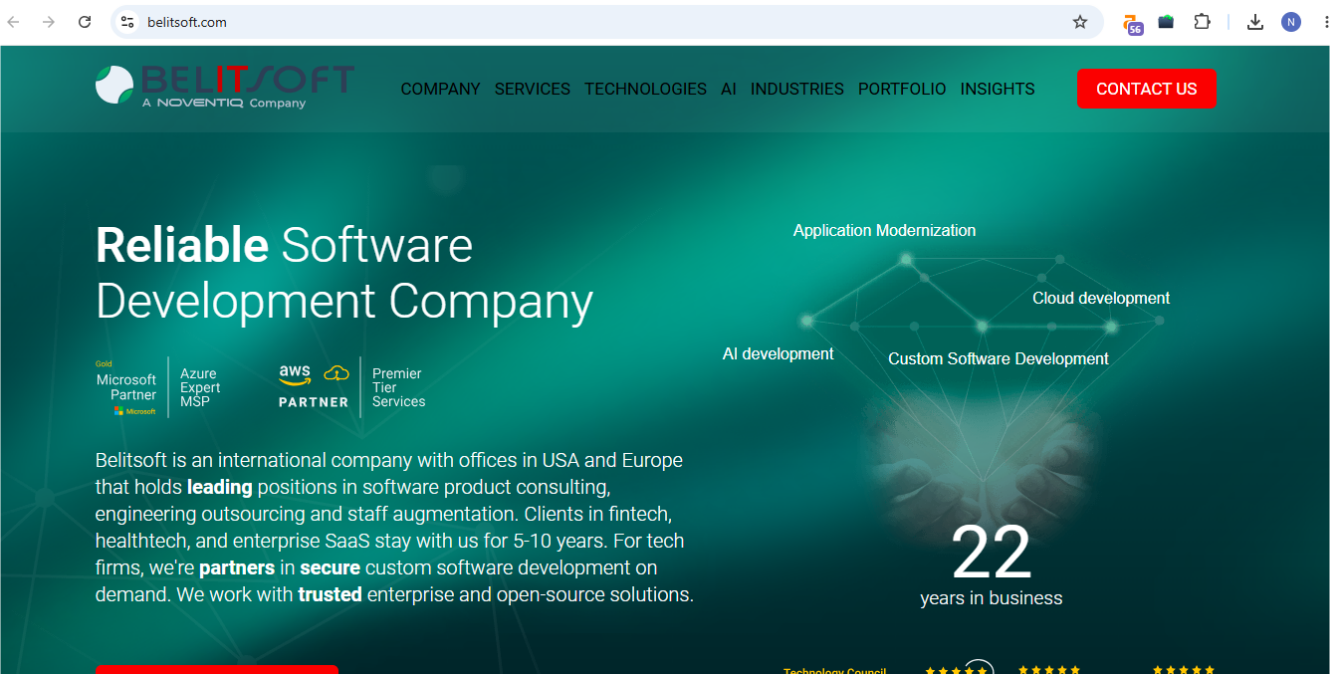
Belitsoft works best for companies wanting a long-term dedicated development team with a strong track record of hitting deadlines without constant oversight.
Client feedback consistently describes on-time delivery and clean, maintainable code, which matters most on longer engagements where a team effectively becomes an extension of your own. That reliability tends to matter more the longer the engagement runs, which is exactly where Belitsoft's model is built to perform.
-
Dedicated development teams
-
Long-term staff augmentation
-
Full-stack web development
-
Quality-focused code delivery
-
Cross-functional team building
For multi-year engagements where consistency matters more than flash, Belitsoft's reliability track record stands out.
How to Choose the Right Full-Stack Development Partner
None of these companies is objectively "the best." The right fit depends on a handful of practical factors:
-
Technical fit over technical breadth: A team deeply skilled in the two or three technologies your product actually needs beats one that's superficially familiar with a dozen.
-
Review patterns, not review scores: Look for recurring themes in client reviews — communication, deadline reliability — since a single high rating can hide a specific weakness that matters to you.
-
Team structure that matches your certainty: If your scope is still evolving, prioritize a flexible dedicated-team model over a fixed-bid contract.
-
Evidence of post-launch support: A company that disappears after launch leaves you holding maintenance work you didn't budget for.
-
Communication style, tested early: A short paid discovery engagement reveals more about how a team communicates than any sales call will.
-
Relevant case studies, not just any case studies: A portfolio full of unrelated industries tells you less than one or two projects genuinely similar to yours.
Let's Wrap This Up!
Hiring a full-stack team feels like it should simplify your decision, and instead it usually multiplies the options. That's the tension this list is meant to resolve, not add to.
Every company here does genuinely good work, just for different situations. A team built for enterprise-scale rebuilds isn't the right fit for a two-person startup validating an MVP, and vice versa.
The real question isn't which company is objectively best. It's which one matches your product's stage, your budget's shape, and how much oversight you actually want to provide.
If you're building a SaaS platform, an AI-powered product, or an enterprise system that needs to hold up long after launch, Classic Informatics can walk you through what that build actually looks like, without steering you toward more scope than you need.
FAQS

Frequently Asked Questions
Rates vary widely by region and experience, typically from $25–$50 per hour for offshore teams to $100–$165 per hour for US and Western European agencies. Total project cost depends more on scope and timeline than on hourly rate alone, so compare full project estimates rather than rates in isolation.