
Key Takeaways
- Product development outsourcing means hiring an outside team to design, build, and maintain your product on your behalf.
- Outsourced projects usually fail for the same three reasons: unclear scope, no accountable decision-maker, and unsettled IP ownership.
- Three engagement models exist: fixed price for a locked scope, time and materials for an evolving product, and a managed team for multi-year work.
- Engagement model and scope clarity drive total cost more than the hourly rate does.
- IP ownership and source-code escrow belong in the contract before the first sprint, not after a dispute.
- Outsourcing wins on tight timelines and missing skills. In-house wins when the product itself is the business.
Product development outsourcing has become one of the default ways companies close a skills or capacity gap without a full-time hire. Where it goes wrong is almost always the model chosen before a line of code gets written, not the execution afterward.
Global spending on IT services is projected to reach $1.87 trillion in 2026, and a growing share of that is product work rather than back-office IT. At the same time, 81% of organizations report a shortage in developer-level tech skills, according to a 2023 EY and iMocha survey. That gap is why outsourcing keeps growing even as AI assistance keeps improving developer productivity.
This guide is for the founder deciding whether to outsource at all, and the CTO who's already decided and now has to structure the engagement. We'll cover what's included, when outsourcing beats building in-house, how to structure the engagement, what it costs, how to pick a partner, and the contract terms that keep things from falling apart later.
What Product Development Outsourcing Covers
Product development outsourcing is the practice of handing an external team ownership of designing, building, testing, and usually maintaining a digital product, rather than hiring individual contractors to slot into your existing team's workflow.
That's the line that gets blurred constantly, and it's worth drawing clearly.
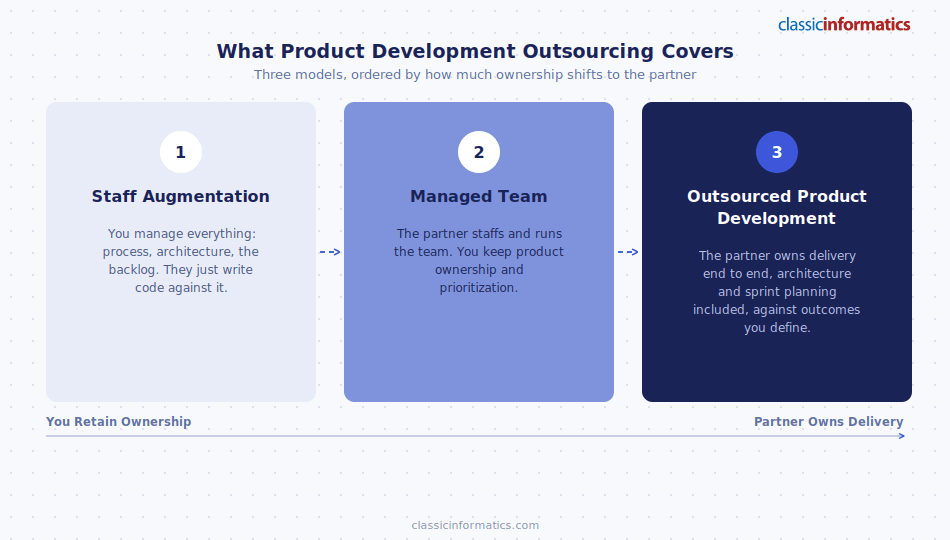
Staff augmentation means you're adding developers to your team, under your management, your process, your standups. You own the roadmap and the architecture; the augmented developers just write code against a backlog you control.
Outsourced product development means the external team owns the delivery, often including architecture decisions, sprint planning, QA, and sometimes the product management layer itself. You're buying an outcome, not a headcount.
A third category sits between them. A managed team is where the external partner assembles and runs a dedicated team against your roadmap, but you retain product ownership and prioritization. Most engagements that call themselves "outsourcing" are actually this middle category.
Getting that distinction straight before you sign anything saves a lot of confusion three months in.
What's typically included in an outsourced product development engagement:
- Discovery and requirements definition, translating a business idea into a technical scope
- UX and product design, from wireframes through to a testable prototype
- Architecture and technology stack decisions
- Development across the full stack, mobile, backend, or whatever the product needs
- QA and testing, often including automated test coverage
- Deployment and DevOps setup
- Post-launch maintenance and iteration, on an ongoing basis
That list assumes a greenfield build, but it doesn't have to be one. Refactoring or modernizing an existing application is one of the more common reasons companies outsource in the first place, since the skills needed to safely restructure a live codebase without breaking production are often narrower and harder to hire for than the skills needed to build something new.
Where the lines usually sit: pure staffing (you manage everything), managed teams (they staff and run the team, you own the product), and full outsourced ownership (they own delivery end to end against outcomes you define). A startup building a first product usually wants the third option. An enterprise with an in-house product team usually wants the second.
Very few situations call for the first. It gets mislabeled as "outsourcing" when it's really just contracting.
Here's what that looks like in practice. A founder with a validated idea and no technical co-founder typically hands over a business requirement and expects a working product back, with the partner making the architecture and design calls along the way.
A Series B company with an in-house engineering team, by contrast, usually wants a managed team that plugs into their existing sprint cadence and reports to their VP of Engineering, not a partner making independent product decisions.
Same word, "outsourcing," two very different engagements.
MVP-scoped engagements are a common entry point into outsourcing specifically because the scope is naturally bounded. Weighing the benefits of MVP development before you outsource it is worth doing first, since scope clarity is the single biggest driver of whether an outsourced engagement goes well.
When Outsourcing Beats Building In-House (and When It Doesn't)
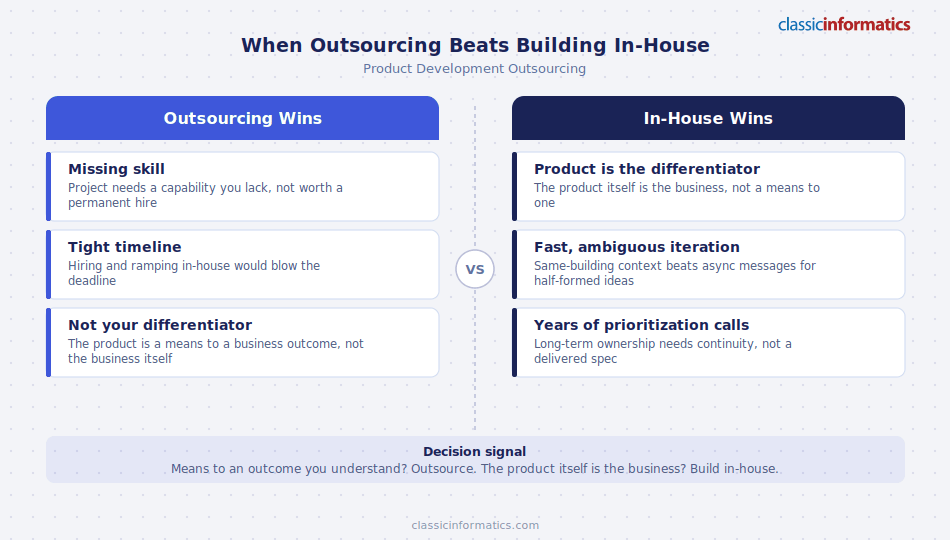
Outsourcing wins when you need capability you don't have on a timeline that makes hiring impractical. Building in-house wins when the product itself is the permanent differentiator rather than the means to one.
Three conditions point toward outsourcing pretty clearly:
- Your team lacks a specific skill the project genuinely requires, and hiring for one project doesn't justify a permanent headcount
- The timeline is tight enough that recruiting, onboarding, and ramping an in-house team would blow the deadline before anyone starts writing code
- The product isn't your core differentiator
That combination, a missing skill plus a tight timeline, is exactly what outsourced product development engagements exist to solve.
If you're a logistics company building an internal tool, the tool matters. But building it isn't what makes you competitive. The logistics operation is.
The in-house case has one advantage that's easy to undervalue: the speed of making a change. When the person who wants a feature adjusted and the person who builds it sit in the same building, on the same working hours, a small technical question gets answered in a hallway conversation instead of an async message that waits for the next overlap window. That doesn't make in-house teams better at everything. It makes them faster at the specific job of iterating quickly on ambiguous, half-formed ideas.
In our experience, the calculation shifts once a product moves past its first stable release and into a phase where every roadmap decision has direct customer-facing consequences. At that point, the case for an in-house team owning the product long-term gets stronger, because context and continuity start mattering more than raw building capacity.
That doesn't mean outsourcing can't be a long-term arrangement. When Classic Informatics built a digital survey and benchmarking platform for MarketMeter, an Australian market research firm serving ASX-listed companies, the engagement replaced a manual, Excel-based process with a centralized platform, and it's still an active partnership.
Outsourcing doesn't have to mean a one-off build followed by a handoff. It can mean a long-running relationship that evolves the same way an in-house team's priorities would.
The honest counter-case, one Marty Cagan's SVPG makes well, is that outsourcing struggles when the goal is a genuine product organization rather than a delivered product. If what you actually need is a team that owns discovery, makes prioritization calls, and iterates based on live user data over years, an external team working against a fixed spec will always be a step removed from that.
The fix isn't to avoid outsourcing. It's to be honest about which of the two you're buying.
Decision signal: If the product is a means to a business outcome you already understand, outsourcing usually wins. If the product itself is the business and you expect to be making weekly prioritization calls on it for years, weigh in-house vs outsourcing software development more carefully before you commit externally.
Three Ways to Structure an Outsourcing Engagement
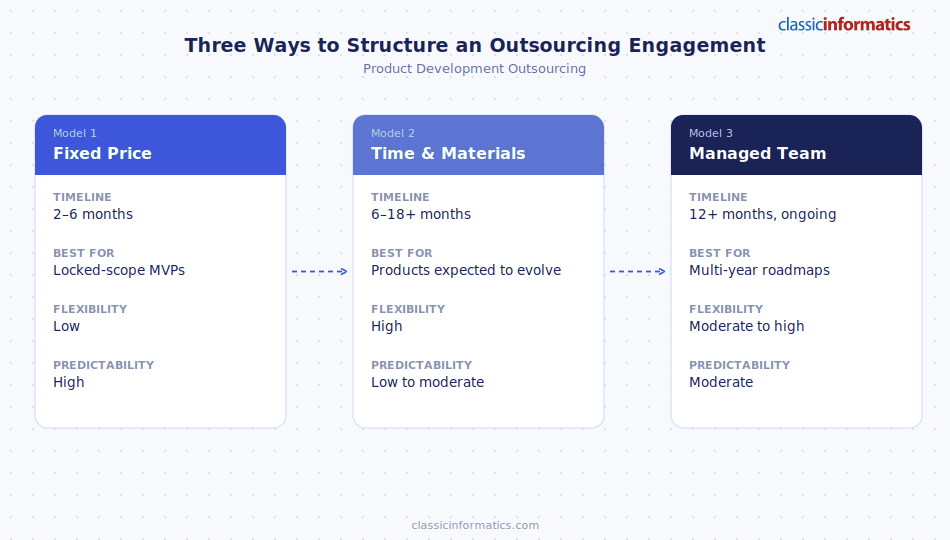
Every outsourced product development engagement runs on one of three pricing and delivery models. Picking the wrong one for your situation is the single most common cause of a relationship going sideways.
| Model | Typical timeline | Best for | Scope flexibility | Cost predictability |
|---|---|---|---|---|
| Fixed price | 2–6 months | Locked-scope MVPs | Low | High |
| Time and materials | 6–18+ months | Products expected to evolve | High | Low to moderate |
| Managed team | 12+ months, ongoing | Multi-year roadmaps | Moderate to high | Moderate |
Fixed Price
You agree on a defined scope and a defined price before work starts.
- What it is: A single-sum contract covering an agreed set of features and deliverables.
- When it makes sense: Requirements are settled, the timeline is fixed, and the product is small enough that scope creep is unlikely. MVPs with a genuinely locked feature list fit this well.
- What to watch for: Any change to scope after signing usually means a change order, which slows things down and often costs more than negotiating flexibility upfront would have.
- Decision signal: If you can write a complete, unambiguous requirements document today and don't expect it to change before launch, fixed price works. If you're still discovering what the product needs to do, look elsewhere.
Time and Materials
You pay for actual hours worked and materials used, with no fixed total.
- What it is: Billing based on hourly or daily rates for the team assigned to your project.
- When it makes sense: Requirements are expected to evolve, the product will keep changing after the first release, or you want the flexibility to reprioritize mid-build.
- What to watch for: Without active oversight, a T&M engagement can run longer than planned. A guaranteed maximum price clause caps this risk without giving up the flexibility.
- Decision signal: If your product roadmap will still be moving six months after this build starts, time and materials gives you room to adjust without renegotiating a contract every time priorities shift.
Managed Team
The partner assembles and runs a dedicated team, billed as a unit rather than per feature or per hour.
- What it is: A team, often cross-functional, that operates as an extension of your organization on an ongoing basis rather than against a single project scope.
- When it makes sense: You expect a long-term relationship, want continuity across multiple releases, and would rather manage a roadmap than negotiate scope changes repeatedly.
- What to watch for: This model depends heavily on how well the partner staffs and retains the team. Ask directly about attrition rates before committing.
- Decision signal: If you're planning multiple years of ongoing development rather than a single delivery, a managed team avoids the friction of re-scoping and re-contracting every few months. Building an offshore development team this way works best when you already have a product owner on your side who can direct the roadmap.
A note on methodology: some outsourcing firms bundle these three into hybrid or story-point-based contracts, buying a fixed monthly capacity you can reprioritize freely. That's a reasonable fourth option worth asking about, but it's a variation on time and materials rather than a distinct category, so it isn't broken out separately here.
Agile delivery cuts across all three models rather than replacing any of them. Fixed-price and managed-team engagements both run better with agile software development outsourcing practices layered on top, even though the underlying contract terms differ.
The rule of thumb:
- Fixed price when scope is locked and small.
- Time and materials when the product will keep evolving.
- Managed team when you're planning years, not months.
What Product Development Outsourcing Costs, and What Drives the Number
Outsourced product development typically costs somewhere between $25 and $150 per hour depending on region, with the total project cost driven far more by scope clarity and engagement model than by the hourly rate itself.
That last part surprises people.
A $25/hour team working against an unclear spec, with constant rework and change orders, can end up costing more in total than a $60/hour team working against a tight scope with a fixed-price contract. Rate is one input. Rework is the multiplier.
Geography still matters, but less than it used to.
| Region | Typical hourly rate |
|---|---|
| North America / Western Europe | $100–$150 |
| Eastern Europe | $40–$99 |
| India | $20–$49 |
Outsourcing to India remains one of the more common cost-optimization moves specifically because the talent pool has scaled without a corresponding jump in rates. The gap between projected and real outsourcing cost savings is usually wider than the rate comparison alone would suggest.
The bigger cost drivers, in rough order of impact:
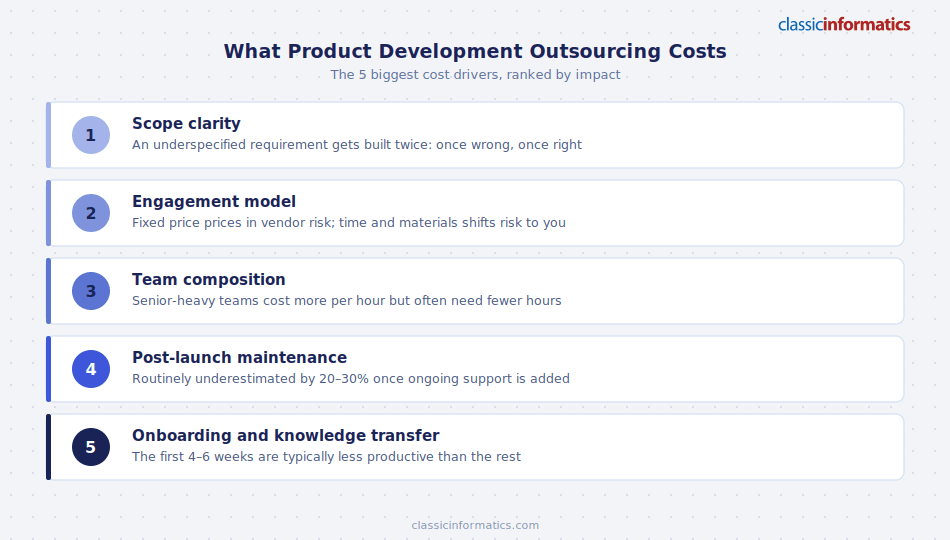
- Scope clarity. An underspecified requirement gets built twice: once to the wrong interpretation, once to the right one.
- Engagement model. Fixed price concentrates risk with the vendor and usually prices that risk in. Time and materials shifts the risk (and the potential savings) to you.
- Team composition. A team with senior architects and fewer junior developers costs more per hour but often needs fewer hours to reach the same outcome.
- Post-launch maintenance. Cost estimates that stop at launch routinely underestimate total spend by 20–30% once ongoing support and iteration are added in.
- Onboarding and knowledge transfer. The first four to six weeks of any engagement are typically less productive than the rest, since the partner is still learning your domain, your data model, and your existing systems. Budgeting for a slower ramp-up avoids the surprise of a first sprint that looks underwhelming.
None of these show up on a rate card. A proposal quoting $35/hour reads cheaper than one quoting $55/hour, right up until the $35/hour team needs 40% more hours to hit the same scope because the requirements weren't nailed down going in, which is exactly why outsourcing software development cost varies so much by project type rather than by rate alone.
A rough estimation framework: multiply the expected hours by the region's typical rate, then add 15–20% for the almost-inevitable scope adjustments that show up mid-build even on well-planned projects, which is exactly the gap that makes software development cost estimation harder than a spreadsheet formula alone.
How to Choose a Product Development Partner
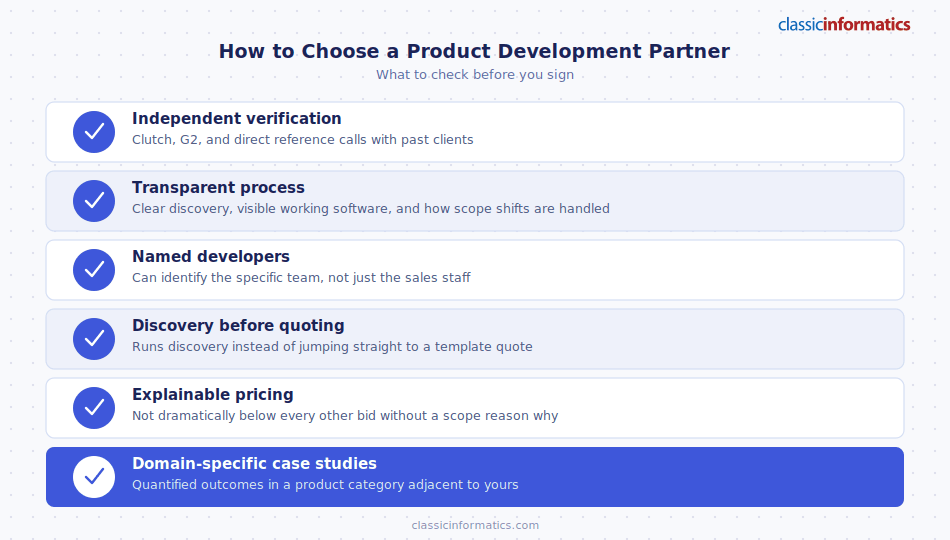
The right partner has relevant portfolio evidence, a transparent process, and a track record you can verify independently, beyond whatever a sales team says in a pitch.
What to Check Before You Sign
- Domain-specific case studies. Two or three examples in your specific product category, not a generic capabilities deck, with outcomes that are quantified rather than vague.
- Independent verification. Clutch, G2, and direct reference calls with past clients. If a partner is reluctant to connect you with one, that's worth noting.
- A transparent process. How they run discovery, how often you'll see working software, and what happens to the timeline when requirements shift mid-build.
Decision signal: If a prospective partner can point to a named case study with a quantified outcome in a domain adjacent to yours, and can describe their change-management process without hedging, that's a strong signal. If they can only offer general claims about experience, keep looking.
Red Flags Worth Watching For
These show up often enough to be patterns rather than exceptions.
- A quote dramatically lower than every other bid, which usually means an unrealistically narrow scope interpretation, not a genuinely better price
- Reluctance to name the specific developers who'll work on your project, as opposed to the sales team you're talking to, which often means heavy reliance on subcontracted talent you haven't vetted
- A proposal that skips discovery entirely and jumps straight to a fixed quote, a sign the partner is estimating from a template rather than your actual requirements
Due diligence goes beyond the sales conversation. A vendor due diligence checklist for IT outsourcing is worth running through before any contract gets signed.
Portfolio strength and process transparency only cover half of the picture, though. Organizational fit, how well a partner's working style matches yours, is the harder thing to screen for from a pitch deck, and it's exactly what key factors in the right outsourcing decision is built around.
Outsourcing Contracts, IP Ownership, and Vendor Lock-In
Your outsourcing contract should specify who owns the code, what happens if the relationship ends, and how source access is protected. All three need to be settled before the first sprint starts, not after a dispute.
IP ownership isn't automatic just because you're paying for the work. Under the work-made-for-hire doctrine, a commissioned work created by an independent contractor only counts as work made for hire, with the client owning the copyright by default, if it falls into specific categories and both parties sign a written agreement saying so explicitly. Software often doesn't fall neatly into those categories.
That means most outsourcing relationships need an explicit IP assignment clause in the contract. "We paid for it, so we own it" isn't an assumption you can rely on.
Vendor lock-in shows up in less obvious ways than most people expect. Contract terms are only part of it. The other part is whether your accounts, your source repository, and your infrastructure are set up in your name from day one, or whether they live inside the partner's environment where switching later means starting from scratch.
Setting up accounts in your own name from the start is a small amount of friction early. It avoids a much bigger problem later.
A software outsourcing contract should specify, at minimum:
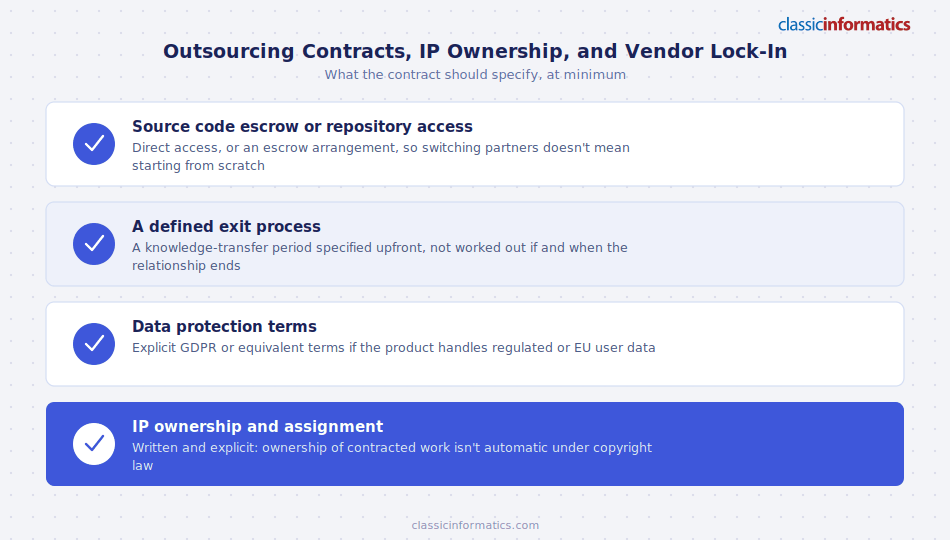
- IP ownership and assignment terms
- Source code escrow or direct repository access
- A defined exit process with a knowledge-transfer period
- Data protection terms if the product handles regulated data
On that last point, any product touching EU user data needs gdpr data protection outsourcing written into the contract explicitly, not assumed as standard practice.
Why Outsourced Product Development Fails (and How to Avoid It)
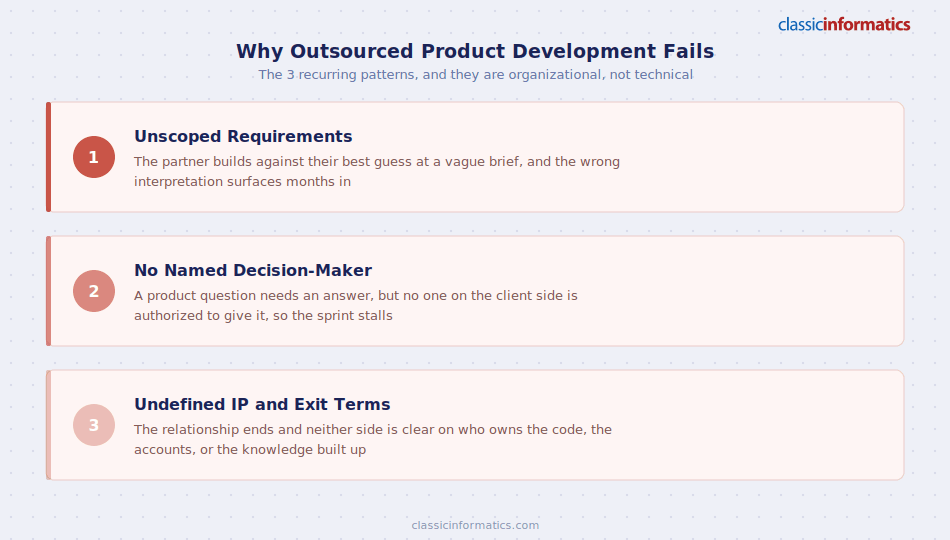
Outsourced product development projects fail for three recurring reasons: unclear scope, no accountable decision-maker on the client side, and a contract that never specified who owns what.
All three are organizational failures. None of them are technical.
Unscoped Requirements
- What it looks like: the partner builds against their best interpretation of a vague brief, and the client discovers three months in that the interpretation was wrong.
- Why it happens: writing a genuinely complete requirements document is harder than it looks, and most first-time outsourcers underestimate how much detail "detailed" actually requires.
- How to fix it: a structured discovery phase before development starts, with the scope document reviewed and signed off by both sides before a single sprint begins.
No Named Decision-Maker
- What it looks like: the partner needs a call made on a product question, and there's no single person on the client side authorized to make it, so the question sits unanswered for two weeks while the sprint stalls.
- Why it happens: outsourcing sometimes gets treated as a way to offload execution and decision-making alike, which isn't what it's for.
- How to fix it: name one person on the client side as the single point of product authority before the engagement starts, and hold that person accountable for turnaround time on decisions.
Undefined IP and Exit Terms
- What it looks like: the relationship needs to end, for whatever reason, and neither party is clear on what happens to the code, the accounts, or the knowledge the outsourced team built up.
- Why it happens: contracts get negotiated around price and timeline and treat IP and exit terms as boilerplate to sign quickly.
- How to fix it: settle these terms explicitly at signing, per the contract guidance above, rather than leaving them to be worked out if and when the relationship ends.
All three of these repeat themselves across engagements more often than any other cause. Together, they're a good part of why outsourcing product development fails as often as it does.
The second failure mode, in particular, is less about any single decision and more about ongoing habit. Managing outsourced teams day to day is largely about keeping it from showing up in the first place.
The Advantages and Trade-offs of Outsourcing Product Development
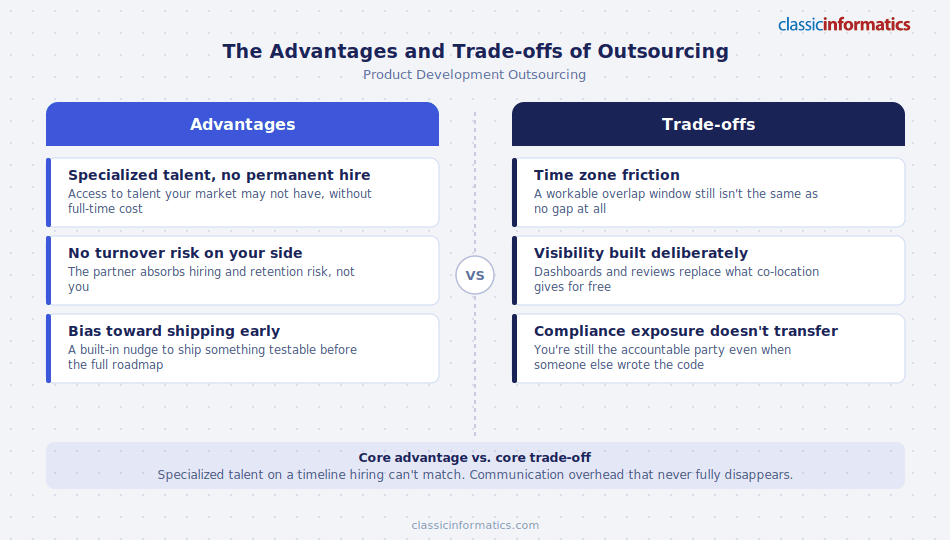
The core advantage of outsourcing is access to specialized talent on a timeline hiring can't match, and the core trade-off is a communication overhead that never fully disappears.
| Advantages | Trade-offs |
|---|---|
| Access to specialized talent without a permanent hire | Time zone friction, even with a workable overlap window |
| No turnover risk sitting on your side of the ledger | Day-to-day visibility has to be built deliberately, not picked up by osmosis |
| A built-in bias toward shipping something testable early | Compliance exposure doesn't transfer just because the work does |
The Advantages
You get access to talent your local market may not have at all, without carrying the full-time cost of that talent when the project doesn't need it permanently. Deloitte's 2024 survey found that 80% of executives plan to maintain or increase third-party outsourcing investment, and skilled talent access now sits alongside cost reduction as a primary driver.
That shift matters. Outsourcing used to be framed almost entirely as a cost play. It's increasingly a capability play.
A second advantage that rarely gets its own line item: outsourcing sidesteps the hiring and retention risk that in-house teams carry. Specialized developers, the ones with the skills a given project actually needs, tend to be in demand everywhere, and losing one mid-project to a better offer is a normal risk of running an in-house team. An outsourcing partner absorbs that turnover risk on their side; the team composition might shift, but the delivery commitment doesn't.
A third: a partner that's built multiple products brings a bias toward shipping something testable early rather than building every planned feature before anyone sees it. That habit is worth more than it sounds like it should be. Left unchecked, an ambitious internal roadmap tends to grow rather than ship, and an experienced outside team is often the one voice in the room asking what could be cut from the first release.
The Trade-offs
Time zone differences, however manageable, add friction that a co-located team doesn't have. A twelve-hour gap between a US client and an Indian development team still leaves a workable overlap window, and most teams adapt within a few weeks.
But adapting isn't the same as eliminating the friction entirely.
A second trade-off gets less attention than time zones but matters more in practice: day-to-day visibility into how the work is actually going. When your team sits down the hall, you see the code, the standup friction, the near-misses, without asking.
With an outsourced team, that visibility has to be built deliberately, through shared dashboards, recorded sprint reviews, or direct repository access, rather than picked up by osmosis. Partners who resist giving you that visibility are telling you something worth hearing.
A third, worth naming specifically if your product touches regulated data: compliance exposure doesn't transfer just because the work does. If you're building in healthcare, finance, or anywhere else with regulatory obligations, you're still the accountable party even when an external team wrote the code, which means audit trails, data handling practices, and access controls need to be specified as contract requirements rather than assumed.
The benefits of outsourcing software development hold up across most of the advantages above, and the honest version of this trade-off, again, is Marty Cagan's point from earlier: outsourcing gets you a delivered product efficiently. It doesn't automatically get you a product organization that owns discovery and iterates on live data the way an in-house team can. Know which one you actually need before weighing the trade-off.
Evaluating Product Development Companies
Evaluating a shortlist of product development companies comes down to matching their proven domain experience against your specific product type, not ranking them by size or by how polished their website is.
What to weigh:
- Relevant case studies in your product category
- Verifiable client references
- A transparent engagement model that matches what your project actually needs
- A team structure that fits your product's technical requirements rather than a generic one-size-fits-all staffing model
A ranked list of product development companies is useful as a starting shortlist, but the ranking criteria a listicle uses rarely match your specific requirements exactly, so treat any such list as a starting point for research rather than a final answer.
Let's Sum Up!
If you take one thing from this guide, make it this: the engagement model you pick before the contract is signed matters more than almost anything that happens afterward.
Outsourcing product development works when the scope is clear, the decision-maker on your side is named, and the contract settles IP and exit terms before anyone starts writing code. Get those three things right and the rest becomes a much easier set of decisions.
Classic Informatics has run outsourced and managed-team product engagements for 23+ years, across 3,000+ projects in 30+ countries spanning fintech, insurance, and travel. If you're weighing whether to outsource your next build, or trying to fix a partnership that isn't working the way it should, we're happy to talk through where you are and what would actually help.
Frequently asked questions
What does "product development outsourcing" mean?
It means hiring an external team to design, build, test, and often maintain your product, rather than adding contractors to a team you manage directly. The external partner typically owns delivery decisions like architecture and sprint planning, working against outcomes you define rather than a backlog you run day to day.
Is outsourcing product development safe for a startup's core IP?
It's safe when the contract explicitly assigns IP ownership to you and includes source code access or escrow from day one. Under U.S. copyright law, ownership of contracted work isn't automatic, so this needs to be a written contract term, not an assumption. Settle IP terms before the first sprint starts, not after a dispute arises.
What's the difference between fixed price and time-and-materials contracts?
Fixed price sets one total cost for an agreed, locked scope, which suits well-defined MVPs. Time and materials bills for actual hours worked, which suits products expected to keep changing after the first release. Fixed price shifts risk to the vendor; time and materials shifts flexibility to you, usually at the cost of a less predictable total.
How much does it cost to outsource product development?
Hourly rates typically range from $20 to $49 in India, $40 to $99 in Eastern Europe, and $100 to $150 in North America and Western Europe. The bigger cost driver isn't the rate, though. It's scope clarity: an underspecified requirement gets built twice, which usually costs more than a higher hourly rate with a tight scope ever would.
Why do outsourced product development projects fail?
The three recurring causes are unscoped requirements, no single named decision-maker on the client side, and a contract that never specified IP ownership or exit terms. All three are organizational failures rather than technical ones, and all three are preventable by settling them explicitly before development starts.
Should I outsource to India, Eastern Europe, or keep development onshore?
India typically offers the lowest hourly rates with a large, English-speaking talent pool, making it a common choice for cost-sensitive builds. Eastern Europe sits in the middle on cost with strong time zone overlap for European clients. Onshore development costs the most but removes time zone friction entirely. The right choice depends more on your budget and communication tolerance than on quality differences between regions.
How is outsourcing different from staff augmentation?
Staff augmentation adds developers to a team you manage, using your process and owning your architecture decisions. Outsourcing hands an external team ownership of delivery, often including architecture and sprint planning, against outcomes rather than a backlog you control directly. The distinction matters for how much day-to-day management the arrangement requires from you.