Last Updated: June 2026
.NET has outlived every framework that was supposed to kill it.
Twenty-four years after its first release, Microsoft's platform now runs cross-platform, performs near the top of industry benchmarks, and consistently ranks among the most-used development frameworks worldwide in Statista's developer survey data. Enterprises never left it. Startups are quietly coming back to it.
The catch? The gap between great and mediocre dot net development companies is wider than in almost any other ecosystem — because .NET spans everything from 2008-era WebForms monoliths to cloud-native .NET 10 microservices, and very few teams handle both ends well. This post helps you find the ones that do.
Key Takeaways
- Modern .NET is cross-platform and fast; partners still treating it as Windows-only are a red flag.
- The best dot net development companies handle both new builds and legacy .NET Framework modernization.
- Microsoft partnership status signals real platform investment, not just a logo on the website.
- Pricing varies by region and model; senior .NET capacity runs $40–$200 per hour globally.
- Match the partner to the job: product builds, enterprise systems, and migrations need different strengths.
What Buyers Get Wrong About .NET Partners
Here's the misconception that costs companies the most: treating ".NET expertise" as one skill.
It's at least three. Building a greenfield ASP.NET Core application is one discipline. Maintaining a 15-year-old .NET Framework 4.8 system is another. Migrating between the two — without breaking the business processes welded to the old code — is a third, and it's the rarest.
A genuine net development company can show you work across all three. A body shop with ".NET" on its services page can usually show you one. And every dot net development company you shortlist will claim the full range — which is exactly why you ask for a shipped example of each.
The second mistake is ignoring the modernization question entirely. If you're running legacy .NET, the partner you choose for new features today should be capable of carrying you to modern .NET tomorrow. Otherwise you're hiring twice.
So before you scan the list — know which of those three jobs you're actually hiring for.
How We Evaluated These Dot Net Development Companies
We assessed each company against criteria that predict delivery success on .NET work specifically:
-
Modern .NET depth: Real production work on ASP.NET Core, .NET 8+, and cloud-native architectures.
-
Legacy capability: Experience modernizing .NET Framework systems, not just building new ones.
-
Microsoft ecosystem standing: Partnership status and Azure delivery experience.
-
Industry experience: Domain work in enterprise-heavy .NET sectors — manufacturing, healthcare, finance, insurance.
-
Client satisfaction: Review ratings, retention rates, and long-term engagement evidence.
-
Engineering process: Code review discipline, CI/CD maturity, and AI-augmented delivery practices.
Companies at a Glance
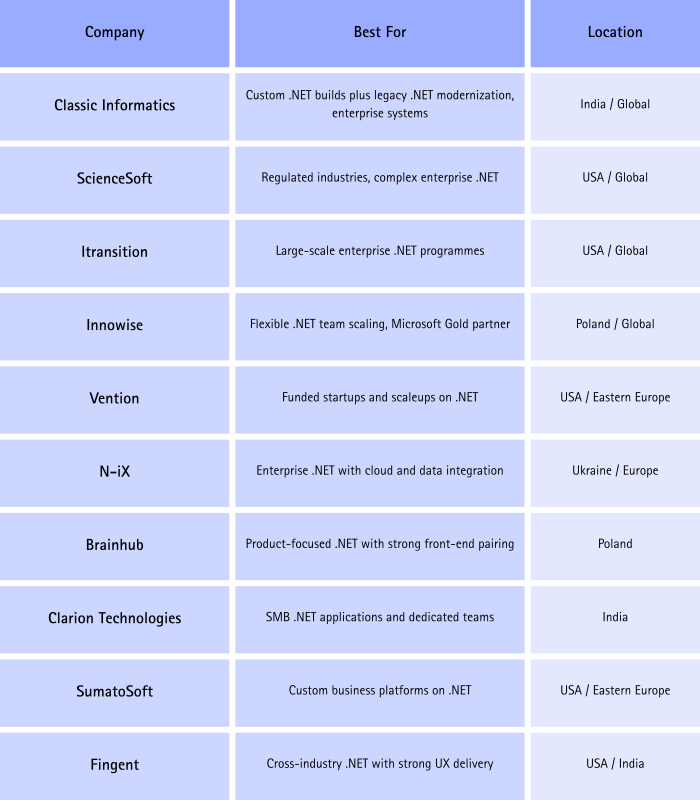
10 Dot Net Development Companies Worth Evaluating
1. Classic Informatics
Classic Informatics is a Microsoft Partner and AI-first technology company that covers the full .NET spectrum: greenfield ASP.NET Core builds, enterprise platforms, and the legacy side most vendors avoid. With 23+ years of delivery, 3,000+ projects, and clients across 30+ countries, the team has lived through every .NET era — which matters when your estate spans more than one of them.
Two strengths set the work apart. First, custom software development on modern .NET with AI-augmented engineering workflows, so delivery is faster without loosening review and testing discipline. Second, legacy modernization: assessing aging .NET Framework systems and migrating them incrementally to .NET 10-era architecture, instead of betting everything on a rewrite. Need intelligence in the product too? AI integration into existing .NET platforms is a core practice, not an add-on.
-
ASP.NET Core and .NET application development
-
Legacy .NET Framework modernization and migration
-
Enterprise systems, BI dashboards, and content platforms
-
Azure cloud architecture and deployment
-
AI integration into .NET products
If you want one partner who can build the new system and retire the old one — with a 95% client retention rate behind that promise — start here.
2. ScienceSoft
ScienceSoft has been building on Microsoft technologies since the .NET platform launched, and it shows. The Texas-headquartered firm delivers complex enterprise .NET systems for healthcare, BFSI, manufacturing, and retail clients across 30+ industries.
Its strength is rigour: documented processes, security certifications, and the compliance fluency regulated buyers need.
-
Enterprise .NET application development
-
Healthcare and financial domain depth
-
Security and compliance certifications
-
Long-term support and evolution
The right call for compliance-heavy enterprise builds. Startups will likely find the engagement model heavier than they need.
3. Itransition
Itransition is a global software firm with a large, mature .NET practice serving enterprise clients. Its 3,000+ engineers deliver .NET work inside broader programmes — ERP integrations, enterprise portals, and multi-year platform builds.
Scale and process consistency are the differentiators here.
-
Enterprise .NET development at scale
-
Microsoft stack integration (Azure, Dynamics, SharePoint)
-
Managed long-term delivery
-
Broad industry coverage
Best when .NET is one stream in a larger enterprise programme. For a single focused product build, smaller teams move faster.
4. Innowise
Innowise is a Microsoft Gold certified partner with 2,000+ engineers and a flexible delivery model. Its .NET group handles web applications, enterprise systems, and team extension, scaling capacity up or down as projects demand.
That elasticity makes it popular with companies whose .NET needs fluctuate quarter to quarter.
-
ASP.NET Core and .NET Framework development
-
Microsoft Gold partnership
-
Team extension and project delivery models
-
Cross-industry experience
A solid choice for flexible .NET capacity. Buyers wanting deep strategic ownership of one product may prefer a partner-model firm.
5. Vention
Vention, headquartered in New York, pairs funded startups and scaleups with dedicated engineering teams, and its .NET practice is a strong part of that portfolio. The firm is known for moving at startup pace while maintaining enterprise-grade engineering standards.
-
Dedicated .NET teams for scaleups
-
Fintech, healthtech, and e-commerce experience
-
Fast team assembly
-
US-aligned account management
Great for venture-backed companies that need to scale .NET capacity quickly. Less suited to legacy-heavy enterprise estates.
6. N-iX
N-iX is a 2,000-person European engineering firm with a well-established .NET practice and strong cloud, data, and embedded capabilities around it. It works mostly with mid-market and enterprise clients across manufacturing, logistics, and financial services.
The appeal is .NET expertise combined with adjacent disciplines — useful when your .NET system needs to talk to data platforms and cloud infrastructure.
-
Enterprise .NET development and modernization
-
Azure cloud migration
-
Data engineering integration
-
Manufacturing and logistics domain work
Best for European enterprises wanting .NET plus cloud and data under one roof. US-only buyers may prefer partners with more US-overlap hours.
7. Brainhub
Brainhub is a Polish product engineering studio that pairs .NET back-ends with strong JavaScript front-ends — React, TypeScript, Node.js. The team is deliberately senior-heavy and works best on focused product builds where engineering quality is the priority.
-
.NET back-end with modern front-end pairing
-
Senior-only engineering teams
-
Product development focus
-
Gaming, fintech, and healthcare experience
Choose Brainhub for a product where code quality matters more than team size. Large multi-team programmes will outgrow the model.
8. Clarion Technologies
Clarion Technologies, based in Pune, India, has spent two decades as a .NET application development company providing dedicated teams to small and mid-sized businesses, serving 1,500+ clients across 35 industries.
Its sweet spot is giving SMBs reliable, affordable .NET capacity without enterprise procurement overhead.
-
.NET web and application development
-
Dedicated developer and team models
-
SMB-friendly pricing
-
Power BI and full-stack capabilities
A practical choice for SMBs with steady .NET needs. Complex enterprise architecture work points to firms higher on this list.
9. SumatoSoft
SumatoSoft is a Boston-based custom software firm delivering business platforms on .NET for clients including recognisable enterprise brands. It emphasises transparent estimation and structured delivery — clients get detailed time and cost breakdowns before work starts.
-
Custom business platform development
-
Transparent estimation and reporting
-
Enterprise and mid-market clients
-
Web and mobile delivery
Good for buyers who value predictability and process clarity. Teams wanting heavy R&D experimentation may find the structure constraining.
10. Fingent
Fingent operates from New York and Kochi, delivering .NET applications with notably strong UX design across healthcare, logistics, real estate, and education. It suits organisations that want business applications employees actually enjoy using.
-
.NET application development with UX focus
-
Healthcare and logistics domain work
-
Cloud and enterprise integrations
-
Cross-platform web development
Best for business applications where adoption depends on design quality. For deep platform engineering or migrations, consider the specialists above.
How to Choose the Right .NET Development Partner
Run your shortlist through these filters before any pricing conversation:
-
Three-job coverage: Can they build new, maintain legacy, and migrate between the two? Ask for one example of each.
-
Modern .NET fluency: A real .NET core development company works in ASP.NET Core, .NET 8/10, and containerised deployments — not just .NET Framework war stories.
-
Custom .net development company fit: Verify they build bespoke systems, not template-tweaked products.
-
Azure depth: Most .NET roadmaps end up cloud-bound; partner Azure experience saves you a second vendor.
-
Code quality evidence: Review practices, test coverage expectations, and how AI coding tools are governed.
-
Domain familiarity: An asp.net development company that knows your industry's workflows shortens discovery by months.
-
Engagement transparency: Clear estimates, honest risk flags, and easy exit terms.
Let's Wrap This Up!
.NET rewards the companies that take it seriously and punishes the ones that coast on it. The platform's range — from legacy Framework estates to cloud-native .NET 10 — means the "right" partner is entirely a function of where your systems sit on that spectrum and where you need them to go.
Most of the firms on this list are excellent at one point on the spectrum. A few cover all of it.
If you're building a new .NET application, untangling a legacy one, or trying to do both at once without doubling your vendor count, Classic Informatics has done exactly that across manufacturing, healthcare, insurance, and technology — and our web development and platform teams are easy to test with a small first engagement.
FAQS

Frequently Asked Questions
Rates depend on region and seniority: $40–$80 per hour for strong Indian and Eastern European teams, $100–$200+ for US-based firms. A mid-sized custom .NET application typically runs $50,000–$250,000. Modernization projects vary more, because legacy system complexity — not new code volume — drives the effort.