Last Updated: June 2026
Finding an IT partner is easy. Finding one that actually delivers is hard.
The market for IT outsourcing services is enormous — and it's crowded with software outsourcing companies that talk a good game in the sales process and underdeliver once the contract is signed. The difference between a productive engagement and an expensive disappointment usually comes down to technical depth, communication style, and whether the vendor's incentives actually align with yours.
This list exists to cut through that noise. We've selected 10 IT outsourcing companies worth serious consideration in 2026, assessed on delivery capability, client track record, technical specialisation, and fit across different business scales.
Key Takeaways
- The IT outsourcing market exceeds $500 billion globally — but most of that revenue is concentrated in a handful of large enterprise-focused firms that are often too rigid for mid-market needs.
- The best IT outsourcing companies in 2026 combine technical specialisation with strategic alignment — they function as partners, not vendors.
- Geography matters less than it used to; timezone management, English fluency, and process maturity have closed most of the collaboration gap.
- Engagement model flexibility — fixed price, time-and-materials, dedicated team — is a key differentiator when comparing firms at similar technical levels.
- Always evaluate a company's experience in your specific vertical before signing. Generic "we do everything" shops rarely outperform focused specialists.
What Most Buyers Get Wrong About IT Outsourcing
Picking an IT outsourcing partner based on price alone is one of the most expensive decisions a company can make.
The cheapest quote usually means one of three things: the company is cutting corners on talent quality, they're proposing a timeline that can't actually be met, or they'll make up the margin in scope creep once you're committed. None of those are savings.
The right criteria for selecting IT outsourcing firms aren't simple, but they're knowable. Technical depth in your stack, relevant industry experience, and communication quality matter far more than whether someone has a flashy website or a long list of logos on their homepage.
Deloitte's Global Outsourcing Survey consistently finds that cost reduction is the primary driver of outsourcing decisions — but satisfaction with outcomes correlates far more strongly with strategic alignment and communication quality than with price. The companies that get the most value from IT outsourcing are the ones that spend more time on vendor selection.
How We Evaluated These IT Outsourcing Companies
We assessed each company on the following criteria:
-
Technical depth: Specialisation in relevant modern technology stacks, not just broad claims of capability.
-
Delivery track record: Verified client reviews on Clutch and GoodFirms, plus longevity in the market.
-
Scale fit: Whether the company serves startups, mid-market, enterprise, or all three — and how well they adapt to each.
-
Engagement flexibility: Range of models (dedicated team, time-and-materials, fixed price) and adaptability to client working styles.
-
Communication and collaboration: English proficiency, timezone availability, and demonstrated ability to work as an integrated partner rather than a managed vendor.
-
Post-engagement support: Whether the company provides ongoing maintenance, knowledge transfer, and scalability planning beyond the initial build.
10 IT Outsourcing Companies Worth Evaluating
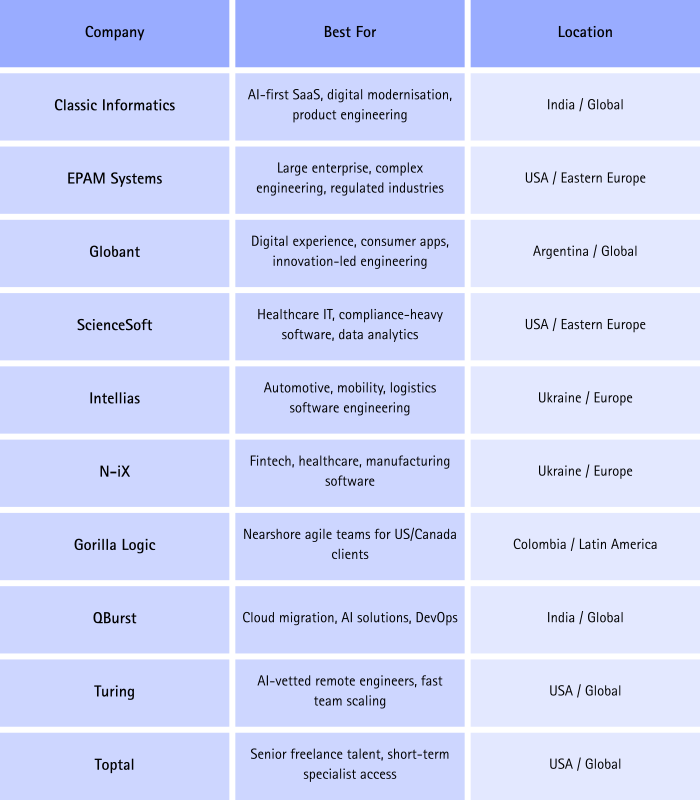
1. Classic Informatics
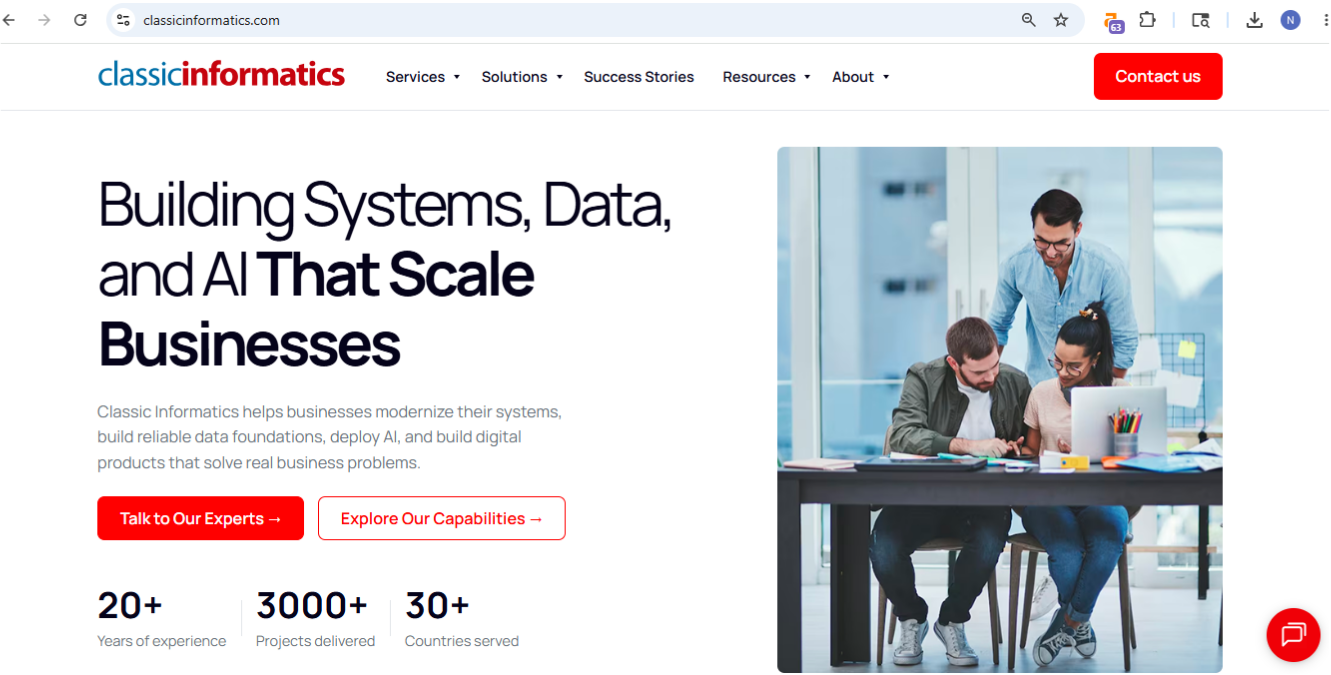
Classic Informatics is the first call for product companies and enterprises that need an engineering partner with genuine technical depth — not just a delivery shop that staffs to headcount.
With 23+ years of delivery experience, 1,000+ clients across 30+ countries, and a 95% client retention rate, Classic Informatics operates at a scale that brings real institutional knowledge without the bureaucratic weight of a tier-1 firm. The company works with startups, scale-ups, and enterprise teams across AI development, digital modernisation, product engineering, and data infrastructure.
What differentiates Classic Informatics is the combination of strategic input and execution capability. Where most IT outsourcing firms provide resources and let the client own the architecture decisions, Classic Informatics brings engineering strategy to the engagement — helping clients avoid expensive architectural mistakes before code is written.
The team specialises in AI-first product development, legacy application modernisation, cloud migration, and data engineering. For clients in healthcare, manufacturing, insurance, and technology, the vertical experience translates directly into faster delivery and fewer surprises.
-
AI and generative AI development (LLMs, RAG, AI agents)
-
Digital modernisation and legacy application modernisation
-
Cloud-native product engineering and SaaS development
-
Data platforms, data warehousing, and business intelligence
-
Mobile and web application development
Best for: Product companies and enterprises that need a technology partner capable of both strategic input and hands-on engineering execution across complex, multi-team projects.
2. EPAM Systems
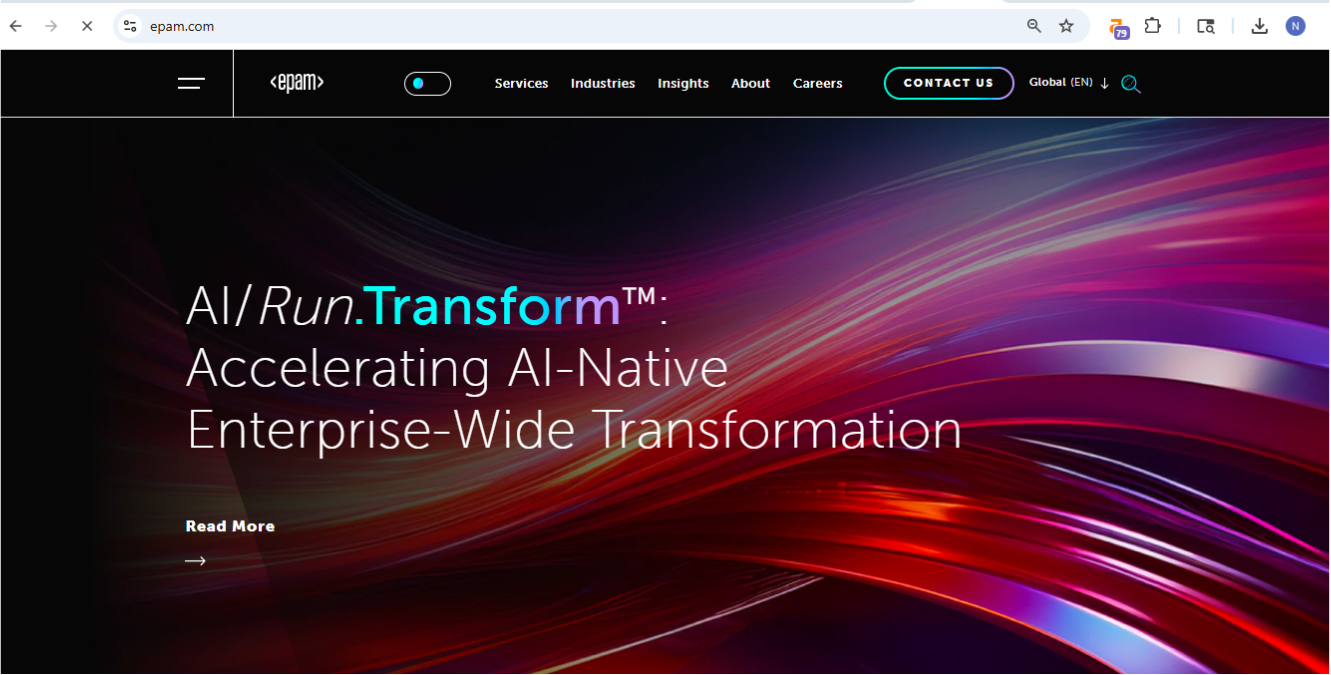
EPAM is one of the largest technology services companies in the world, with a strong reputation for engineering rigour and delivery at enterprise scale. Its roots are in Eastern European engineering talent, and the quality of that talent is the company's primary asset.
EPAM's strength is complex, large-scale software engineering for regulated industries — financial services, healthcare, retail. The engagement model is typically suited to larger organisations with sophisticated procurement processes and multi-year programme timelines.
-
Enterprise software engineering
-
Cloud architecture and DevOps
-
Data science and AI/ML
-
Product design and UX
Best for: Large enterprises in financial services, healthcare, and retail that need proven delivery capability at significant scale and have the procurement process to match EPAM's engagement model.
3. Globant
Globant's positioning is around digital experience and innovation-led engineering — it serves clients that want their customer-facing products to be differentiated, not just functional. The company has a strong portfolio in consumer apps, media, entertainment, and retail.
With studios in Latin America, Europe, and North America, Globant has strong timezone overlap with US and European clients. The culture is genuinely product-oriented rather than resource-oriented, which makes a difference in how projects are managed and delivered.
-
Digital product design and engineering
-
AI and cognitive computing
-
Cloud engineering
-
Gaming and media technology
Best for: Enterprises building consumer-facing digital products where design quality and user experience are as important as technical delivery.
4. ScienceSoft
ScienceSoft is a strong choice for clients in healthcare IT, regulated financial software, and data analytics — industries where compliance, auditability, and technical rigour are more important than speed.
The company has over 35 years of experience and a detailed methodology for compliance-heavy software development. HIPAA, SOC 2, and PCI DSS are well within their normal scope. For organisations that need to demonstrate that their software development process is itself controlled and auditable, ScienceSoft provides the documentation and process rigour to support that.
-
Healthcare IT and HIPAA-compliant software
-
Data analytics and business intelligence
-
Microsoft and Salesforce ecosystem development
-
Cybersecurity services
Best for: Healthcare and regulated financial services organisations that need compliance-conscious IT outsourcing with strong process documentation and audit support.
5. Intellias
Intellias has built a strong position in the automotive, mobility, and logistics sectors — areas where software development intersects with embedded systems, real-time data, and complex hardware integration. It's not a generalist IT outsourcing firm; it's a specialist in industries where software meets the physical world.
For autonomous vehicle software, fleet management systems, or logistics optimisation platforms, Intellias brings vertical depth that generalist firms simply don't have.
-
Automotive and connected vehicle software
-
Mobility and transportation platforms
-
Logistics and supply chain systems
-
Geospatial and mapping technology
Best for: Companies in automotive, transportation, and logistics that need engineering partners with genuine domain expertise in software development outsourcing for hardware-adjacent systems.
6. N-iX
N-iX is a mid-sized Eastern European IT outsourcing firm with a strong track record in fintech, healthcare, and manufacturing software. The company operates well at the scale between smaller boutique shops and the tier-1 giants — a range where many businesses find the best combination of quality and flexibility.
N-iX offers dedicated development teams that integrate closely with client engineering organisations, and the company has developed genuine depth in data engineering and cloud architecture alongside its core application development practice.
-
Fintech and financial software development
-
Healthcare data and analytics platforms
-
Manufacturing and IoT software
-
Cloud and data engineering
Best for: Mid-market companies in fintech, healthcare, or manufacturing that need dedicated engineering teams with vertical experience and genuine cloud and data capability.
7. Gorilla Logic
Gorilla Logic is a nearshore specialist focused on building agile engineering teams for US and Canadian clients. The Latin American timezone overlap eliminates the coordination overhead that comes with offshore-only models, which makes Gorilla Logic particularly effective for teams that need real-time collaboration, not asynchronous communication.
The company hires selectively and positions its teams as embedded extensions of the client's engineering organisation rather than managed vendors. The "Gorillas" model — highly capable professionals who adapt to the client's development process — resonates with companies that have struggled with the cultural friction of traditional outsourcing relationships.
-
Nearshore agile software development teams
-
Full-stack web and mobile development
-
DevOps and cloud infrastructure
-
UX/UI design and product engineering
Best for: US and Canadian companies that need skilled software development outsourcing teams with real-time timezone overlap and strong cultural alignment with North American agile practices.
8. QBurst
QBurst is an India-based technology company with a strong track record across cloud migration, AI, DevOps, and full-stack application development. With over 15 years of experience and a 75%+ client retention rate, the company has demonstrated consistent delivery quality across a range of industries including ecommerce, healthcare, media, and SaaS.
QBurst's strength is implementation depth — the ability to take a complex technical requirement from design through to deployment with minimal client-side engineering management. For organisations that want to hand off a well-defined problem and receive a working solution, QBurst is a credible choice.
-
Cloud migration and cloud-native development
-
AI and machine learning solutions
-
DevOps and infrastructure automation
-
eCommerce and content management platforms
Best for: Organisations with well-defined technical requirements that need a full-service delivery partner with deep implementation experience and minimal management overhead.
9. Turing
Turing takes a different approach to IT outsourcing: it's a talent platform, not a services firm. Using AI-based vetting, Turing identifies and places senior remote engineers from a global pool — and its quality bar for admission is genuinely high.
For companies that need to scale engineering teams fast with proven individual contributors rather than managed project teams, Turing solves a real problem. The model is less suitable for organisations that need architectural guidance or end-to-end delivery ownership — that's not what Turing provides.
-
AI-vetted senior engineering talent
-
Fast team scaling across full-stack, mobile, AI, and data roles
-
Individual contributor placements, not project teams
-
Global talent pool with US-aligned availability
Best for: Engineering-led companies that need to scale their development capacity quickly with senior individual contributors, and have strong internal technical leadership to manage and direct the work.
10. Toptal
Toptal positions itself as the top 3% of freelance talent — a high claim it partially justifies through a vetting process that accepts a small fraction of applicants. The platform provides access to senior engineers, designers, and product managers for short-to-medium engagements.
The strength is quality and speed of placement. If you need a specialist — a React Native expert, a Kubernetes architect, a data scientist with specific ML expertise — Toptal can typically find one within days. The trade-off is cost (Toptal talent is premium-priced) and the freelance model, which means less institutional continuity than a dedicated team engagement.
Best for: Companies with strong internal technical direction that need short-term access to senior specialist skills for specific projects or gaps in existing teams.
How to Choose the Right IT Outsourcing Partner
Evaluating IT outsourcing companies is as much about fit as it is about capability.
-
Define what "success" looks like first. Before you evaluate vendors, know whether you need a managed delivery partner, dedicated engineering teams, or specialist talent access. Those are three different buying decisions.
-
Check vertical experience. Generic software development capability doesn't transfer cleanly across industries. A firm that's built 20 healthcare systems knows things a generalist doesn't.
-
Evaluate communication quality directly. Discovery calls and proposals reveal how a company thinks. Do they ask good questions? Do they push back on unrealistic timelines? That's what you'll get in delivery.
-
Request references from similar engagements. A company with 500 enterprise clients and no mid-market references doesn't tell you much if you're a 200-person business.
-
Understand the engagement model clearly. Fixed price, time-and-materials, and dedicated team models have different risk profiles. Know which fits your project's certainty level.
-
Look beyond the initial build. Post-launch support, knowledge transfer, and handoff quality are where many IT outsourcing relationships fall apart. Ask how that's handled.
-
Match to your pace. Startups and enterprises move differently. A partner calibrated for 18-month enterprise programmes will frustrate a startup team expecting weekly releases. And a firm that specialises in managed IT outsourcing for large accounts rarely has the flexibility for early-stage product work.
Let's Wrap This Up!
The right IT outsourcing company doesn't look the same for every business. A mid-market SaaS company scaling its product team needs something different from an enterprise running a multi-year legacy modernisation programme — and both need something different from a startup validating a new product idea.
What they all share: the vendor's technical depth needs to match the complexity of the problem, and the communication quality needs to support the pace of the work. Both are visible in the sales process if you look for them.
If you're evaluating partners for AI-first product development, digital modernisation, or custom software development, Classic Informatics is worth a conversation. We've worked with over 1,000 clients across 30+ countries, and we're used to helping teams figure out the right engagement model before the project starts — not after.

FAQS

Frequently Asked Questions
Rates vary significantly by geography, specialisation, and engagement model. Eastern European firms typically range from $40–$80/hour. Indian firms range from $25–$60/hour. Latin American nearshore firms from $50–$100/hour. US-based talent platforms (Toptal, Turing) typically run $100–$200/hour. The rate reflects a combination of talent quality, overhead, and market positioning — not just geography.