Finding a software outsourcing partner is easy. Finding one that doesn't walk away six months in is the hard part.
Choosing wrong isn't just an inconvenience — it's expensive. Rework costs money. Delays cost market position. And rebuilding trust with your board after a failed engagement costs more than both. The decision deserves more scrutiny than most teams give it.
This post focuses on companies that can actually sustain a project from first sprint to post-launch scale. Not agencies that win the pitch and quietly hand off to junior teams. According to Statista, the global IT outsourcing market is projected to exceed $591 billion by 2026 — which means a lot of vendors competing for your budget, and a lot of variation in what you'll actually get.
We've narrowed it down to 12 worth a serious look.
Key Takeaways
- The best software outsourcing companies combine technical depth with post-launch accountability — not just fast delivery.
- Cost alone is a poor filter; process maturity and communication style predict outcomes far better.
- "Software outsourcing projects available" is a common search — most vendors have capacity, but few have the right fit.
- Classic Informatics has delivered 3,000+ projects across 30+ countries, with 95% client retention after 23+ years.
- Evaluating 5–6 shortlisted firms on engagement model and client references beats comparing 30 names on a spreadsheet.
What Most Companies Get Wrong About Software Outsourcing
Most buyers start with the wrong filters.
They narrow by price, portfolio size, and location — then wonder why the engagement feels transactional six weeks in. Cost matters, but it's a terrible proxy for quality. A cheap vendor who misunderstands your requirements is more expensive than a mid-range partner who gets it right.
The real differentiators are harder to see in a sales call. Things like: how a team handles a missed deadline. Whether they push back on requirements that don't make sense. Whether their post-launch support is a real offering or a politely worded exit. These signals only emerge through references, trial engagements, and honest questions — not through a proposal deck.
Process maturity is underrated. A company that documents decisions, runs structured sprint reviews, and flags blockers early will outperform a faster team that operates informally.
Communication style matters more than time zone. A team eight time zones away with clear async rhythms will outperform a nearby team with poor documentation habits.
Pick for fit. Not just for availability.
How We Evaluated These Software Outsourcing Companies
Each company on this list was assessed against the same five criteria — the ones that actually determine whether a project ships and scales.
- Engineering depth: Breadth of technical capabilities and stack coverage
- Industry experience: Track record across relevant sectors
- Client satisfaction: Ratings, retention, and long-term partnerships
- Engagement flexibility: Whether they support MVPs, dedicated teams, and full-cycle delivery
- Post-launch support: Ability to maintain and scale post-delivery
12 Software Outsourcing Companies Worth Evaluating
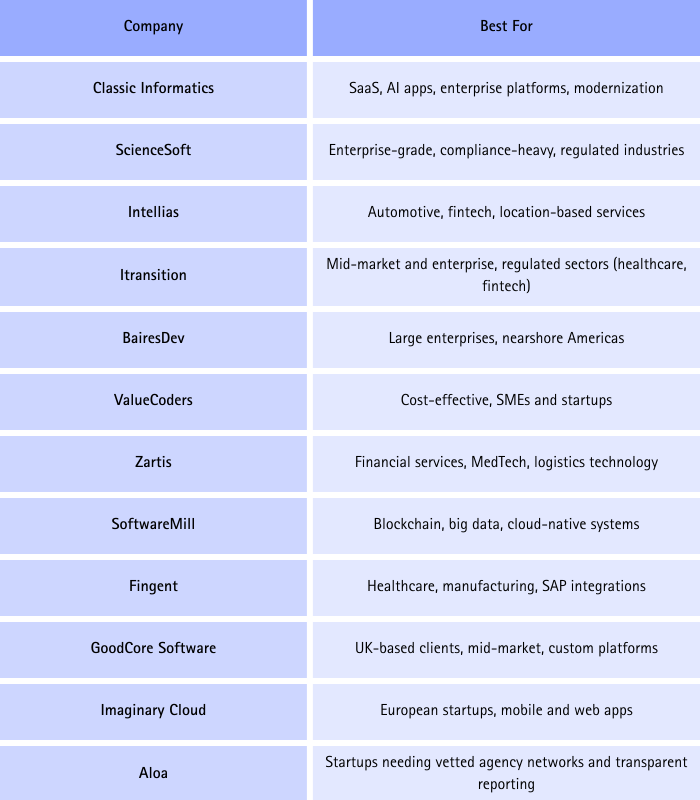
1. Classic Informatics
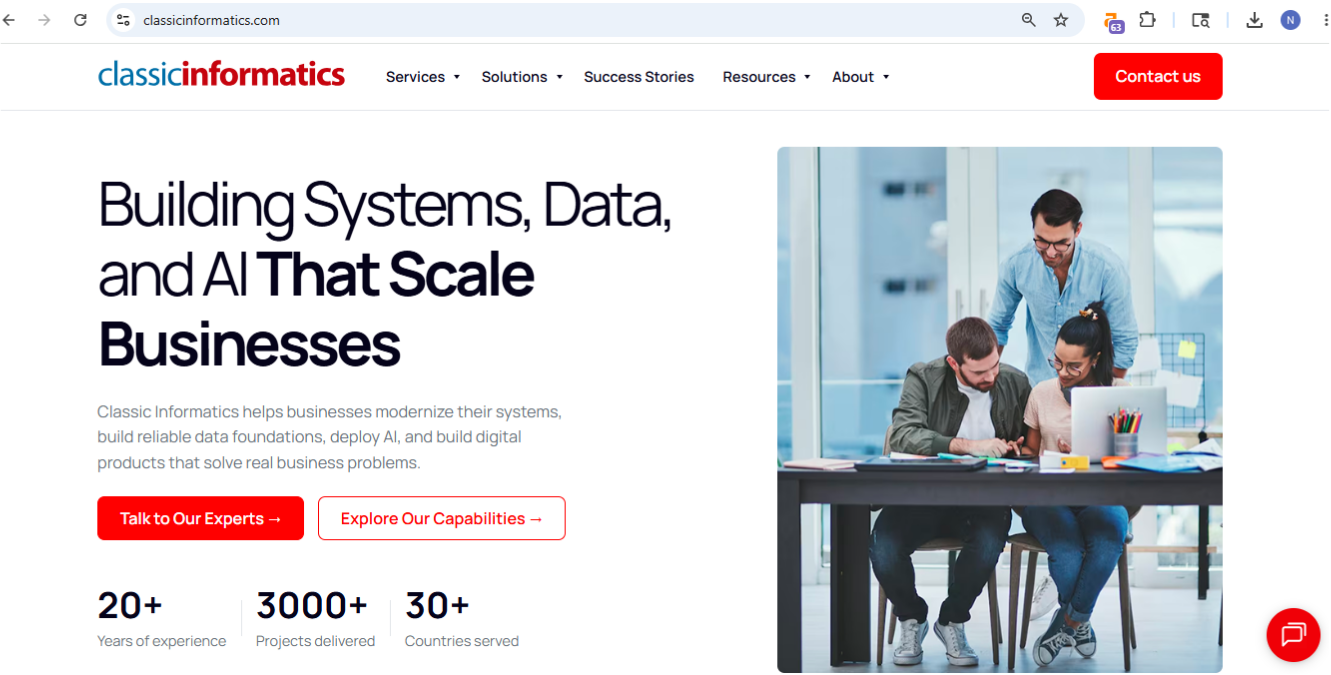
Classic Informatics is best suited for product companies building SaaS platforms, enterprise applications, and AI-powered tools — teams that need a partner who can think alongside them, not just execute instructions.
With 23+ years in software development outsourcing, 3,000+ projects delivered, 1,000+ clients across 30+ countries, and a 95% client retention rate, Classic Informatics brings a level of institutional depth most firms in this space can't match. That retention number matters: it means clients don't just ship with Classic Informatics — they stay.
The delivery model is built for product velocity. CI/CD pipelines, agile sprint structures, rapid prototyping, and iterative releases mean teams move quickly without sacrificing architecture quality. That balance — speed without shortcuts — is what separates product engineering from project delivery. And it's especially important when you're building something you plan to scale.
If you want code that ships and scales, Classic Informatics brings both the technical depth and the collaborative discipline to make it happen.
Core service areas:
- AI applications and LLM integration
- SaaS platform development
- Mobile and web application development
- Modernisation-led engineering
- Custom software development
2. ScienceSoft
ScienceSoft is a strong option for mid-market and enterprise teams that need broad technical coverage across legacy modernisation, data engineering, and IT outsourcing.
Founded in 1989, ScienceSoft has a long track record across healthcare, retail, and finance. Their ISO-certified processes and security compliance credentials make them a credible choice for regulated industries. They operate across full-cycle delivery and managed services.
Capabilities:
- Legacy application modernisation
- Cybersecurity consulting and implementation
- Data analytics and BI
- Cloud migration
- Custom CRM and ERP development
Best for teams that need verifiable compliance credentials and deep industry documentation. Less suited for early-stage product builds that need fast-turn iteration.
eSparkBiz
eSparkBiz is an AI-focused software outsourcing company based in India, with more than 15 years of experience and strong visibility across industry review and search platforms. They've delivered 1,000+ projects across startups, SMBs, and enterprises, with strengths in custom software, SaaS platforms, cloud applications, and AI-powered solutions.
What stands out is their product-focused approach. Beyond providing development teams, they support clients through planning, development, scaling, and ongoing improvements. That, along with their strong Clutch ratings prove that they are a good fit for both startups building new products and businesses looking to modernize existing systems.
Capabilities:
- Custom software development and product engineering
- Dedicated development teams and staff augmentation
- AI application development and automation solutions
- Cloud consulting, migration, and DevOps
- SaaS, web, and mobile application development
- Data engineering and analytics solutions
Best for startups, SaaS companies, and mid-market businesses seeking a flexible product-development partner. Companies needing highly specialized enterprise consulting may prefer larger transformation-focused firms.
4. Itransition
Itransition works well for enterprise teams that need cross-stack delivery across web, mobile, and enterprise systems.
With over 25 years in operation and 3,000+ clients across industries including healthcare, finance, and manufacturing, Itransition offers broad coverage without specialising so narrowly that it becomes inflexible. Their delivery model supports dedicated teams, project-based work, and staff augmentation.
Capabilities:
- Enterprise web and mobile development
- CRM and ERP system integration
- AI and machine learning solutions
- Quality assurance and testing
- IT infrastructure consulting
Works best for mid-to-large organisations that need consistent delivery across multiple workstreams. Less differentiated for product-first startups looking for a co-creative partner.
5. BairesDev
BairesDev positions itself as a nearshore option for North American companies that want Latin American talent with US-compatible working hours.
Their model is built around fast team assembly — they claim to staff projects within two weeks. That speed is genuinely useful for teams that need to scale quickly. Their network spans engineers across Argentina, Brazil, Mexico, and Colombia. They serve clients across technology, finance, and media.
Capabilities:
- Nearshore software development for North America
- Staff augmentation and dedicated teams
- Mobile and web application development
- Quality assurance engineering
- Cloud architecture
A useful shortlist option for US-based companies prioritising time zone alignment. Less of a fit if you need deep post-launch product ownership rather than resource supply.
6. ValueCoders
ValueCoders is an India-based software outsourcing firm with a focus on cost-effective delivery for startups and growing SMBs.
With 20+ years in the market and a client base that spans the US, UK, and Europe, ValueCoders offers a broad stack across web, mobile, and enterprise software. Their pricing model is accessible for teams managing tighter budgets without sacrificing technical competence.
Capabilities:
- Web and mobile application development
- E-commerce platform development
- API integration and development
- UI/UX design
- Dedicated developer teams
A solid choice when budget is a primary constraint and the scope is well-defined. Less suited for complex, ambiguous product work that requires strategic input from the delivery team.
7. Zartis
Zartis specialises in dedicated software engineering teams for European and US tech companies that want long-term team extensions rather than project-based delivery.
Founded in 2011 with delivery hubs across Spain, Poland, and Romania, Zartis focuses on placing senior engineers who integrate closely with in-house teams. Their model suits companies that want control over the day-to-day process while benefiting from external talent.
Capabilities:
- Dedicated software engineering teams
- Staff augmentation
- Software architecture consulting
- Agile team coaching
- Technical leadership placement
Best for mature tech companies that already have strong engineering leadership and need trusted team extensions. Not the right fit if you need a full-service partner to own delivery end-to-end.
8. SoftwareMill
SoftwareMill is a Polish software house known for deep back-end expertise, distributed systems, and data engineering.
They're a smaller firm — deliberately so. Their model is built on senior engineers working directly with clients, avoiding the large-team structures where junior developers get quietly slotted in. Their specialisation in Scala, Kafka, and event-driven architecture gives them a distinctive profile among software outsourcing firms.
Capabilities:
- Distributed systems and event-driven architecture
- Backend development (Scala, Java, Kotlin)
- Data engineering and stream processing
- Blockchain and smart contract development
- Technical consulting and code reviews
A good match for engineering-led teams building high-performance backend systems. Less suited for teams that need broad full-stack or mobile coverage.
9. Fingent
Fingent is a mid-sized software development company with a focus on enterprise technology consulting and digital transformation for sectors like healthcare, real estate, and logistics.
Based in the US with offshore delivery in India, Fingent combines strategic consulting with hands-on development. They support custom software builds, enterprise integrations, and process digitisation projects for clients across North America and the Middle East.
Capabilities:
- Enterprise software development
- Healthcare and logistics software
- ERP and CRM integration
- Cloud computing and DevOps
- Process automation and AI integration
Works well for established enterprises undergoing internal digitisation. May not be the fastest option for product startups that need iterative, sprint-based delivery.
10. GoodCore Software
GoodCore Software is a UK-based software outsourcing firm that works primarily with startups and SMBs on MVP development and bespoke software builds.
Their team is smaller and more founder-focused, which means faster access to senior developers and less bureaucracy in the engagement process. They serve clients in fintech, legal tech, and healthcare. Clients consistently reference their communication clarity as a differentiator.
Capabilities:
- MVP development for startups
- Bespoke software development
- Web application development
- API development and integration
- Post-launch maintenance
A strong shortlist option for early-stage founders who need a technically capable team that communicates well. Engagement scope may be limited for very large enterprise projects.
11. Imaginary Cloud
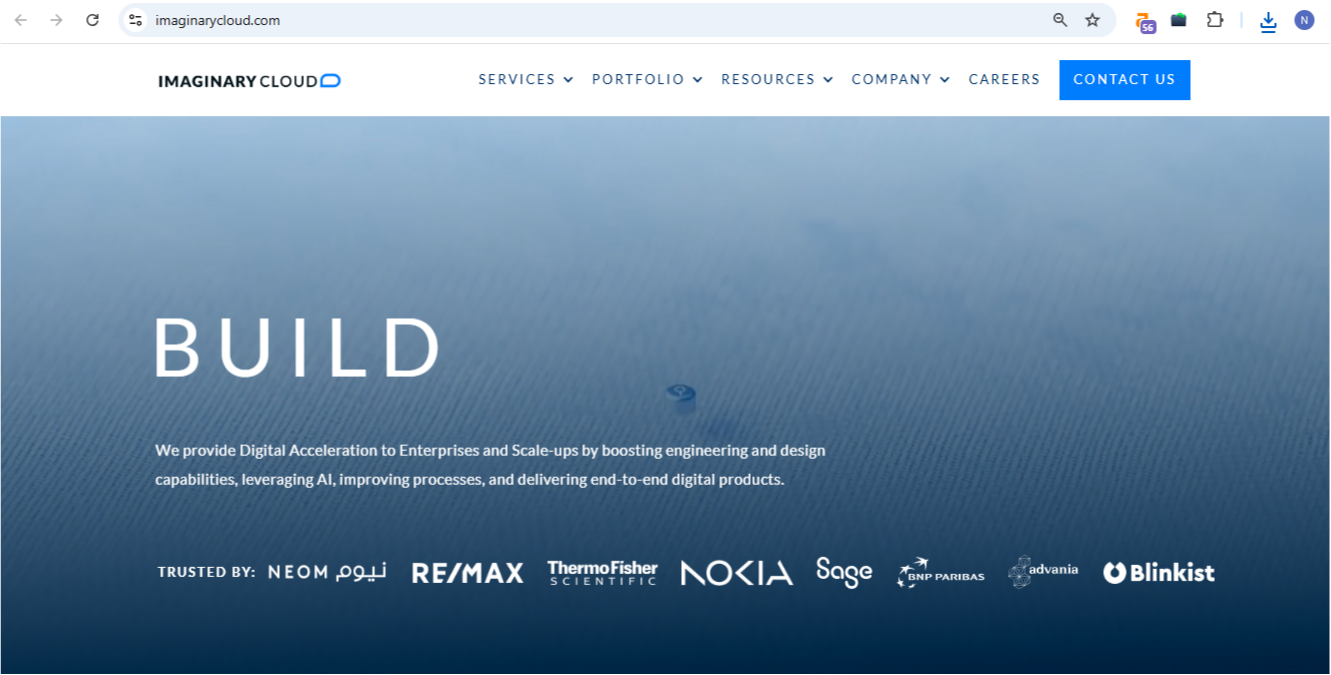
Imaginary Cloud is a Portugal-based product development company specialising in design-led software development for startups and scale-ups.
Their dual focus on product design and engineering means they're particularly effective for teams that want UX thinking embedded in the development process — not bolted on at the end. They've worked with clients across fintech, health, and SaaS.
Capabilities:
- Product design and UX
- Web and mobile development
- SaaS product development
- AI feature integration
- Digital product strategy
Well-suited for product-led companies that need design and development to work from the same team. Less suited for large-scale enterprise systems where integration complexity outweighs design scope.
12. Aloa
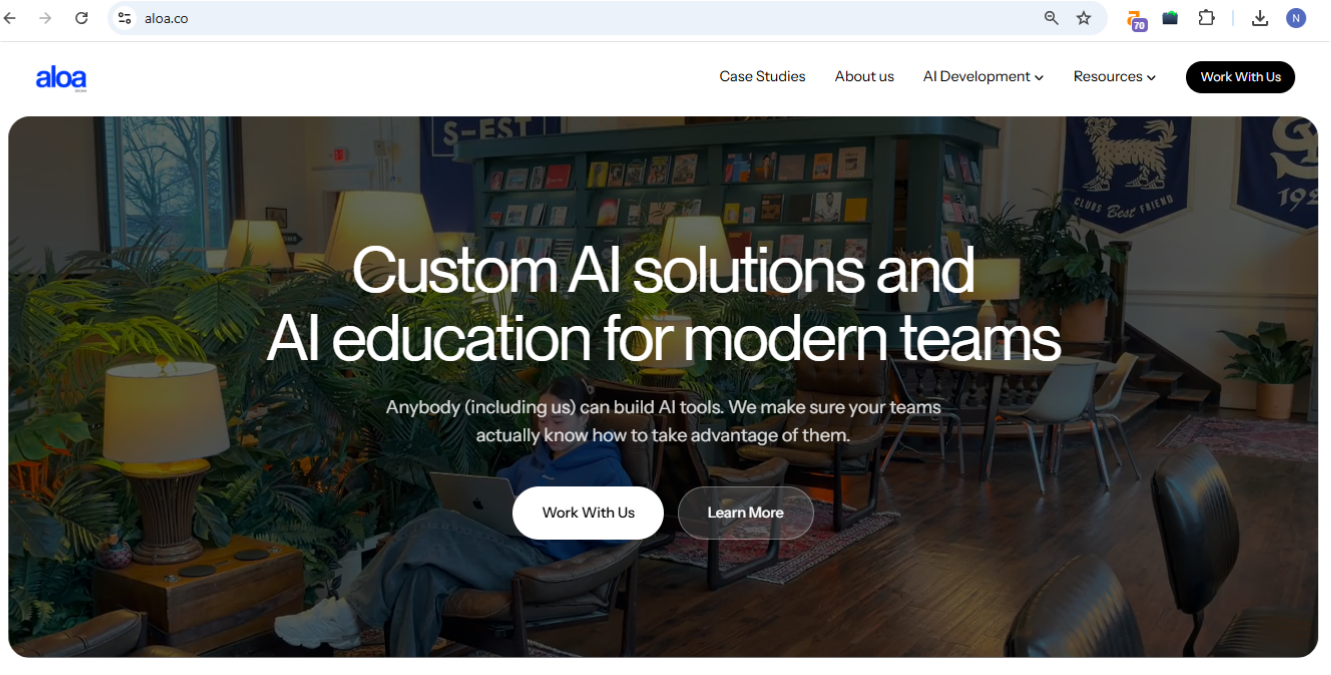
Aloa is a software outsourcing platform that connects US startups with vetted development partners — functioning more as a managed marketplace than a traditional development firm.
Their model is built for founders who want accountability built into the engagement. Aloa vets developers, manages contracts, and provides oversight — reducing the risk of the traditional offshore engagement. It's particularly useful for non-technical founders who need structure around vendor management.
Capabilities:
- Vetted developer matching for startups
- Project management and delivery oversight
- Web and mobile app development
- MVP prototyping
- Technical advisory for non-technical founders
Best for early-stage founders who need managed access to vetted talent with accountability guardrails. Not a fit for mature tech organisations that prefer direct vendor relationships.
How to Choose the Right Software Outsourcing Partner
No single criterion wins it. The right firm depends on your stage, your technical complexity, and how you like to work.
- Process transparency: Does the team document decisions, share sprint outputs, and flag blockers proactively? Process discipline predicts delivery quality better than portfolio size.
- Technical expertise and stack coverage: Does their stack match yours? A team with deep expertise in irrelevant technologies will slow you down, not speed you up.
- Communication and time zone alignment: Async communication discipline matters more than geography. Evaluate how they document and share updates — not just whether they're on your continent.
- Engagement model options: Can they support an MVP sprint, a dedicated team, or full-cycle delivery? Flexibility signals maturity.
- Scalability beyond the MVP: What happens after launch? A partner who can maintain, iterate, and scale is worth more than one who disappears post-delivery.
- Verifiable client outcomes: Ask for references. Not case study PDFs — actual conversations with past clients. Any firm worth engaging will facilitate this.
- Post-launch support: Bugs happen. Scope expands. Whether a firm offers real post-launch accountability — not just an SLA — determines whether you'll trust them with a second project.
Let's Wrap This Up!
Picking the wrong outsourcing partner costs more than hiring in-house. Rework, missed deadlines, and the overhead of managing a disengaged team adds up faster than the savings from lower day rates.
There's no single right answer on this list. BairesDev suits North American teams that need nearshore speed. SoftwareMill suits engineering teams building complex back-end systems. GoodCore suits startup founders who need high-touch communication and a capable team without enterprise overhead.
If you're evaluating outsourcing for a product build, AI integration, or platform modernisation, Classic Informatics works across all three. We've helped 1,000+ clients across 30 countries build software they're still scaling years later. Tell us what you're building.
FAQS

Frequently Asked Questions
A software outsourcing company is a third-party firm that takes on software development work on behalf of another business. They may handle the full product lifecycle — from design through deployment — or support specific functions like back-end development, QA, or mobile builds. The engagement model varies by firm and project scope.