
Key Takeaways
- Custom software is built for your business. Off-the-shelf software is built for the average buyer. That difference drives every other decision.
- Most custom software projects cost between $15,000 and $500,000. What you pay depends on how big the build is, not who you ask.
- Projects go over budget mainly because requirements keep changing after the work starts. Agreeing what you're building first is the biggest saving available.
- Build in-house if you'll be improving the software for years. Hire a partner if you need to start before you could finish hiring.
- Ask a partner how they handle changing requirements and who owns the code. Vague answers on either point become expensive later.
- If you work in a regulated industry, compliance shapes the design from day one. Adding it later costs almost as much as starting again.
Most software decisions aren't really about software. They're about whether an off-the-shelf tool can bend far enough to fit how your business actually works, or whether the gap is big enough that building something custom is the cheaper choice in the long run. Get that call wrong and you either pay for years to work around a tool that was never quite right, or you sink six figures into a custom build the business didn't really need.
This guide is for the CTO scoping a build-versus-buy decision, the founder trying to figure out what a first version should actually cost, and the product leader who's been asked to justify a software budget to a board that wants real numbers, not vendor talk.
What Is Custom Software Development?
Custom software development is the process of designing, building, and maintaining an application built for one organization's specific requirements, rather than licensing a packaged product built for thousands of different buyers at once.
That's the whole definition. Everything else is a variation on it. A custom CRM tuned to a specific sales process. An internal tool that replaces a spreadsheet three teams share by hand. A customer-facing platform nobody else in your industry has built quite the same way, because the way you run that part of the business is genuinely different from your competitors.
Off-the-shelf software is built for the median buyer. Custom software is built for you. That trade-off shows up everywhere: cost, timeline, control, and how well the tool actually fits your workflow five years in, once your process has moved on and the packaged tool hasn't.
| Off-the-shelf software | Custom software | |
|---|---|---|
| Upfront cost | Lower: subscription or license fee | Higher: pays for the build itself |
| Time to first use | Days | Weeks to months |
| Fit to your process | You adapt to the tool | The tool adapts to you |
| Ownership | You rent access | You own the code |
| Long-term cost as you scale | Per-seat and per-feature pricing compounds | Cost is mostly fixed once built |
| Integration with existing systems | Limited to the vendor's supported connectors | Built to your exact stack |
Neither column is universally right. A five-person team with a standard sales process doesn't need a custom build. A CRM off the shelf does the job for a fraction of the cost, and building something custom there is money spent solving a problem that doesn't exist yet.
Custom development earns its price in two situations. First, when the process you're supporting is genuinely different from what packaged software assumes, so every off-the-shelf tool forces a workaround somewhere. Second, when the software itself is meant to be a competitive advantage rather than back-office plumbing. A logistics company running the same route-planning software as every competitor isn't differentiating on it. One that builds its own, tuned to freight patterns nobody else has modeled, is.
Both situations share a test worth applying early: if the software stopped working tomorrow, would the business lose a convenience or lose a capability. Conveniences are usually cheaper to rent. Capabilities are usually worth owning.
There's a middle case worth naming too: heavily customized packaged software, where a platform like Salesforce or a large ERP gets configured and extended until it barely resembles the base product. That's not custom software in the strict sense, but it carries some of the same cost and maintenance profile, and it's the option most buyers skip past without pricing it properly.
What's Included in a Custom Software Development Engagement
A custom software development engagement covers six workstreams, and the ones buyers forget to ask about are usually the ones that decide whether the project lands.
- Discovery and requirements. Stakeholder interviews, a written requirements document, and an explicit out-of-scope list.
- Architecture and design. System architecture, stack selection, database and integration design, UX and UI.
- Development. The build itself, in iterations, with code review and version control discipline.
- Quality assurance. Functional, integration, security, and load testing, running alongside development.
- Deployment and DevOps. Environments, pipelines, monitoring, alerting, and the rollback plan.
- Support and evolution. Bug fixes, security patches, and the next round of features after launch.
The last two are where quotes diverge most. A proposal that prices discovery through deployment and goes quiet on support isn't cheaper than one that includes it. It's the same cost with a gap in it.
Engagement models matter as much as scope. Three are common, and each shifts risk differently.
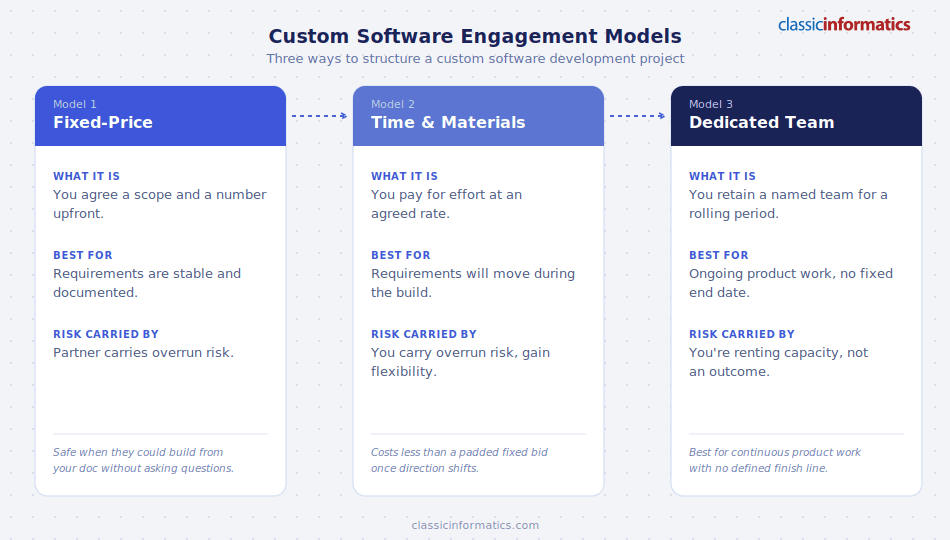
Fixed-price
You agree a scope and a number upfront. The partner carries the overrun risk, which means the quote already contains padding for it. Works when requirements are genuinely stable and documented.
Time and materials
You pay for effort at an agreed rate. You carry the overrun risk, and in exchange you get the flexibility to change direction without renegotiating. Works for anything where requirements will move.
Dedicated team
You retain a named team for a rolling period, effectively renting capacity rather than buying an outcome. Works for ongoing product work with no fixed end date.
Decision signal: If you can hand someone a requirements document and they could build from it without asking you questions, fixed-price is safe. If they'd need a conversation, time and materials will cost you less in the end than a padded fixed bid.
What Does Custom Software Development Cost in 2026?
Custom software development costs anywhere from $15,000 for a narrow internal tool to $500,000 or more for an enterprise platform, and the honest answer to "how much will this cost" depends almost entirely on which of those you're actually building.
Global IT spending is on track to top $6.3 trillion in 2026. Enterprise software is one of the fastest-growing lines in that budget: Gartner's own tracking shows business software spend accelerating to roughly $1.4 trillion this year. Custom builds are a meaningful share of that, and the price range is wide because "custom software" covers everything from a weekend internal tool to a multi-year platform rebuild.
The four brackets below are a starting point, not a quote. Every real estimate depends on team seniority, geography, integration count, and how well-defined the requirements are before development starts. But the brackets hold up well enough across the projects Classic Informatics has scoped that they're a reasonable gut check before you talk to anyone.
| Bracket | Typical cost | Typical timeline | Team size | Best fit |
|---|---|---|---|---|
| Small | $15,000–$50,000 | 1–3 months | 2–3 people | Single-purpose internal tool or a one-workflow MVP |
| Medium | $50,000–$150,000 | 3–6 months | 4–6 people | Customer-facing app or a platform replacing 3–4 tools |
| Large | $150,000–$500,000 | 6–12+ months | 7–12 people | Multi-unit platform or a compliance-heavy build |
| Enterprise | $500,000+ | 12+ months, phased | 12+ people | Core system replacement with a multi-year roadmap |
Note: these ranges reflect blended delivery rates across the regions Classic Informatics works in. A US-only or UK-only team will sit meaningfully higher at every bracket.
Small project
What it covers: A single-purpose internal tool, an MVP with one core workflow, or a lightweight integration between two systems.
Typical timeline: One to three months.
What drives the cost: Almost entirely feature count. There's little architecture work to speak of, so the estimate tracks closely to how many screens and workflows exist.
Decision signal: If you can describe the whole thing in two sentences and it solves one problem for one team, you're in this bracket. If your description needs a diagram, you're probably not.
Medium project
What it covers: A customer-facing app, a mid-sized internal platform, or software replacing three or four disconnected tools with one system.
Typical timeline: Three to six months.
What drives the cost: Integrations. Each system the software has to talk to adds testing surface and failure modes, and integration work is consistently the line item that gets underestimated most.
Decision signal: If the software needs to talk to two or more existing systems and serve more than one internal team, budget here.
Large project
What it covers: A platform supporting multiple business units, heavy compliance requirements, or genuinely novel functionality nobody else has built.
Typical timeline: Six to twelve-plus months.
What drives the cost: Compliance and architecture. Regulatory requirements shape design decisions from day one rather than being layered on at the end, and that shows up across every phase of the build.
Decision signal: If regulatory requirements like HIPAA, SOC 2, or PCI-DSS shape the architecture from day one, or the platform needs to scale to tens of thousands of users at launch, you're here regardless of how simple the feature list looks.
Enterprise project
What it covers: Core system replacement, a platform spanning multiple business lines, or a build with a multi-year roadmap attached.
Typical timeline: Twelve months and up, usually delivered in phases with separate budget approval for each.
What drives the cost: Running two systems at once. Phased replacement means the legacy platform stays live while the new one comes up, and carrying both environments is a real budget line rather than a rounding error.
Decision signal: If the project touches a system the business can't afford downtime on, budget for a phased rollout, not a single cutover. The cost of the phasing pays for itself the first time a rollback is needed.
These ranges hold up against the wider pattern in software development cost estimation: the biggest driver of cost overruns isn't the build itself, it's scope that keeps moving after development starts. McKinsey's research with the University of Oxford, still the most-cited benchmark in the field, found that large IT projects run 45 percent over budget on average, with software projects carrying the highest risk of overrun of any project type. In our experience, the projects that hold their budget are almost always the ones where requirements were locked before development started, not the ones with the tightest initial quote.
Pricing structure matters as much as the bracket itself. Fixed-price contracts work well for small, tightly scoped projects where requirements are genuinely stable. Time-and-materials pricing fits everything else, because it's the only model that doesn't force either side to guess at scope changes before they've happened. A fixed-price quote on a project with loosely defined requirements usually means the padding is already built into the number, whether or not it's stated that way.
The Custom Software Development Process, Step by Step
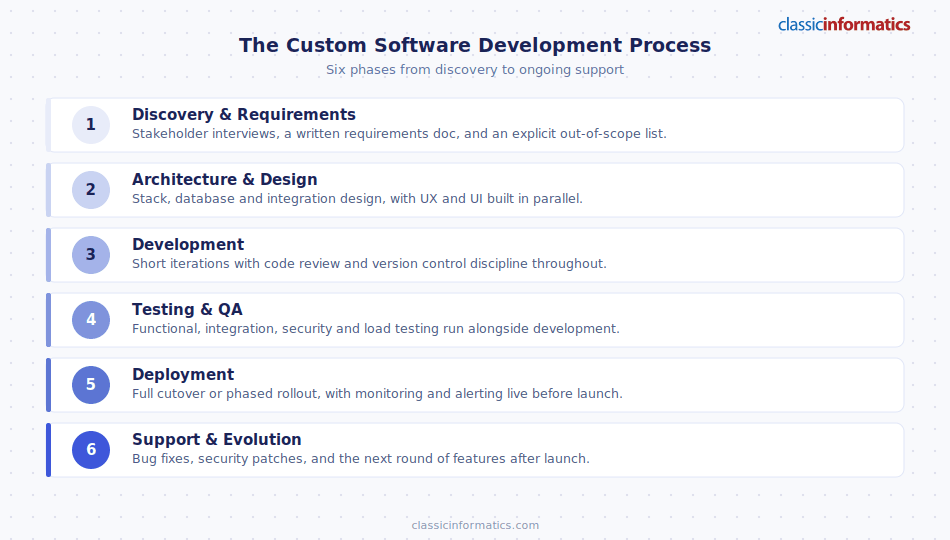
Discovery and requirements
This is where the project either gets scoped honestly or doesn't. A good discovery phase produces a requirements document, a rough architecture sketch, and, critically, a list of what's explicitly out of scope. Two to four weeks for most projects.
Stakeholder interviews happen here too: the people who'll actually use the software, not just the executive sponsoring it, because the gap between what a sponsor thinks the team needs and what the team actually does day to day is where a lot of requirements documents go wrong.
What to watch for: a discovery phase that skips straight to wireframes without writing down what the software actually needs to do is skipping the step that prevents scope creep later.
Architecture and design
The technical team maps out the system architecture, chooses the stack, and designs the database and integration points, while designers build the UX and UI in parallel. Following a published set of architecture principles at this stage catches expensive mistakes before a line of code exists; both AWS's Well-Architected Framework and Microsoft's Azure equivalent organise the same concerns into reliability, security, cost, and operational pillars. This is also where the team decides on a monolith versus a services-based architecture, a call that shapes almost everything downstream and is expensive to reverse once development is underway. Working out how to choose a tech stack belongs at this stage too, while the decision is still cheap.
What to watch for: architecture decisions made by whoever's available that week, rather than reviewed against how the system needs to scale, are the single most common source of a rebuild eighteen months later.
Development
Most teams now build in short iterations rather than one long build-then-test cycle, shipping a working slice of the product every one to two weeks so the client sees progress and can redirect early. This is also where minimum viable product thinking earns its keep: building the smallest version that proves the core assumption, rather than the full feature list, first.
Code review and version control discipline matter more here than almost anywhere else in the process, because the technical debt a rushed sprint creates is invisible until the third or fourth feature built on top of it. The coding best practices modern teams actually follow are less about style guides than about keeping that debt visible while it's still cheap to pay down.
What to watch for: a development phase with no visible output for more than a month has lost its feedback loop, regardless of how busy the team looks.
Testing and QA
Functional testing, integration testing, and, for anything handling real user data, security testing all run in parallel with development rather than bolted on at the end. Application security practices like the ones OWASP publishes and maintains are the baseline here, and NIST's Secure Software Development Framework makes the same point about sequencing: security practices have to be integrated throughout whichever development model you're using, not added to it afterwards. Load testing belongs here too for anything that expects real traffic at launch, not after the first outage proves it was needed.
What to watch for: QA that only starts after development is "finished" finds the expensive bugs at the most expensive possible time.
Deployment
The software goes live, either as a full cutover or, for anything replacing a system the business depends on, a phased rollout that runs the old and new systems in parallel for a defined window. Monitoring and alerting need to be live before launch day, not added after the first incident.
What to watch for: no rollback plan is the single riskiest thing a launch can be missing, and it costs almost nothing to have one ready.
Support and evolution
Custom software isn't finished at launch. Bug fixes, security patches, and the next round of features all happen here. In our experience, this is also where the build-versus-buy bet actually gets settled: a custom system that keeps adapting cleanly as the business changes justified the upfront cost, and one that starts accumulating the same workarounds the packaged tool did probably needed a different architecture decision three steps back.
What to watch for: a support phase with no dedicated owner, internal or from the delivery partner, is how a well-built system quietly turns into next year's legacy problem.
Choosing a Delivery Model
| Model | Best fit | Cost profile | Team you need in-house | Change tolerance |
|---|---|---|---|---|
| In-house | Core product you'll iterate on for years | Highest fixed cost, lowest marginal cost | Full team: product, architecture, dev, QA | High: you control the roadmap |
| Partner-led | Defined build with a clear scope and deadline | Predictable project cost, no hiring overhead | Product owner only | Medium: depends on the change process |
| Hybrid | Ongoing product with capacity gaps | Middle: fixed core plus flexible capacity | Product owner and architect | High: internal team sets direction |
In-house development
What it is: Your own employees build the software, with full-time ownership of the codebase and deep institutional knowledge of the business.
Where it works: Products that are central to how you make money, where the roadmap never really ends and the cost of losing context between teams is high.
Where it doesn't: One-off internal tools. The hiring and onboarding cost alone usually exceeds the value of the tool, and you're left carrying salaries after the build is finished.
Decision signal: If the software is core to your product and you'll be iterating on it for years, in-house ownership is worth the cost of building and retaining the team. If it's a one-off internal tool, look at the other two models.
Partner-led development
What it is: An external partner delivers the build, either as a fixed-scope engagement or an ongoing team extension.
Where it works: Projects that need to start before a hiring cycle could realistically finish, or builds needing specialised skills you don't want to carry permanently.
Where it doesn't: Situations where requirements are genuinely unknown at the outset. Without a defined change process, a partner engagement on shifting requirements gets expensive and adversarial fast.
Decision signal: If you need external delivery capacity and don't have the in-house bandwidth to hire and manage a team before the project needs to start, a partner gets you moving without a six-month hiring cycle. If your requirements are still forming, spend on discovery before you spend on a build.
Hybrid delivery
What it is: A core internal team owns product direction and architecture, while an external partner extends capacity for development, QA, or specialised skills.
Where it works: Teams that already have a product owner and architect but need more hands to hit a date, or need a skill set for one phase only.
Where it doesn't: Organisations with no internal technical ownership at all. Hybrid delivery assumes someone in-house can make architecture calls; without that, it becomes partner-led with extra coordination overhead.
Decision signal: If you already have a product owner and architect in-house but need more hands to hit a timeline, hybrid delivery is usually the fastest path. If you don't have either role filled, fill them first or go partner-led.
The in-house vs outsourcing software development decision usually comes down to two questions: how long will you be maintaining this software, and do you already have the internal expertise the build needs. A short-lived internal tool rarely justifies a hiring cycle. A core product almost always does.
Within partner-led delivery there's a further split worth pricing separately, since a dedicated development team vs freelancers comparison changes the maths on anything expected to run past a couple of months.
What Changes on Enterprise Builds
Enterprise custom software isn't a bigger version of a mid-market build. Four things change, and each one adds time that has nothing to do with writing code.
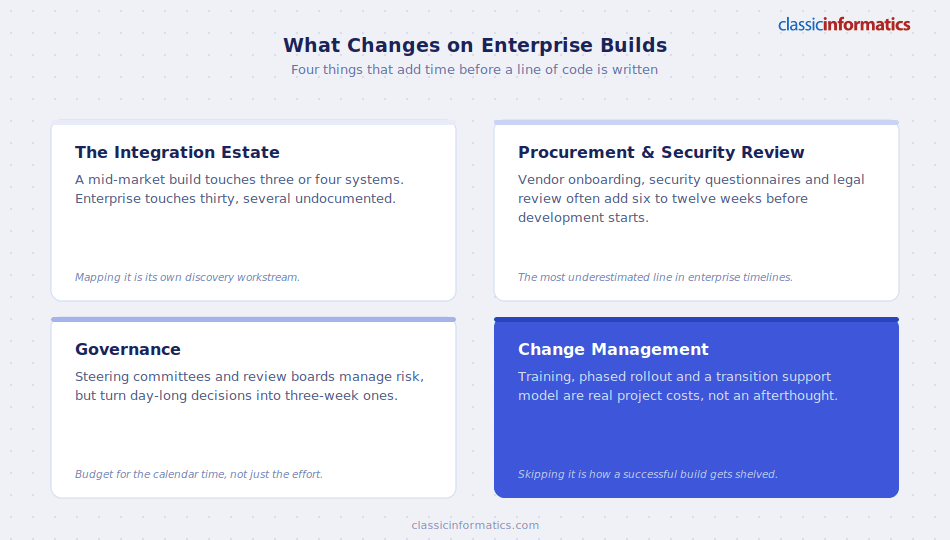
The integration estate. A mid-market build integrates with three or four systems. An enterprise build integrates with thirty, several of which are undocumented and owned by teams who didn't ask for this project. Mapping that estate is a discovery workstream in its own right.
Procurement and security review. Vendor onboarding, security questionnaires, penetration test requirements, and legal review routinely add six to twelve weeks before development starts. In our experience this is the single most underestimated line in enterprise timelines, because it sits outside the delivery team's control.
Governance. Steering committees, stage gates, and architecture review boards exist to manage risk, and they do. They also mean decisions that take a day in a startup take three weeks. Budget for the calendar time, not just the effort.
Change management. Getting a thousand people to use a new system is a separate discipline from building it. Training, phased rollout, and a support model for the transition period are project costs, and leaving them out of the budget is how a technically successful build ends up shelved.
Decision signal: If your project needs sign-off from more than three functions before development starts, add a quarter to the timeline and staff a dedicated project manager for coordination alone. If it needs sign-off from one, don't.
Benefits of Custom Software Development
The case for custom software isn't abstract. The benefits of custom software development show up in specific, measurable ways once the system is live.
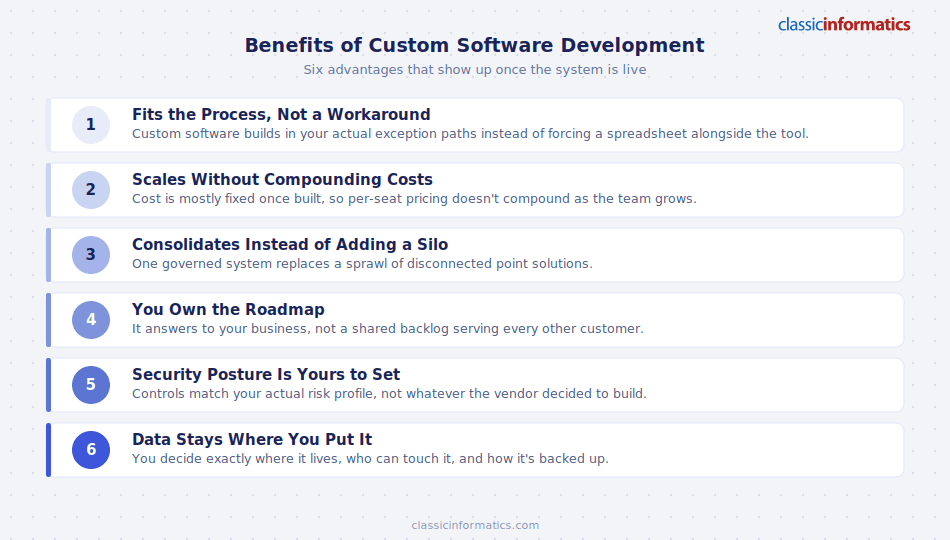
It fits the process instead of forcing a workaround. Off-the-shelf tools solve the average case. If your billing process has three exception paths a packaged tool doesn't support, custom software builds those in rather than making your team maintain a spreadsheet alongside the "real" system.
It scales without per-seat pricing compounding against you. A SaaS tool billed per user gets expensive fast once you're past a few hundred seats. Custom software's cost is mostly fixed once built, which changes the economics as the team grows.
It consolidates instead of adding another silo. When Classic Informatics built a governed portal of 40-plus purpose-built applications for a 250-clinic US dental group, the point wasn't any single application. It was replacing a sprawl of disconnected point solutions with one system the organization actually controlled. That's a pattern specific to custom builds: off-the-shelf tools rarely consolidate, because each one is built to be its own silo by design.
You own the roadmap. A packaged vendor decides what gets built next based on what serves their whole customer base. With custom software, the roadmap answers to your business, not a shared product backlog.
Security posture is yours to set. A packaged tool's security is whatever the vendor decided to build. Custom software lets you match security controls to your actual risk profile, which matters more in regulated industries than the feature list ever does.
Data stays where you put it. With packaged software, your data lives on the vendor's infrastructure under the vendor's terms. Custom software lets you decide exactly where data is stored, who can touch it, and how it's backed up, which matters a great deal once a compliance auditor starts asking specific questions.
Custom Software Development by Industry
The core process barely changes across industries. What changes is which constraints shape the architecture from day one, and how much they cost to get wrong.
Healthcare
software has to be built around HIPAA compliance and interoperability standards from the first architecture decision, not retrofitted later. Patient data handling, audit trails, and access controls aren't features you add at the end; they're assumptions baked into the database schema from day one. Retrofitting compliance into a system that wasn't designed for it is close to a full rebuild in disguise, which is why HIPAA compliant app development is an architecture question rather than a QA checklist item.
Financial services
software carries similar weight around PCI-DSS and fraud controls, with the added complexity of integrating against legacy core banking systems that weren't designed for modern APIs. A lot of the real engineering effort in fintech custom builds goes into that integration layer, not the customer-facing product, and anyone scoping mobile banking app development should budget accordingly.
Logistics and manufacturing
software tends to live or die on real-time data: inventory counts, shipment status, machine telemetry. That pushes the architecture toward event-driven systems rather than the simple request-response pattern that works fine for most business software, and it narrows the field of logistics software development companies capable of building it well.
Ecommerce
software raises the build-versus-platform question more sharply than any other vertical, because Shopify, BigCommerce and their peers cover the standard path well. The custom software vs off-the-shelf call here usually turns on catalogue complexity, B2B pricing rules, and how many fulfilment systems the storefront has to coordinate. Below a certain complexity threshold, extending a platform beats building one.
Retail
software has to handle traffic spikes that are orders of magnitude above baseline during peak periods, which shapes infrastructure decisions most other industries never have to make. A system that performs fine at typical volume can fall over completely during a single seasonal event if load testing wasn't built into the process, and it's the first thing worth probing when evaluating retail software development companies.
The common thread across all four: the industry doesn't change the development process described above. It changes which architecture and compliance decisions get made first, and how much weight they carry against speed to launch.
How to Choose a Custom Software Development Partner
Six things to check before you sign, each with the same three questions applied. Working from a shortlist of custom software development companies makes this faster, but the criteria matter more than the list.
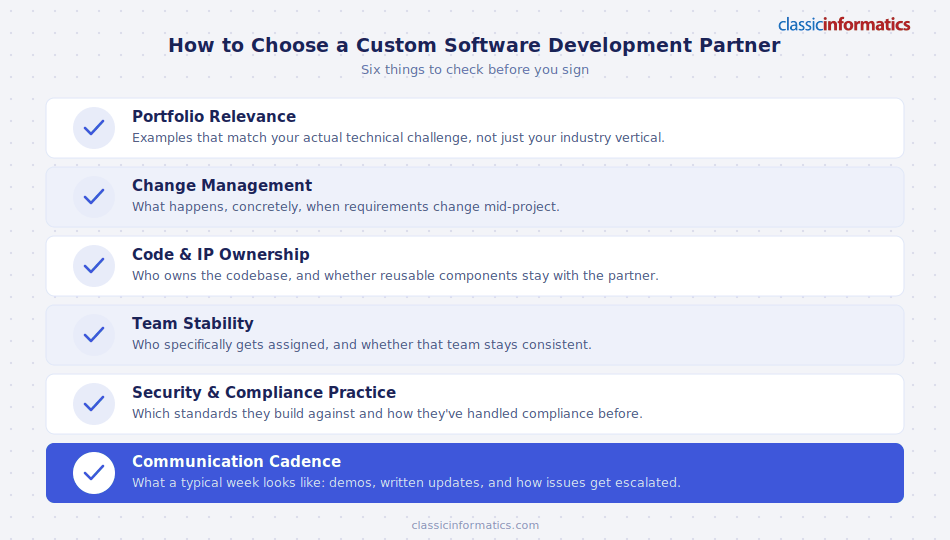
Portfolio relevance
What to ask: For examples that match your actual technical challenge, not just your industry vertical.
Why it matters: A partner that's built ten healthcare apps hasn't necessarily built one that solves your integration problem. Domain familiarity and technical fit are different things.
Decision signal: If a prospective partner can only point to marketing copy about industry experience and not a specific engagement resembling yours, keep looking. The fuller method for choosing a custom software development company works through each criterion in more depth.
Change management
What to ask: What happens, concretely, when requirements change mid-project.
Why it matters: Every project's scope shifts somewhat. A defined change process reprices and resequences work openly; "flexible" with no process means undocumented scope creep both sides regret later.
Decision signal: If the answer is vague, that vagueness becomes your problem at the worst possible moment.
Code and IP ownership
What to ask: Who owns the codebase, and whether any reusable components stay with the partner.
Why it matters: Some engagement models retain partial rights to shared libraries or frameworks, which limits your ability to move the work elsewhere later.
Decision signal: If IP ownership isn't spelled out in the statement of work, don't proceed until it is. A well-drafted software outsourcing contract settles this before work starts rather than during an exit.
Team stability
What to ask: Who specifically gets assigned, and whether that team stays consistent for the life of the engagement.
Why it matters: A partner with 200 developers doesn't help you if your project goes to a rotating cast of junior staff. Continuity is where institutional knowledge lives.
Decision signal: If the sales conversation is with senior staff but delivery is handled entirely by names you've never met, ask why before you sign.
Security and compliance practice
What to ask: Which standards they build against, whether security testing runs during development, and how they've handled HIPAA or SOC 2 requirements before.
Why it matters: "We take security seriously" isn't an answer. Compliance shapes architecture, and a partner learning it on your project charges you for the education.
Decision signal: A partner who names specific frameworks and describes a real compliance engagement is worth more than one with a slicker case-study page and no specifics. Running a vendor due diligence checklist for IT outsourcing keeps this consistent across candidates.
Communication cadence
What to ask: What a typical week looks like: demos, written updates, who attends, how issues get escalated.
Why it matters: Some partners run weekly demos and async updates; others go quiet for a month and resurface with a status deck. Neither is automatically wrong, but the mismatch between expectation and reality is where engagements sour.
Decision signal: If you can't get a straight answer about cadence and reporting during the sales process, expect the same vagueness once the contract is signed.
The pattern worth naming here: the partners worth hiring are the ones who ask hard questions about your requirements before quoting a number, not the ones who quote fastest.
Where Custom Software Projects Go Wrong
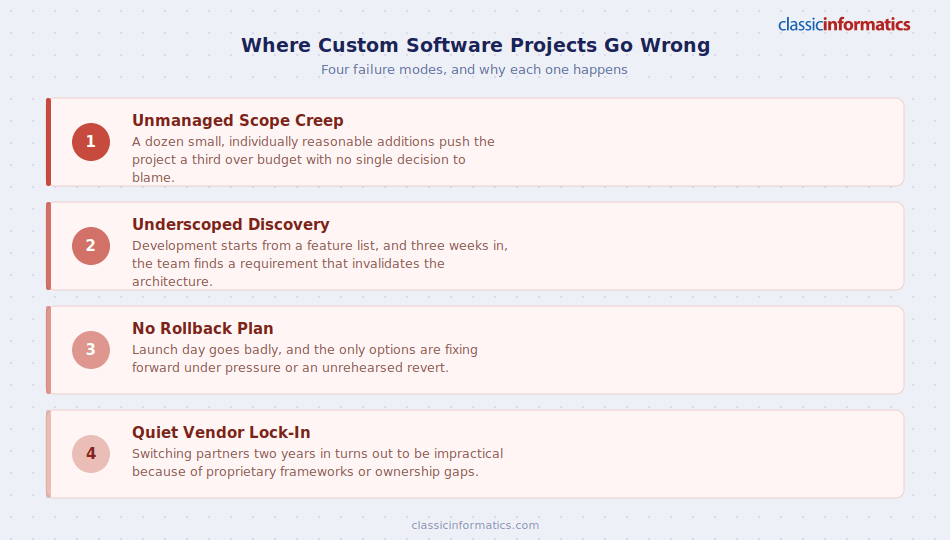
Unmanaged scope creep
What it looks like: A dozen small additions, each individually reasonable, that collectively push the project a third over budget with no single decision anyone can point to.
Why it happens: Organisational, not technical. Nobody wants to be the person who says no to a small request, and without a tracked change log, the cumulative cost stays invisible until the budget review.
How to fix it: Lock a change-request process before development starts, with a clear answer to what a given change costs and what it pushes back.
Underscoped discovery
What it looks like: Development starts from a sales conversation and a feature list, and three weeks in the team discovers a requirement that invalidates the architecture.
Why it happens: Discovery feels like overhead when everyone's eager to see progress, and a paid discovery phase is an easy line to cut when a budget is tight.
How to fix it: Treat discovery as a paid, deliverable-producing phase, not a free pre-sales call. The two to four weeks it costs is cheaper than a rebuild.
No rollback plan
What it looks like: Launch day goes badly, and the only options on the table are fixing forward under pressure or an uncontrolled revert nobody has rehearsed.
Why it happens: Rollback planning reads as planning for failure, which is culturally difficult to prioritise in the run-up to a launch everyone is invested in.
How to fix it: Treat the rollback plan as a deliverable of the deployment phase, not an afterthought. It costs a fraction of what an uncontrolled failure does.
Quiet vendor lock-in
What it looks like: Two years in, switching partners or bringing the work in-house turns out to be impractical because of proprietary frameworks or gaps in code ownership.
Why it happens: The convenience of a turnkey stack is real and immediate, while the lock-in cost is deferred and invisible until you actually try to leave.
How to fix it: Confirm code ownership and portability in the contract before development starts, not when you're already trying to exit the relationship. Treating this as technology risk management rather than a procurement footnote is what gets it onto the agenda early enough to matter.
The Short Version
- Match your budget bracket to project scope before you ask for a quote. The range runs from $15,000 to $500,000-plus, and knowing which bracket you're in shapes every other decision.
- Choose in-house, outsourced, or hybrid based on how long you'll be maintaining the software, not just this quarter's headcount.
- Lock requirements before development starts. This is the single biggest lever on cost and timeline.
- Vet a partner on their change-management process and team stability, not just their portfolio.
- Confirm code ownership and portability before you sign, not when you're trying to leave.
- Plan the rollback before you plan the launch party.
Let's Sum Up!
Custom software development isn't a decision you make once and forget. It's a bet that the process your business runs on is different enough from the average case that building something specific to you pays for itself over the life of the system. For a lot of businesses, that bet is right, but only when the budget matches the actual scope, the delivery model matches how long you'll own the system, and the partner is chosen on substance rather than the fastest quote.
Classic Informatics has delivered custom software across 30-plus countries with a 95 percent client retention rate, which mostly comes down to getting those three decisions right before development starts. If you're weighing a custom build and want a second opinion on scope or budget before you commit to either, we're glad to talk it through.
Frequently asked questions
What is custom software development?
Custom software development is building an application designed for one organization's specific requirements, rather than licensing a packaged product built for a broad market. It covers everything from a single internal tool to a full enterprise platform, and the defining trait is that the software adapts to your process instead of the other way around.
How much does custom software development cost?
Custom software development typically costs between $15,000 and $500,000-plus, depending on project size. Small internal tools run $15,000–$50,000, mid-sized platforms $50,000–$150,000, and large or compliance-heavy builds $150,000–$500,000 or more. The biggest driver of cost overruns is scope that keeps changing after development starts, not the initial estimate.
What's the difference between custom software and off-the-shelf software?
Off-the-shelf software is built for the average buyer and priced per seat or per license, with lower upfront cost but limited ability to match your exact process. Custom software costs more upfront but is built to your specific requirements, and you own the code rather than renting access to it.
Should I build custom software in-house or work with an outside partner?
It depends on how long you'll be maintaining the software and whether you already have the right skills in-house. Core products you'll iterate on for years usually justify an in-house team. Shorter-lived tools, or projects that need to start before a hiring cycle could finish, are usually better served by an outside partner or a hybrid team.
How long does custom software development take?
Timelines run from one to three months for a small, single-purpose tool, three to six months for a mid-sized platform, and six to twelve-plus months for a large or enterprise build, often delivered in phases. The single biggest factor in whether a project stays on schedule is whether requirements were locked before development started.
What are the top custom software development companies?
There's no single objective ranking, and most "top 10" lists are built by the vendors themselves. A better approach is evaluating candidates against the same criteria: a portfolio matching your specific technical problem, a defined process for handling changing requirements, clear IP ownership terms, and a stable delivery team rather than rotating junior staff.
What are the main SDLC models used in custom software development?
Most custom software today is built using Agile, delivering working software in short iterations rather than one long build-then-test cycle. Waterfall still appears on projects with fixed, upfront requirements and regulatory sign-off gates. Hybrid models — Agile execution inside a Waterfall-style governance structure — are common on larger, compliance-heavy builds.