
Every software leader eventually asks the same question: build the team, or hire one that's already built? There's no universal right answer, only a set of factors that point one way or the other for your specific project.
More than half of global business services organizations plan to expand their outsourcing footprint over the next three years, according to Deloitte's latest Global Business Services Survey. The in-house vs outsourcing software development decision isn't going away. Here's how to make the call for your team, not someone else's.
Key Takeaways
- In-house wins on control and cultural fit; outsourcing wins on cost, speed, and access to specialized talent you can't easily hire locally.
- Deloitte reports that more than half of global business services organizations plan to expand outsourcing over the next three years.
- Most software-driven businesses now run a hybrid: an in-house core paired with an outsourced team for execution capacity.
- Core, IP-sensitive, or heavily regulated systems generally belong in-house. Well-scoped, time-boxed execution work is a strong outsourcing fit.
- The right answer depends on urgency, business context, and budget, not which model is "better" in the abstract.
What In-House Software Development Actually Gets You
In-house software development means hiring engineers, designers, and QA directly onto your payroll, working exclusively on your product. The appeal is straightforward: you're the one steering the ship.
-
Full project control. You set priorities in real time. There's no waiting on a vendor's sprint cadence to redirect effort.
-
Deep cultural and business fit. A team embedded in your company absorbs context that outside vendors have to be told repeatedly. Over years, that context compounds into faster, better-informed decisions.
-
Fast feedback loops. Face-to-face conversations catch ambiguity before it turns into rework. A bug report or feature change gets clarified in minutes, not through a ticket queue.
-
Direct oversight of quality. You define what "done" means and watch it get enforced firsthand, rather than trusting a vendor's internal QA process.
Where In-House Development Falls Short
The tradeoffs are just as real, and they're the reason so many companies eventually look outside their own walls.
-
Higher, front-loaded cost. Salaries, benefits, recruiting fees, equipment, and ramp time all land on your books before a single feature ships. Retention costs keep adding up long after that.
-
Slow to stand up. Sourcing, interviewing, and onboarding a single senior engineer routinely takes months, not weeks, and that's before they're productive on your codebase.
-
Talent limited by geography. If the skill you need isn't in your local labor market, you're stuck training someone or waiting for the right hire to surface.
-
Team gets stretched thin. In-house teams juggle maintenance, new features, and whatever fire drill shows up that week. Specialized initiatives often lose to whatever's most urgent.
The Pros and Cons of Outsourcing Software Development
Outsourcing means handing part or all of your development work to an external team. Weighing the pros and cons of outsourcing software development starts with understanding what you're actually trading away control for.
What outsourcing gets you:
-
Lower, more predictable cost. You're paying for output, not headcount, with no recruiting overhead, no benefits liability, and no bench time between projects.
-
Faster ramp. A vendor's team has already worked together. There's no forming-and-storming period before they're productive.
-
Access to talent you can't hire locally. Specialized skills, whether that's a specific framework, compliance domain, or AI tooling fluency, become reachable without a multi-month search.
-
Flexible scaling. Add capacity for a crunch, release it when the work is done. In-house headcount doesn't bend that way.
-
Shared risk. A good software development outsourcing partner absorbs some of the delivery risk alongside you, particularly valuable for startups still finding their footing.
Where outsourcing falls short:
-
Communication overhead. Time zones, language, and distance mean assumptions that would get caught instantly in person can slip through for days. A clear communication cadence in the contract fixes most of this.
-
Real but manageable IP exposure. Sharing code, business logic, and sometimes customer data with an outside team requires a contract that actually spells out data handling and ownership, not just an NDA.
-
Less hands-on control. You're reviewing sprint outputs rather than watching work happen in real time. Teams that need to approve every micro-decision will find this friction, not flexibility.
-
Uneven documentation and process discipline, depending on the vendor. This is a vetting problem, not an inherent flaw of outsourcing itself.
In-House vs Outsourcing Software Development: Side-by-Side
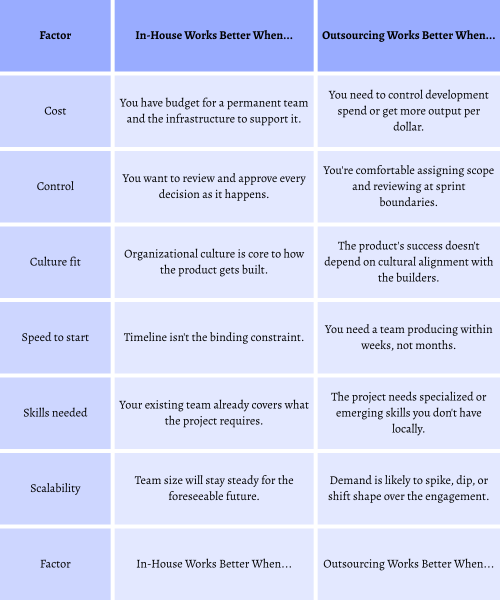
When Should You Keep Development In-House?
If it's part of your core product. When the software is the business, the core app, the platform your customers touch daily, keeping it in-house makes sense. Security, rapid iteration, and deep system familiarity matter more than cost savings here.
If organizational culture drives outcomes. Some businesses build products that reflect a specific internal culture and decision-making style. That's hard to replicate in an external team, however skilled.
If your roadmap shifts constantly. Early-stage products with frequent pivots benefit from a team that can drop what it's doing and pick up something new without a scope-change conversation first.
If cost isn't the only reason you're considering the alternative. Outsourcing purely to save money, without weighing the other tradeoffs, tends to backfire. Pick a model because it fits the work, not because it's cheaper on paper.
When Should You Outsource Software Development?
Knowing when to outsource software development comes down to a handful of recurring situations:
The project is bigger than your team can absorb. Adding one or two hires won't close the gap fast enough. A dedicated outsourced team, or a team that extends your existing one, can take on the extra scope without a lengthy hiring cycle.
There's a real technology gap. You need a specific stack, framework, or AI capability that your local market doesn't have in depth, or prices at a premium if it does.
Speed is the deciding factor. Competitive pressure, a hard deadline, or an idea with a short shelf life all argue for a team that can start producing in weeks rather than months.
You want a growth partner, not just a vendor. Especially for startups, the right partner brings pattern-matching from other engagements, not just extra hands.
The Hybrid Model: Why More Teams Are Combining Both
The old framing treated this as binary: pick in-house or pick outsourcing. That's no longer how most software-driven businesses actually operate.
The common pattern now is a small in-house core, product owner, technical lead, and the people who hold deep domain context, paired with an outsourced or AI-augmented development team that handles execution capacity. The in-house side owns the roadmap and the "why." The outsourced side owns delivery speed and the "how, faster."
This works because each side does what it's structurally best at. Business context that took years to build doesn't transfer well to an outside team, so it stays in-house. Execution capacity that's expensive to build internally and cheap to bring in externally goes to the partner. Neither side is doing the other's job.
If you're not sure where the line falls for your project, that's usually a sign the answer is a hybrid, not a hard either/or.
How to Choose the Right Model for Your Project
Three questions tend to settle it:
-
How urgent is the work? If you need something shipping in one to three months, standing up an in-house team from scratch usually isn't realistic. Outsourcing or a hybrid model becomes the practical path.
-
How much business context does the work require? Core IP, customer-facing product decisions, and deeply regulated systems lean in-house. Well-defined, scoped execution work leans outsourced.
-
What's your risk tolerance? In-house carries hiring and capability-building risk. Outsourcing carries vendor-selection risk. A hybrid model spreads both across a smaller surface area.
None of these questions have a universally correct answer. They just tell you which model fits the work sitting in front of you right now, which is a very different question than which model is "better."
Let's Wrap This Up!
In-house vs outsourcing software development isn't a debate with a permanent winner. It's a fit question you answer project by project, sometimes even running both models side by side on the same product.
If you're weighing IT outsourcing against building in-house and want a second opinion on where the line should fall for your specific project, Classic Informatics is glad to walk through it with you, including how IT outsourcing challenges and the right outsourcing decision factor into the call.

FAQS

Frequently Asked Questions
Usually, yes, but not only because of lower rates. Outsourcing avoids recruiting costs, benefits, office overhead, and bench time between projects. In-house can still be worth the premium when a project needs deep, ongoing business context that's expensive to hand off repeatedly to an outside team.