
Key Takeaways
- Digital product development has eight stages, from discovery to iteration. Most builds reach production in six to twelve months.
- Products rarely fail at one stage. They fail in the gaps between stages, and the cause is usually organisational.
- Discovery is the first thing cut when a deadline moves. It's also the cheapest place to kill a bad idea.
- Some architecture decisions are easy to change later. The data model isn't one of them. Get that one right early.
- After launch, teams often scale the wrong part of the MVP. That's what stalls products, not a weak MVP.
- Healthcare and insurance follow the same stages. Compliance just has to be built in from week one, not checked at the end.
Digital product development gets used loosely enough that two people in the same planning meeting often mean different things by it. One means the build. The other means everything from the first user interview to the production release, and the twelve months of iteration after that.
This guide means the second one.
Most teams don't fail at any single stage. They fail at the handoffs. Discovery findings that never make it into the requirements document. A roadmap that stopped reflecting reality around sprint four. An architecture decision nobody revisited until changing it meant a six-month migration. McKinsey research found that more than half of all product launches miss their business targets, and the pattern behind that number is rarely a single bad decision.
That failure pattern looks different at enterprise scale than it does in a startup pitch deck. A five-person team can hold the whole product in one person's head. A 200-person engineering org needs the process to carry what no individual can.
This guide is for the CTO scoping a build, the VP of Engineering who has to deliver it, and the product lead who owns the roadmap it runs on.
What Digital Product Development Means
Digital product development is the full sequence of turning an idea into a system running in production. Discovery, strategy, requirements, design, architecture, build, launch, and iteration, treated as one accountable process rather than a set of disconnected handoffs.
The word "product" is doing real work in that definition. A project ends. A product doesn't. That distinction changes how you staff it, how you budget it, and what "done" means at the end of the first release.
Digital products cover a wide range: customer-facing SaaS platforms, internal operations tools, mobile apps, patient portals, claims systems, marketplace platforms. The stages below apply to all of them. What changes is the weight each stage carries.
Some teams start from the classic [new product development process] taught in business schools and adapt it here; this guide's eight stages are the software-specific version of that same discipline.
Here's the sequence, with the timeline ranges we typically see on mid-market and enterprise engagements.
| Stage | What it produces | Typical duration | Where it goes wrong |
|---|---|---|---|
| Discovery | Validated problem, user evidence, scope boundary | 2–6 weeks | Compressed to a single workshop |
| Strategy | Positioning, success metrics, sequencing bet | 1–3 weeks | Assumed rather than written |
| Requirements | A PRD engineering can build against | 2–4 weeks | Written for sign-off, not for building |
| Roadmap | Sequenced releases with dependencies mapped | 1–2 weeks, then continuous | Frozen after kickoff |
| Architecture | Stack, data model, integration boundaries | 2–4 weeks | Decided implicitly by the first sprint |
| Build | Working, tested, deployable software | 3–9 months to first release | Scope grows without the timeline moving |
| Launch | Product in production with real users | 2–6 weeks | Treated as the finish line |
| Iteration | Improvements driven by usage data | Continuous | Unfunded after the launch budget closes |
Note: these are ranges from Classic Informatics engagements across product engineering, healthcare, insurance, and retail. Different teams slice the same work into six stages or nine. The labels matter less than making sure no stage silently gets skipped.
Two things about that table are worth saying plainly. The durations overlap in practice, because these stages aren't a relay race. And the "where it goes wrong" column is organisational in every single row, not technical.
Whether you run this in-house or with a partner is a separate decision from the process itself. Product development outsourcing changes who owns architecture calls and sprint planning. It doesn't remove a single stage below. Teams weighing that decision are often better served by comparing product development companies directly, rather than choosing on reputation alone.
Product Discovery: The Phase Most Teams Compress or Skip
Discovery gets cut for the same reason most process failures happen. It doesn't look like progress to anyone watching the calendar.
Product discovery is the work of confirming that the problem is real, that the people you think have it actually have it, and that solving it is worth what it will cost. It produces user evidence, a scope boundary, and usually a shorter feature list than the one you walked in with.
In our experience, discovery is the first thing compressed when a deadline moves, and it's almost never the right thing to compress. A two-week discovery that kills a bad feature saves three months of build. The reverse trade never works out.
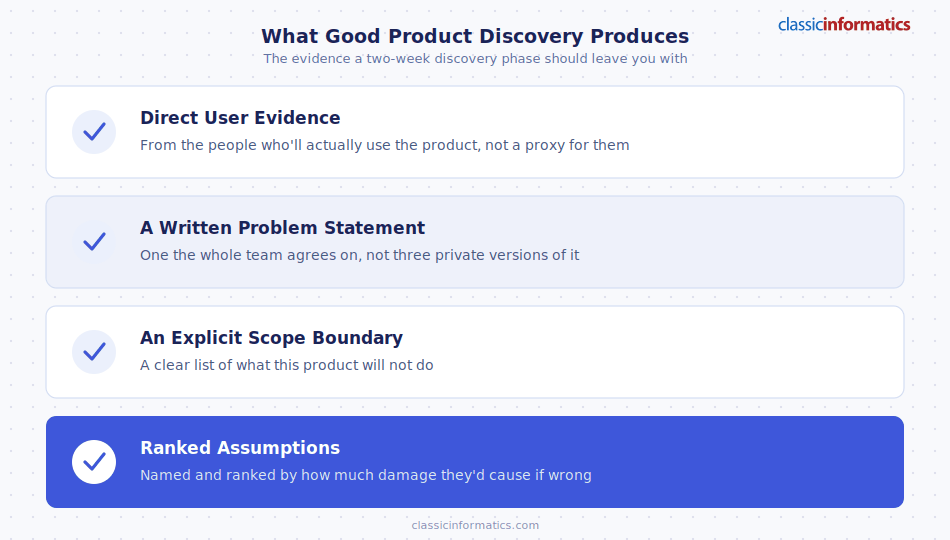
What good discovery produces:
- Direct evidence from the people who'll use the product, not a proxy for them
- A written problem statement the whole team agrees on
- An explicit list of what this product will not do
- Assumptions named and ranked by how much damage they'd cause if wrong
That last one matters more than it sounds. Most product plans contain three or four load-bearing assumptions nobody has written down. Discovery's job is to write them down and test the expensive ones.
Where discovery gets faked: a one-day workshop with internal stakeholders and no end users in the room. That produces alignment, which feels like discovery and isn't. Internal alignment tells you what your organisation believes. It tells you nothing about whether the belief is correct.
The design thinking process gives this work a repeatable shape, moving from problem framing to tested concept without letting the actual user drop out somewhere along the way.
Decision signal: If you can't name the three assumptions your product plan depends on, discovery isn't finished. If you can name them and you've tested the two most expensive ones, move on.
Setting Product Strategy Before Anyone Writes Code
A product strategy answers why this, why now, and why you. Skipping it is how teams end up building the right features for the wrong bet.
Strategy sits between discovery and requirements, and it's the stage most often assumed rather than written. Everyone in the room believes they share a strategy. Then a prioritisation argument in month four reveals they didn't.
A working product strategy is short. It states the target user, the specific problem, the wedge you're leading with, the metric that says it's working, and the things you're deliberately not doing. One page is usually enough. Ten pages usually means nobody's made a decision yet.
The metric is the part teams most often leave vague. "Improve customer experience" isn't a metric. "Cut average claim submission time from eleven minutes to under four" is. The second one tells engineering what to optimise and tells the business when to stop funding.
Validation belongs here too, not after the build. Testing a positioning bet against real market signal costs far less than discovering the mismatch at launch, and validating product-market fit with AI makes that check fast enough to run before an engineering quarter is committed.
Decision signal: If your strategy document doesn't name something you're choosing not to build, it isn't a strategy. If it does, and engineering can point to the metric it moves, you're ready to write requirements.
Turning Strategy Into a Requirements Document Engineers Will Use
A product requirements document sitting unread in a shared drive isn't a requirements document. It's a liability with a table of contents.
The gap between a PRD that works and one that doesn't is mostly about who it's written for. A document written to secure a stakeholder sign-off optimises for coverage and defensibility. A document written for engineers optimises for decisions. Those two goals pull in opposite directions, and most PRDs try to serve both and serve neither.
What engineers actually need from a PRD:
- The problem, stated once, in plain terms
- User stories with acceptance criteria specific enough to test against
- Explicit non-goals, so scope arguments have a reference point
- Named edge cases, especially around data, permissions, and failure states
- Open questions listed as open, not quietly resolved by the writer
The last one gets skipped constantly. A PRD that hides its uncertainty forces engineers to guess, and their guess becomes the product. Writing "we haven't decided how this behaves when the payment fails" is more useful than inventing an answer nobody has agreed to.
Length isn't the measure of quality here. We've seen twelve-page PRDs that generated a hundred clarifying questions and four-page ones that generated none.
Where PRDs break down: they get written once and never updated. By sprint six, the document describes a product that no longer exists, so the team stops reading it, so it drifts further. A PRD is a living document or it's a historical artefact. It doesn't sit in between.
Decision signal: If an engineer can read your PRD and start work without scheduling a meeting, it's doing its job. If the first response is a list of clarifying questions, the document isn't finished.
Building and Maintaining the Product Roadmap
A product roadmap earns its place by staying accurate, and most stop being accurate somewhere around sprint four.
The roadmap's real job is alignment between engineering and the business. It answers what ships when, in what order, and what depends on what. When it works, the sales team knows what to promise and engineering knows what's coming next quarter. When it drifts, both sides start operating on private versions of the plan.
Only 13% of companies maintain detailed roadmaps beyond a year, according to product development research compiled by Tenet, and more than half of teams with fifty or more people name roadmap consistency as their hardest coordination problem. Those two numbers describe the same failure from different angles.
What keeps a roadmap accurate:
- A fixed review cadence, monthly at minimum, where dates actually change
- Dependencies mapped across teams, since one team's backlog won't show them
- Confidence levels stated, so a Q4 item isn't read with the same certainty as a Q1 one
- One named owner who can move an item without convening a committee
Confidence levels are the underused one. A roadmap that presents month two and month ten with identical visual weight is lying about what you know. Marking later items as directional protects the roadmap's credibility when they inevitably move.
The roadmap and the PRD get confused often enough to be worth separating. The roadmap says when and in what order. The PRD says what and to what standard. A team that has one but not the other will feel the gap within a quarter.
Decision signal: If your roadmap hasn't changed in three months, it's not being maintained. If it changes every week without a review process, it's not a roadmap.
Architecture Decisions That Are Hard to Reverse Later
Enterprise software architecture comes down to a handful of decisions that matter most, made earliest, usually before anyone has enough information to make them well.
That's not a solvable problem. It's a constraint to manage. The useful move is separating the decisions that are cheap to change from the ones that aren't, and spending your limited certainty on the second group.
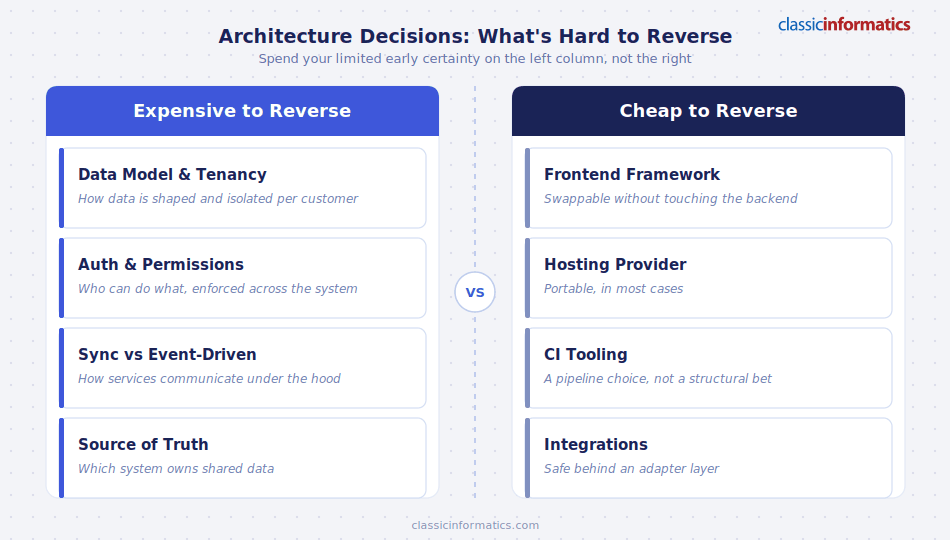
Expensive to reverse:
- Data model and how tenancy is handled
- Authentication and permissions architecture
- Synchronous versus event-driven service boundaries
- Which system is the source of truth for shared data
Cheap to reverse:
- Frontend framework choice
- Hosting provider, in most cases
- CI tooling
- Most third-party integrations behind an adapter
Teams routinely burn weeks debating the second list and default their way into the first. The frontend framework argument feels important because everyone has an opinion. The data model gets decided by whoever writes the first migration.
The AWS Well-Architected Framework organises the same territory into six pillars covering operational excellence, security, reliability, performance efficiency, cost optimisation, and sustainability. It's worth running a product's architecture against before the first release rather than after the first incident.
Reusable architecture pays off when the product isn't a single application. When we built a reusable React Native architecture for multi-brand retail apps, the point wasn't the framework. It was that a shared foundation let several brand apps ship and stay maintained without each one becoming its own codebase with its own drift.
Stack selection sits downstream of these decisions rather than upstream. How to choose a tech stack gets considerably easier once the data model and service boundaries are settled, because the structural calls have already ruled most options out. Multi-tenant SaaS is the exception worth naming. There, tenancy shapes the data model rather than following from it, which makes SaaS development a different sequencing problem from the one above.
Decision signal: If reversing a decision would take more than one sprint, decide it deliberately and write down why. If it takes less, pick something reasonable and move.
Agile Product Development in an Enterprise Setting
Running an agile product development inside an enterprise means working against constraints a startup team never meets. Dependency chains across teams, compliance sign-offs with their own calendars, and a roadmap answering to more than one stakeholder.
The ceremonies are the same. The physics aren't.
A five-person team can reprioritise in a standup. A 200-person engineering org can't, because the change ripples into three other teams' sprint commitments and a release train with a fixed window. Enterprise agile is mostly the discipline of managing those dependencies, not the discipline of running better retrospectives.
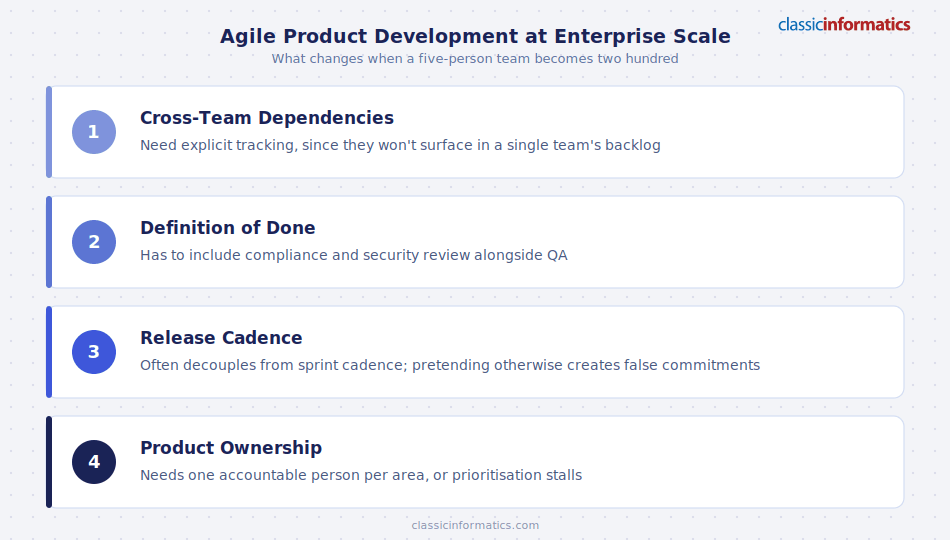
What changes at enterprise scale:
- Cross-team dependencies need explicit tracking, since they won't surface in a single team's backlog
- Definition of done has to include compliance and security review alongside QA
- Release cadence often decouples from sprint cadence, and pretending otherwise creates false commitments
- Product ownership needs one accountable person per area, or prioritisation stalls waiting for consensus
Distributed teams add a further layer, mostly around handoff quality between time zones. Distributed agile development holds up when the handoffs are written down rather than spoken, and stalls when they aren't.
Where enterprise agile breaks down: the organisation adopts the ceremonies without changing the decision rights. Teams run standups and sprints while every meaningful prioritisation call still routes through a monthly steering committee. That produces agile theatre, which costs more than waterfall and delivers less, because you're now paying the coordination overhead of both.
The honest counter-position: some enterprise contexts genuinely need stage-gated delivery. A build with a fixed regulatory submission date and a requirements set that's legally frozen doesn't benefit from iteration on scope. In those cases, iterate on implementation and hold the scope. Don't pretend the scope is flexible when it isn't.
How this plays out day to day varies more than any framework suggests. The enterprise product development process that actually runs inside a large organisation rarely matches the one on the slide describing it.
Decision signal: If your teams can reprioritise within a sprint without escalating, you're running agile. If every change needs steering committee approval, you're running waterfall with standups.
Where AI Is Changing the Development Phase
AI-assisted software development for teams changes how fast code gets written. It doesn't change whether review, testing, and architecture discipline still have to happen.
Adoption is close to universal. Stack Overflow's 2025 Developer Survey found 84% of developers using or planning to use AI tools, with 51% of professional developers using them daily. The same survey found trust moving the other way, with only 29% expressing trust in AI output, down eleven points year over year.
That gap is the whole story. The tools are in every workflow and the output still needs verifying.
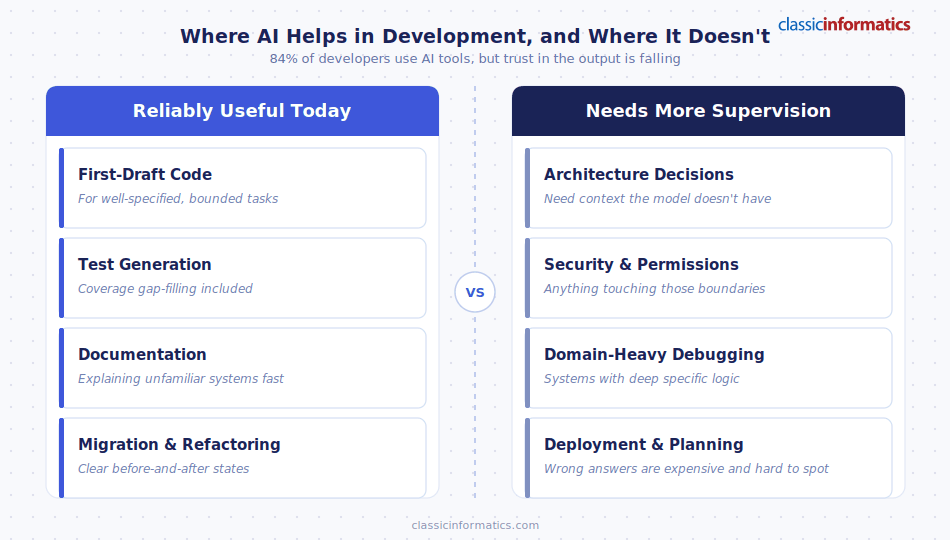
Where AI is reliably useful today:
- First-draft code for well-specified, bounded tasks
- Test generation and coverage gap-filling
- Documentation and code explanation on unfamiliar systems
- Migration and refactoring work with clear before and after states
Where it needs more supervision than it saves:
- Architecture decisions, which need context the model doesn't have
- Anything touching security boundaries or permissions logic
- Debugging in systems with heavy domain-specific logic
Developers themselves are clear about this boundary. The Stack Overflow data shows the strongest resistance to AI in deployment, monitoring, and project planning, which are exactly the tasks where a wrong answer is expensive and hard to spot.
Product management is seeing the same shift on its side of the process. AI prompts for product managers earn their keep on spec drafting and research synthesis, and lose it on prioritisation calls that need context the model was never given.
Building AI capability into the product is a different problem from using AI to build it. AI-augmented development is the second one, and the two get conflated often enough to derail a scoping conversation.
Decision signal: If a task has a clear spec and a testable output, AI assistance usually pays. If the hard part is deciding what to build rather than writing it, it usually doesn't.
Launching and Scaling: From MVP to Production
Most products that stall after launch don't fail from a bad MVP. They fail from scaling the wrong part of it.
An MVP answers a question. Once it's answered, you're holding two things at once: evidence about what users value, and a codebase built to test a hypothesis rather than to run a business. Those two things point in different directions, and the decision about what to do next is the single most consequential call in the post-launch year.
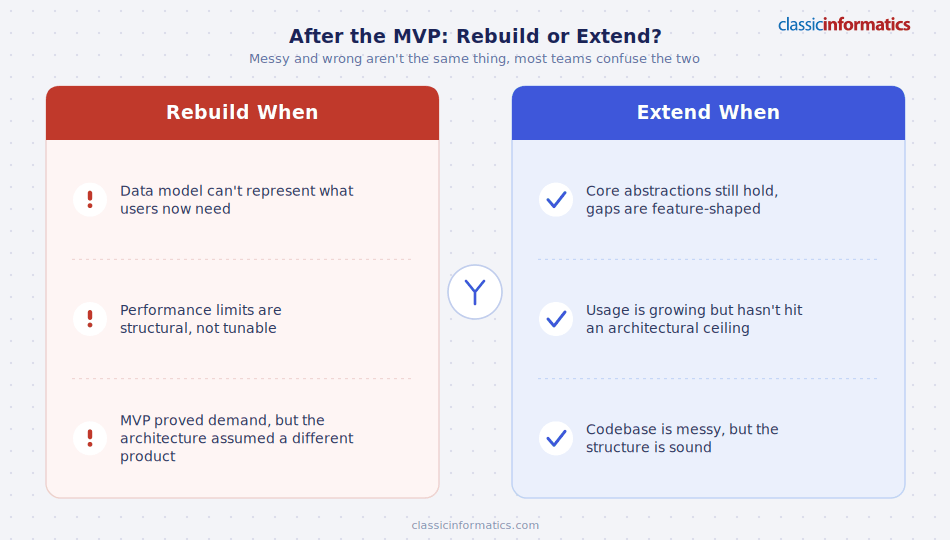
Rebuild when:
- The data model can't represent what you now know users need
- Performance limits are structural rather than tunable
- The MVP proved the demand but the architecture assumed a different product
Extend when:
- The core abstractions still hold and the gaps are feature-shaped
- Usage is growing but hasn't hit an architectural ceiling
- The codebase is messy but the structure is sound
Messy and wrong aren't the same thing. Messy code inside a sound structure is a refactoring problem measured in sprints. A sound-looking codebase built on the wrong data model is a rebuild measured in quarters. Teams confuse the two constantly, usually in the direction of rebuilding something that only needed cleaning up.
This holds for products with real usage data by month three. Earlier than that, the rebuild-versus-extend call is closer to a guess, and the better move is usually to extend and buy yourself more evidence.
When we built a travel planning MVP connecting travellers with experts and friends, the itinerary and budgeting features were scoped tightly enough that the post-launch question was about which direction to extend, not whether the foundation could carry it. That's what a well-scoped MVP buys you: the next decision is about direction rather than survival.
Scoping that first release is its own discipline. MVP development is where the scope boundary gets set, and how to build an MVP is where that boundary survives contact with a real backlog. The stage after it has a name of its own. A minimum marketable product is what you ship once the question the MVP asked has been answered.
Beyond that stage, a product's journey through growth, maturity, and eventual decline is what's usually called the product development life cycle, a distinct discipline from the launch process covered here.
Decision signal: If the data model can represent the next twelve months of roadmap, extend. If it can't, rebuild now rather than after two more feature layers make it harder.
Product-Led Growth After Launch
Product-led growth works when the product itself can carry the sales motion. It's a genuine mismatch for products that can't, and forcing it costs more than skipping it.
PLG means the product acquires, converts, and expands its own user base. Self-serve signup, value delivered before a sales conversation, expansion driven by usage rather than by a renewal meeting.
Where PLG fits:
- The user can reach real value alone, without configuration or onboarding help
- Individual users or small teams can adopt without procurement involvement
- Usage naturally expands within an account
Where PLG is a mismatch:
- The product needs data migration or integration work before it does anything useful
- The buyer and the user are different people, and the buyer never touches the product
- Contract value is high enough that procurement and security review are unavoidable
Enterprise products often sit squarely in the second list, and that's fine. A claims platform bought by a COO and used by adjusters isn't a PLG product no matter how good the interface is. Building self-serve onboarding for it is effort spent on a motion the buyer will never take.
The hybrid case is real and worth naming. Plenty of enterprise products run a self-serve tier for individual users alongside an enterprise sales motion for accounts. That works when the two tiers genuinely serve different needs, and it becomes expensive when the self-serve tier exists mainly because PLG was in the strategy deck.
Decision signal: If a new user can reach real value in one session with no help, PLG is worth building toward. If they can't, invest in onboarding and sales enablement instead.
Digital Product Development in Regulated Industries
Healthcare and insurance don't exempt a product team from any stage above. They add constraints on top of every one of them.
The pattern is consistent across both. Discovery takes longer because the end user is harder to access. Requirements carry legal weight. Architecture decisions get made under data-residency and audit constraints. Launch has a compliance gate that isn't negotiable. And the cost of getting it wrong isn't a bad review, it's a regulatory finding.
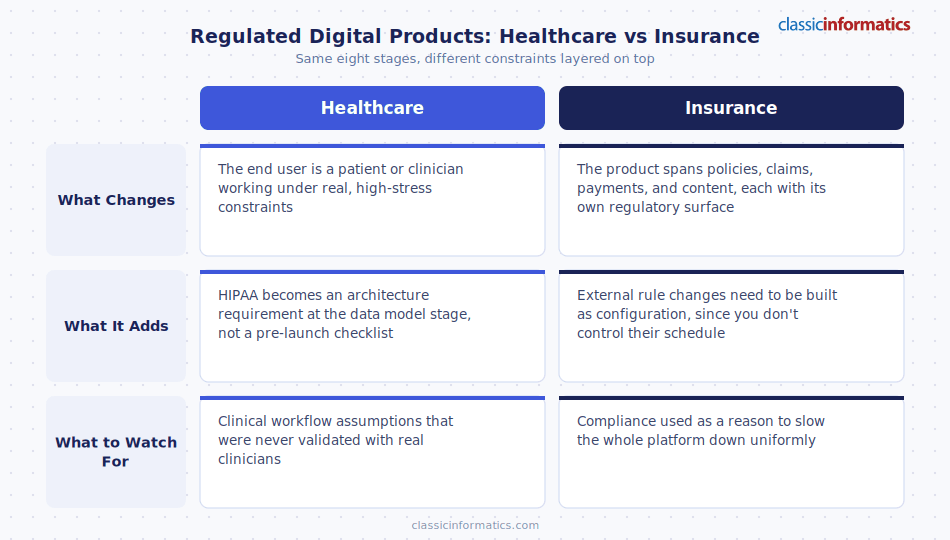
Healthcare Software Product Development
What changes: healthcare software product development changes who the end user is: a patient or a clinician, both operating under conditions that most product assumptions don't account for. A patient using a portal may be anxious, unwell, or navigating on a phone in a waiting room. A clinician has eleven seconds between tasks.
What it adds to the process: HIPAA and equivalent regional obligations become architecture requirements rather than a compliance checklist applied at the end. Audit logging, access controls, and data handling all need designing in at the data model stage. HIPAA compliant app development is cheap as an architecture input and expensive as a retrofit.
What to watch for: clinical workflow assumptions that were never validated with clinicians. A feature that adds thirty seconds to a consultation won't get used, regardless of how well it tests in a usability lab.
Decision signal: If your product touches protected health information, treat compliance as an architecture input from week one. If it doesn't, treat it as a review gate before launch.
Patient portal development carries a pre-launch checklist of its own, covering identity verification, records integration, and accessibility standards a general consumer product never has to meet. AI in healthcare stacks another layer on top, since anything touching clinical judgement inherits all of those obligations and adds explainability to them.
Insurance Software Product Development
What changes: custom insurance software development usually spans policies, claims, payments, and content, and each of those has its own regulatory surface. Requirements often encode rules that are set externally and change on a schedule you don't control.
What it adds to the process: rule changes need to be configurable rather than hard-coded, because they will change. Teams that treat regulatory logic as business logic end up shipping a release every time a rate table updates.
What to watch for: compliance being used as a reason to slow everything down uniformly. Not every part of an insurance platform carries the same regulatory weight. Content and customer experience layers can often iterate at normal speed while the rating engine follows a stricter path.
Decision signal: If the regulatory rules change more than annually, build them as configuration. If they're stable, hard-coding is acceptable and simpler.
We saw this directly building a greenfield omnichannel insurance portal covering policies, claims, payments, and content management. Building the compliance-heavy paths and the customer-facing paths at the same tempo would have slowed the whole product to the speed of its most constrained component.
Budgeting and Protecting Spend Through the Build
A budget set at kickoff and never revisited is a prediction, not a budget. Protecting it takes governance through the build, not accuracy at the start.
The distinction matters because most budget conversations focus entirely on the estimate. Software development cost estimation is worth doing well, but it's a prediction made at the point of least information. The money gets lost after the estimate, not inside it.
McKinsey and University of Oxford research covering more than 5,000 large IT projects found average overruns of 45% on budget and 7% on schedule, with delivered value 56% below what was predicted. The value gap is larger than the cost gap, which tells you where the real problem is.
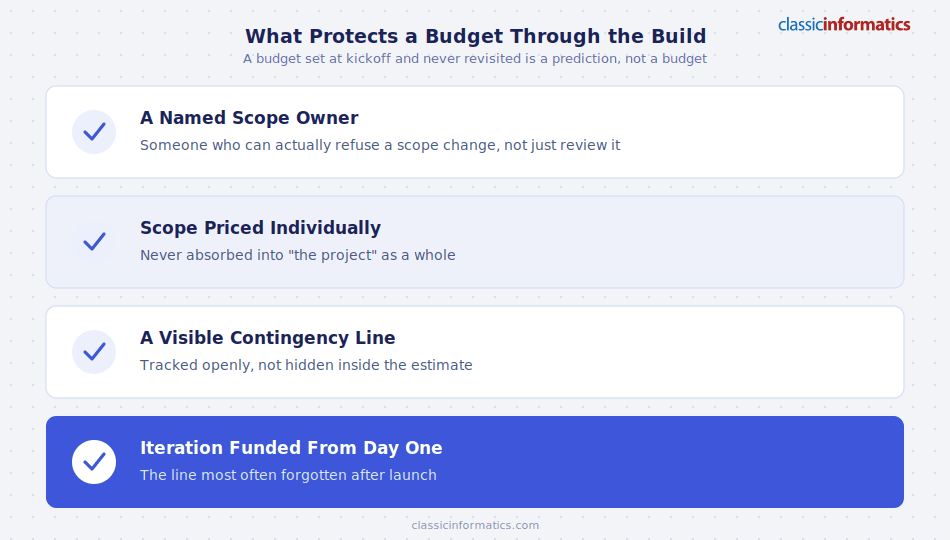
What protects a budget through a build:
- A named person who can approve or refuse scope changes, with the authority to actually refuse
- Scope changes priced individually, not absorbed into "the project"
- A contingency line that's visible and tracked, rather than hidden inside estimates
- Post-launch iteration funded from the start, since it's the line most often forgotten
That last point accounts for a lot of the overspend we see. Budgets that stop at launch routinely underestimate real total cost, because the product needs work in months thirteen through twenty-four and that work gets funded reactively at worse rates.
Decision signal: If your budget has no named owner who can say no to scope, it will overrun. If it has one and changes get priced individually, it usually holds within contingency.
Where Digital Product Builds Go Wrong
Three failure patterns account for most of the builds we've seen go sideways. All three are organisational. None are technical.
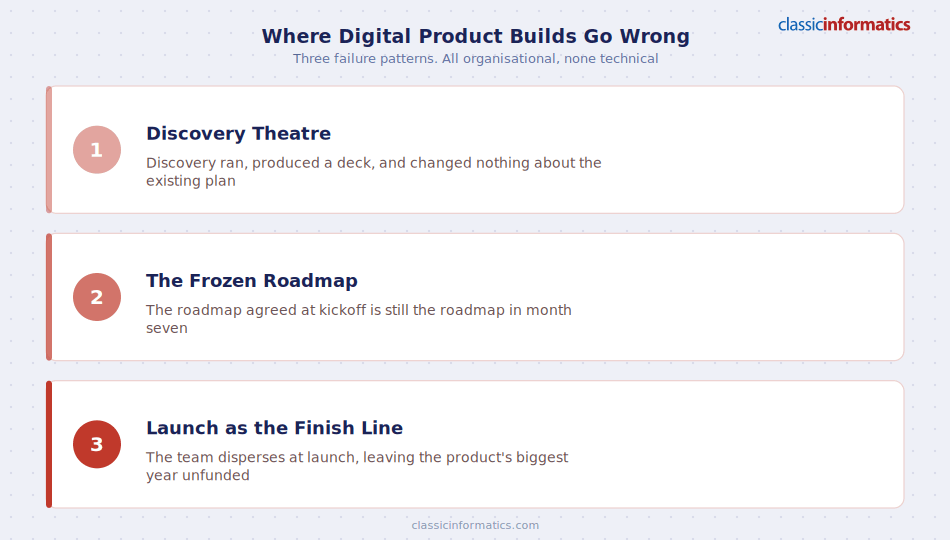
Discovery Theatre
What it looks like: a discovery phase happened, produced a deck, and changed nothing about the plan that existed before it started.
Why it happens: discovery is run to validate a decision already made rather than to test it. The team wants confirmation, gets it, and mistakes that for evidence.
How to fix it: define upfront what finding would change the plan. If no possible finding would change anything, don't run discovery. Just ship the plan and be honest that it's a bet.
The Frozen Roadmap
What it looks like: the roadmap agreed at kickoff is still the roadmap in month seven, despite six months of learning that should have changed it.
Why it happens: the roadmap got treated as a commitment to stakeholders rather than a plan for the team. Changing it feels like admitting failure, so it stays accurate on the wall and inaccurate in reality.
How to fix it: a monthly review where dates and priorities are genuinely allowed to move, with confidence levels published so later items were never read as promises.
Launch as the Finish Line
What it looks like: the team hits launch, the budget closes, the project team disperses, and the product enters its most important year with no funded owner.
Why it happens: the work was scoped as a project. Projects end at delivery. Products don't. Product engineering exists as a separate discipline precisely because the unit of work is the product's whole life rather than its first release.
How to fix it: fund and staff the first post-launch year at kickoff, not after launch. The iteration budget is what turns a delivered product into a used one.
Let's Sum Up!
If you take one thing from this guide, make it the handoffs. The stages are well understood and most teams execute each one competently in isolation. What breaks is what falls between them: discovery findings that never reach the PRD, a roadmap that stops matching reality, an architecture decision nobody revisits until it's expensive.
Concept to production isn't a sequence of phases you complete. It's a set of decisions that stay live, and the teams that ship well are the ones that keep revisiting them instead of locking them at kickoff.
The whole guide, collapsed into twelve rules:
- Run discovery until you can name your three load-bearing assumptions.
- Write the strategy down, including what you're not building.
- Write the PRD for engineers, not for sign-off.
- Review the roadmap monthly and let the dates move.
- Decide the expensive architecture calls deliberately, default the cheap ones.
- Match your agile ceremonies to your actual decision rights.
- Use AI where the spec is clear and the output is testable.
- Extend after MVP unless the data model can't carry the roadmap.
- Build toward PLG only if a user can reach value alone.
- In regulated builds, treat compliance as an architecture input, not a review gate.
- Name a budget owner who can refuse scope.
- Fund the first post-launch year before you launch.
Classic Informatics has been building digital products for 23+ years, including regulated healthcare and insurance builds where the process has to hold up under audit. If you're scoping a build, or trying to work out why one that's already running isn't moving the way it should, we're happy to talk it through.
Frequently asked questions
What is digital product development?
Digital product development is the full process of turning an idea into a software product running in production. It covers discovery, strategy, requirements, architecture, build, launch, and ongoing iteration. The word product matters here: a project ends at delivery, while a product keeps evolving based on how people actually use it, which changes how you staff, budget, and govern the work from the start.
What are the stages of digital product development?
Eight stages cover most builds: discovery, strategy, requirements, roadmap, architecture, build, launch, and iteration. Discovery typically runs two to six weeks, architecture two to four, and the build itself three to nine months to a first release. These overlap in practice rather than running in strict sequence. Different teams slice the same work into six stages or nine, and the labels matter less than making sure none get silently skipped.
How long does it take to go from concept to production?
For most mid-market and enterprise products, six to twelve months to a first production release. Discovery through architecture usually takes six to twelve weeks combined, with the build running three to nine months after that. Regulated products in healthcare or insurance sit at the longer end, since compliance review and clinical or actuarial validation add time that can't be compressed by adding engineers.
What is the difference between a product roadmap and a PRD?
A roadmap says when things ship and in what order. A product requirements document says what gets built and to what standard. The roadmap is a sequencing and alignment tool between engineering and the business. The PRD is a working specification engineers build against. Teams that maintain one but not the other usually feel the gap within a quarter, either as scope confusion or as missed dependencies.
When should you rebuild versus extend after an MVP?
Rebuild when the data model can't represent what users now need, or when performance limits are structural rather than tunable. Extend when the core abstractions still hold and the gaps are feature-shaped. Messy code inside a sound structure is a refactoring problem measured in sprints, not a rebuild. This call needs real usage data, so it's best made from around month three rather than immediately after launch.
Does the process change for regulated industries like healthcare or insurance?
The stages stay the same. The constraints on each one tighten. In healthcare, HIPAA obligations become architecture requirements at the data model stage rather than a pre-launch checklist. In insurance, externally set rules should be built as configuration since they change on a schedule you don't control. Both add compliance gates before launch, and both make discovery slower because end users are harder to access.
Should we build a digital product in-house or with a partner?
In-house works when the product is the business and you'll be making weekly prioritisation calls on it for years. A partner works when you need capability you don't have on a timeline that makes hiring impractical. That decision is separate from the process itself, and the stages in this guide apply either way. Engagement models, cost drivers, and contract terms are covered in the product development outsourcing guide.