Everyone claims to do product engineering. Almost none of them do it well enough to matter.
Picking the wrong partner doesn't just waste a budget. It gets discovered eighteen months later, when the "fast" MVP can't handle real usage and the whole thing needs rebuilding. Here are 10 product engineering companies worth evaluating, and what actually separates them.
What Most Teams Get Wrong About Product Engineering
Most teams treat product engineering like a coding task: hand over a spec, get back a working product. That's software development. Product engineering is a different discipline.
It's the work of deciding how something should be built, not just building what's already been decided. Architecture choices, technical trade-offs, and scalability planning all happen before a feature ships, not after it breaks.
Skip that discipline, and you get a product that works in the demo and falls apart under real users. A good product engineering company should be pushing back on your spec sometimes, not just executing it.
How We Evaluated These Product Engineering Companies
We looked at public reviews, service scope, and delivery track record to build this list, prioritizing companies that could show real outcomes, not just marketing claims.
-
Product and engineering depth: Does the company go beyond writing code into architecture, UX, and technical strategy?
-
Industry experience: Have they shipped in your industry or a genuinely comparable one?
-
Client satisfaction: What do verified reviews on Clutch, GoodFirms, or G2 actually say?
-
Execution fit: Are they built for startups, enterprises, or both, and does that match what you need?
-
AI-augmented development: Can the team use modern AI tooling to move faster without cutting corners on quality?
-
Post-launch support: What happens to the relationship once the first version ships?
10 Product Engineering Companies Worth Evaluating
1. Classic Informatics
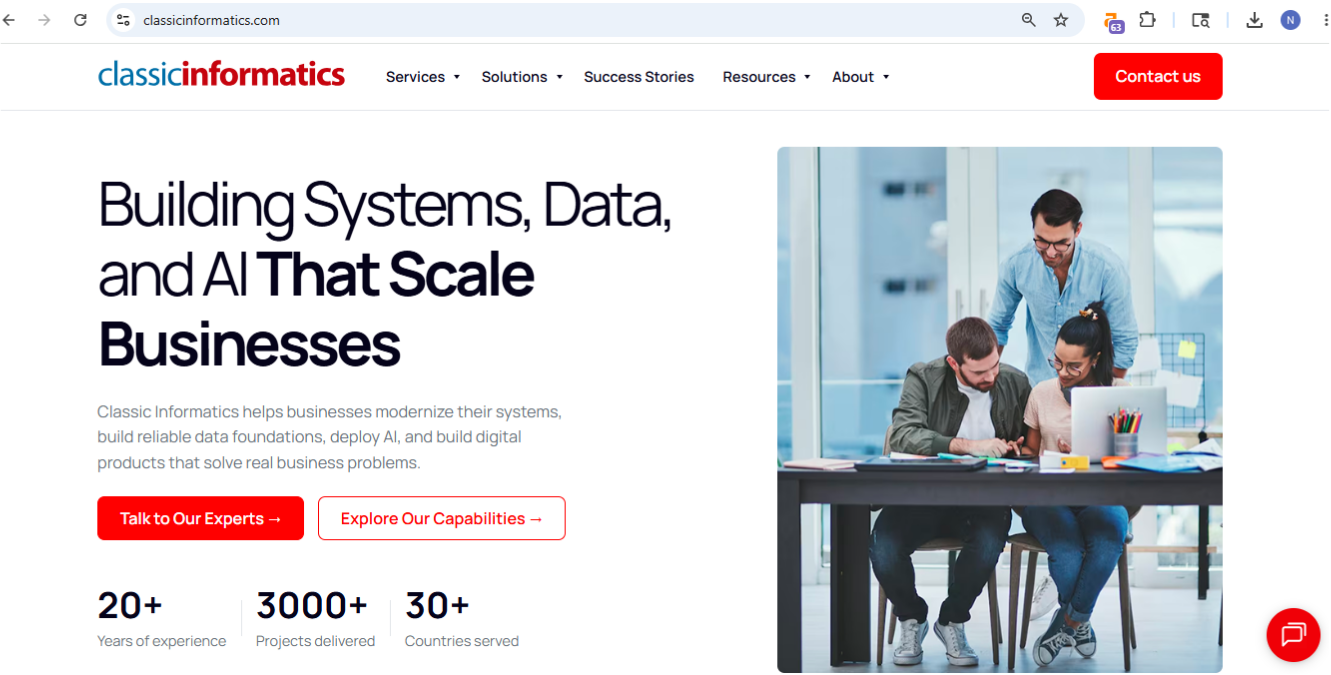
Classic Informatics works best for startups building their first AI-powered product and mid-market companies modernizing an existing one into something that can actually scale. The company prioritizes getting the architecture right before writing feature code, on the belief that a fast MVP built on the wrong foundation costs more to fix later than it saved at launch.
Founded in 2002, product engineering at Classic Informatics spans SaaS platforms, AI-augmented applications, and enterprise workflow systems, with delivery teams in India and account teams in the UK and Australia. What separates the company from a generic vendor is its focus on MVP development built to extend, not thrown away once real users show up.
-
AI-augmented development
-
SaaS and enterprise platform engineering
-
MVP-to-scale product roadmaps
-
UI/UX and full-stack delivery
-
Dedicated and extended team models
For teams that need a product built once and built to last, that focus on architecture over speed alone tends to show up eighteen months later, not on launch day.
2. Blue Label Labs
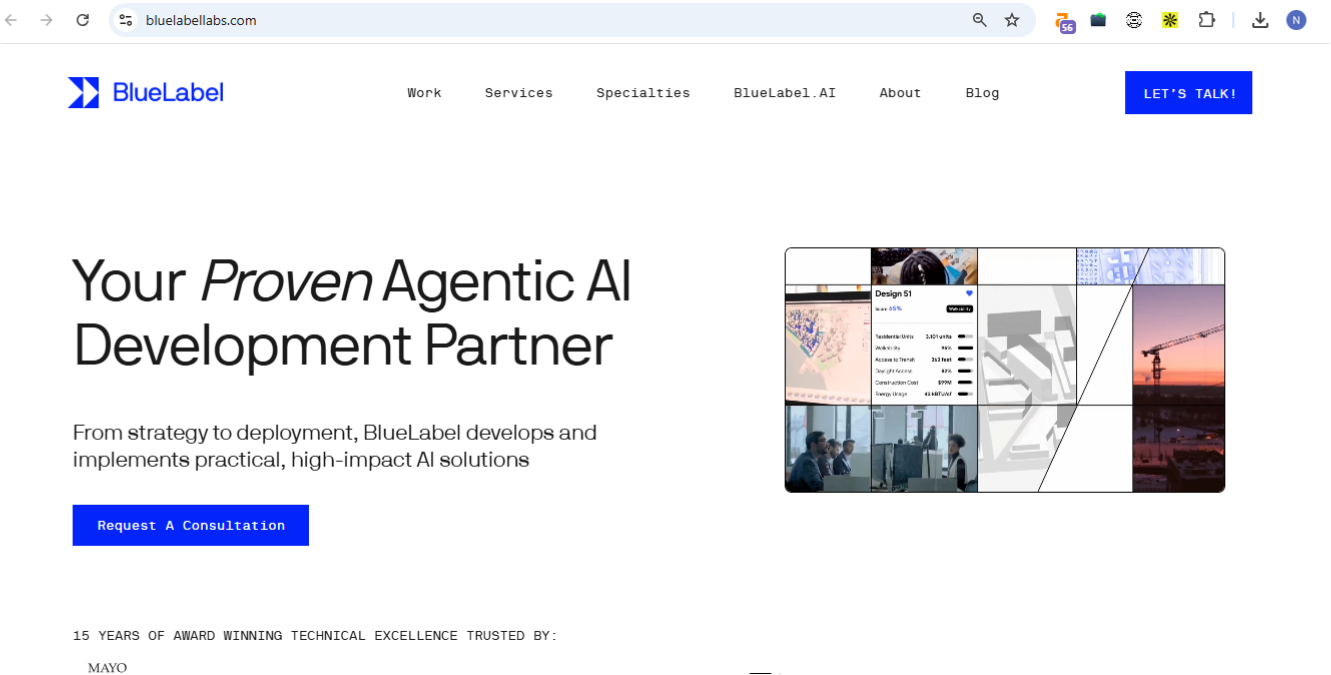
Blue Label Labs works best for startups and growth-stage companies building a mobile or AI-powered digital product from the ground up.
Founded in 2016 and based in New York City, Blue Label Labs has spent over a decade helping businesses take a product from discovery through launch, with services spanning research, prototyping, and full build. The company has shifted much of its recent work toward agentic AI development, applying that same discovery-first approach to newer AI-native products.
- Mobile and web product engineering
- AI and agentic application development
- Product discovery and validation
- UX/UI design
- Startup-to-scale delivery
Blue Label Labs suits founders who want a partner involved from the idea stage, not just the build stage. Teams with an already-locked spec may need less of that upfront discovery work.
3. Simform
Simform works best for mid-market and enterprise teams that need custom software built on a specific cloud stack, particularly Azure, alongside broader product engineering support.
Simform has built a strong reputation on Clutch, including recognition as a top AI and custom software development provider, backed by a large bench of Azure-certified engineers. The company operates at a $25–49/hr rate, blending onshore account management with offshore engineering capacity.
-
Cloud-native application development
-
Azure and multi-cloud engineering
-
AI/ML integration
-
QA and DevOps
-
Dedicated development teams
Simform's cloud specialization is a real advantage for teams already committed to a specific platform. Teams without a clear cloud preference yet may prefer a partner who helps make that decision first.
4. Ditstek Innovations
Ditstek Innovations works best for startups and small businesses looking for a dedicated product engineering team without the overhead of building one internally.
Based in India, Ditstek delivers web and mobile product development, ongoing maintenance, and technology consulting through long-term, multi-year client relationships rather than one-off projects. The company's model favors dedicated teams that stay embedded with a client's product over time.
-
Web and mobile product engineering
-
Dedicated development teams
-
R&D and technology consulting
-
Ongoing maintenance and support
-
Multi-year client partnerships
For companies wanting a stable, long-term extension of their team, Ditstek's relationship-first model is a strong fit. Companies looking for a single fixed-scope project may find larger firms better suited.
5. Acquaint Softtech
Acquaint Softtech works best for early-stage startups and small businesses that need to move fast on a limited budget without sacrificing product quality.
The India-based company offers staff augmentation, dedicated teams, and full outsourcing models, with a specific focus on modernizing legacy business systems into scalable software products. Its service range covers the full product engineering lifecycle from build to long-term maintenance.
-
Staff augmentation and dedicated teams
-
Legacy system modernization
-
Full-cycle product engineering
-
Web and mobile development
-
Budget-conscious delivery models
Acquaint Softtech's flexible engagement models suit founders unsure whether they need a project team or ongoing staff support. For complex, multi-year enterprise programs, a firm with deeper enterprise delivery experience may be a better match.
6. Ness Digital Engineering
Ness Digital Engineering works best for large enterprises that need full life-cycle digital engineering at significant scale, not a boutique product team.
Headquartered in New York and backed by KKR, Ness operates from 11 innovation hubs across the US, Eastern Europe, Latin America, and India, with over 13,000 employees. That scale gives Ness the ability to staff large, multi-year enterprise transformation programs that smaller product engineering firms simply can't take on.
-
Enterprise digital engineering
-
Multi-region delivery at scale
-
Digital advisory and strategy
-
Legacy modernization for large systems
-
Industry-specific enterprise solutions
If your organization needs a partner that can scale to hundreds of engineers across regions, Ness has the infrastructure for it. For startups or mid-market teams, that scale usually means more process than a smaller product team actually needs.
7. Hexaware Technologies
Hexaware Technologies works best for large enterprises running AI-led digital transformation programs across multiple business units at once.
Hexaware is a global, publicly-traded technology services company offering cloud, data, and digital engineering solutions with AI positioned at the center of its delivery approach. Its scale and breadth of services make it a common choice for enterprises consolidating multiple technology vendors into fewer, larger relationships.
-
Enterprise AI and digital transformation
-
Cloud and data engineering
-
Global delivery infrastructure
-
Multi-industry technology consulting
-
Large-scale system integration
Hexaware fits organizations already comfortable working with large, multi-service technology vendors. Smaller companies or single-product teams will likely get more focused attention from a boutique product engineering firm.
8. Fireart Studio
Fireart Studio works best for startups and mid-market companies that need strong design work paired with full-stack product engineering, particularly for SaaS and consumer-facing products.
Founded in 2013 and based in Warsaw, Poland, Fireart Studio has built its reputation on Clutch as a top-ranked design and web development firm, with 50–249 employees delivering at $50–99/hr. The team pairs UX/UI design with engineering under the same roof, rather than treating design and development as separate handoffs.
- UX/UI and product design
- Full-stack web and mobile engineering
- SaaS product development
- Design systems
- Startup-to-growth-stage delivery
Fireart Studio suits teams that want design quality to carry the same weight as engineering quality. Companies that already have strong in-house design may get more value from a pure engineering-focused partner instead.
9. DBB Software
DBB Software works best for founders who need reliable, well-reviewed engineering without paying enterprise-agency rates.
The company holds a 5.0 rating on Clutch across 31 reviews, deploys across AWS, Azure, and GCP, and delivers at $25–49/hr, making it one of the more accessible options on this list for early and growth-stage teams. Its focus stays on core product engineering rather than a broad portfolio of adjacent services.
-
Web and mobile product engineering
-
Multi-cloud deployment
-
Cross-functional engineering teams
-
Startup and growth-stage delivery
-
Ongoing product support
DBB's combination of strong reviews and accessible pricing makes it a solid option for cost-conscious founders. Larger enterprises may want a partner with a longer enterprise track record.
10. Thoughtbot
Thoughtbot works best for teams that want senior-level product and engineering thinking applied from day one, not just implementation.
Thoughtbot has spent over two decades helping organizations of all sizes design, build, and grow web and mobile products, with a reputation built on strong technical writing and open-source contributions alongside client work. The firm tends to attract teams that value engineering rigor as much as delivery speed.
-
Product strategy and design
-
Web and mobile engineering
-
Modern web stack expertise
-
Technical due diligence
-
Team training and mentorship
Thoughtbot suits teams that want a thoughtful, senior-heavy engagement over a large, junior-staffed team. Companies needing to scale a large team quickly may find a bigger firm more practical.
How to Choose the Right Product Engineering Partner
Picking from a list of product engineering services companies gets easier once you're clear on what you're actually solving for.
-
Product discovery capability: Does the partner help define what to build, or only build what you've already specified?
-
Technical expertise fit: Does their stack and industry experience match your specific product type?
-
Scalability planning: Can they support you from MVP through growth, or only one stage of that journey?
-
Communication and collaboration: How will you actually work together day to day, and across which time zones?
-
Post-launch support: What happens to your product, and the relationship, after the first release ships?
-
Speed vs. quality balance: Are they optimizing for a fast demo or a product built to survive real usage?
-
Relevant case studies: Have they solved a problem close to yours, not just something loosely adjacent?
Let's Wrap This Up!
None of the ten companies above is universally "the best." A hardware-heavy medical device company needs something different from a SaaS startup validating its first MVP, and a Fortune 500 running a multi-region transformation needs something different again.
The real question isn't which of these is the best product engineering company. It's which one fits what you're actually building, at the stage you're actually at.
If you're building an AI-powered SaaS product, modernizing an existing platform, or still deciding whether you need a dedicated partner or just extra hands, Classic Informatics can help you think through the architecture before a single sprint starts.
FAQS

Frequently Asked Questions
Rates typically range from $25–49/hr for India and Eastern Europe-based firms to $150–200/hr for boutique US design-engineering studios. Enterprise-scale firms often price by program rather than hourly rate. The right comparison isn't the rate alone, it's the rate relative to the specific expertise you need.