Last updated: June 2026
Most companies collect far more data than they use. Clickstream data, transaction logs, customer support tickets, IoT sensor feeds, social media signals — it piles up in databases, warehouses, and file systems, waiting for someone to do something with it.
Big data analytics is what turns that pile into something useful.
This post explains what big data analytics actually is, how it works, why the importance of big data analytics keeps growing for businesses of every size, and what it takes to start using it effectively.
Key Takeaways
- Big data analytics is the process of examining large, complex data sets to uncover patterns, correlations, and insights that drive better business decisions.
- The "big" in big data refers to volume, velocity, and variety — not just size alone.
- The main value areas are risk reduction, customer retention, cost optimisation, targeted marketing, and operational innovation.
- Big data analytics tools range from cloud data warehouses to real-time streaming platforms — the right stack depends on your data volume and latency requirements.
- Companies that operationalise analytics — embedding insights into daily decisions — consistently outperform those that treat it as a periodic reporting exercise.
What Is Big Data Analytics?
Big data analytics is the process of collecting, processing, and analysing large, complex data sets to uncover hidden patterns, correlations, customer behaviours, and market trends that inform smarter business decisions.
The "big" in big data doesn't just mean large files. It refers to data that has high volume (massive amounts), high velocity (generated rapidly and continuously), and high variety (structured data from databases, unstructured data from emails and social media, semi-structured data from logs and APIs). Traditional data processing tools weren't designed for data with these three characteristics — which is why a distinct discipline of big data and analytics emerged.
Where basic reporting tells you what happened, big data analytics tells you why it happened — and often, what's likely to happen next.
Why Does Big Data Analytics Matter?
McKinsey research consistently shows that data-driven organisations are 23 times more likely to acquire customers, 6 times as likely to retain them, and 19 times as likely to be profitable as their less data-oriented peers.
That gap exists because of what analytics enables at the operational level. Here are the core value areas.
1. Identifying Risks Before They Become Expensive
Every business operation generates risk signals — a supplier delivering late, a cluster of product returns from a specific region, a spike in payment failures correlated with a checkout update. The trouble is that these signals are buried in data volumes no human team can manually monitor.
Big data analytics surfaces these patterns automatically. Risk management processes built on real-time analytics can flag anomalies — unexpected spikes, deviations from baseline, correlations between events — before they escalate into material problems.
For financial services companies, this means fraud detection that catches patterns across millions of transactions. For manufacturers, it means quality control signals that identify production issues before defective batches reach distribution. For healthcare organisations, it means patient data patterns that predict readmission risk before discharge.
The importance of big data analytics for risk is this: it converts reactive problem-solving into proactive prevention. And prevention is almost always cheaper.
2. Customer Acquisition and Retention
Your customers leave digital footprints at every touchpoint — purchase history, page views, search queries, support interactions, abandoned carts. Big data analytics organises these signals into a coherent picture of who your customers are, what they want, and when they're at risk of leaving.
Amazon is the most-cited example for good reason: its recommendation engine — powered by behavioural big data and analytics — is estimated to drive 35% of the company's total revenue. The mechanism is straightforward: monitor what customers buy, browse, and search for; model those patterns; recommend the next logical purchase before the customer goes looking for it.
You don't need Amazon's infrastructure to benefit from this. Even mid-market businesses can use big data analytics tools to build churn propensity models — identifying customers showing disengagement signals before they cancel — and trigger targeted retention campaigns at exactly the right moment.
3. Cost Optimisation
There's a version of cost reduction that just means cutting. And there's a version that means understanding where money is actually going and making smarter allocation decisions. Big data analytics enables the second kind.
Common applications: pricing optimisation (analysing how different price points perform across segments and channels), inventory management (reducing overstock and stockout simultaneously by modelling demand more accurately), and supply chain analytics (identifying the cost impact of route changes, supplier switches, or logistics disruptions before committing to them).
In manufacturing, big data analytics services help teams move from scheduled maintenance — replace the part every 90 days — to predictive maintenance: replace the part when the sensor data says it's about to fail. The cost difference across a large equipment fleet is significant.
4. Focused and Targeted Promotions
Generic marketing is expensive and inefficient. You spend money reaching people who don't care, at moments they're not interested, with messages that don't connect.
Big data analytics lets you replace generic with specific. By analysing customer behaviour — purchase patterns, content consumption, browsing context, channel preferences — you can build audience segments that reflect real purchase intent rather than demographic approximations. Campaigns targeted this way consistently deliver better ROI on the same budget.
The mechanism: analytics identifies what your best customers have in common, when they converted, what messages they responded to, and what channels they used. You then replicate those conditions for similar prospects rather than broadcasting to everyone.
5. Innovation and Product Development
Innovation without data is expensive guessing. With data, it becomes a testable hypothesis.
Big data analytics tools enable product teams to analyse how users interact with existing features — where they succeed, where they drop off, which paths lead to retention and which lead to churn. Those patterns guide prioritisation decisions: build what the data says users need, not what sounds compelling in a brainstorm.
For companies launching new products, business intelligence consulting can surface unmet market needs through analysis of search trends, support ticket clusters, and competitor review data — giving product leaders a data-grounded starting point rather than pure intuition.
What Are Big Data Analytics Tools?
Big data analytics tools is a broad category covering everything from cloud data warehouses to real-time streaming platforms. The right stack depends on your data volume, the types of questions you need to answer, and how quickly you need answers.
Common categories and examples:
-
Cloud data warehouses: Snowflake, Google BigQuery, Amazon Redshift — store and query structured data at scale
-
Stream processing platforms: Apache Kafka, Amazon Kinesis — for real-time analytics on continuously generated data
-
Data processing frameworks: Apache Spark, Hadoop — for distributed processing of large data sets
-
BI and visualisation tools: Tableau, Power BI, Looker — for business-facing dashboards and reporting
-
Machine learning platforms: DataRobot, SageMaker, Vertex AI — for predictive modelling and pattern recognition
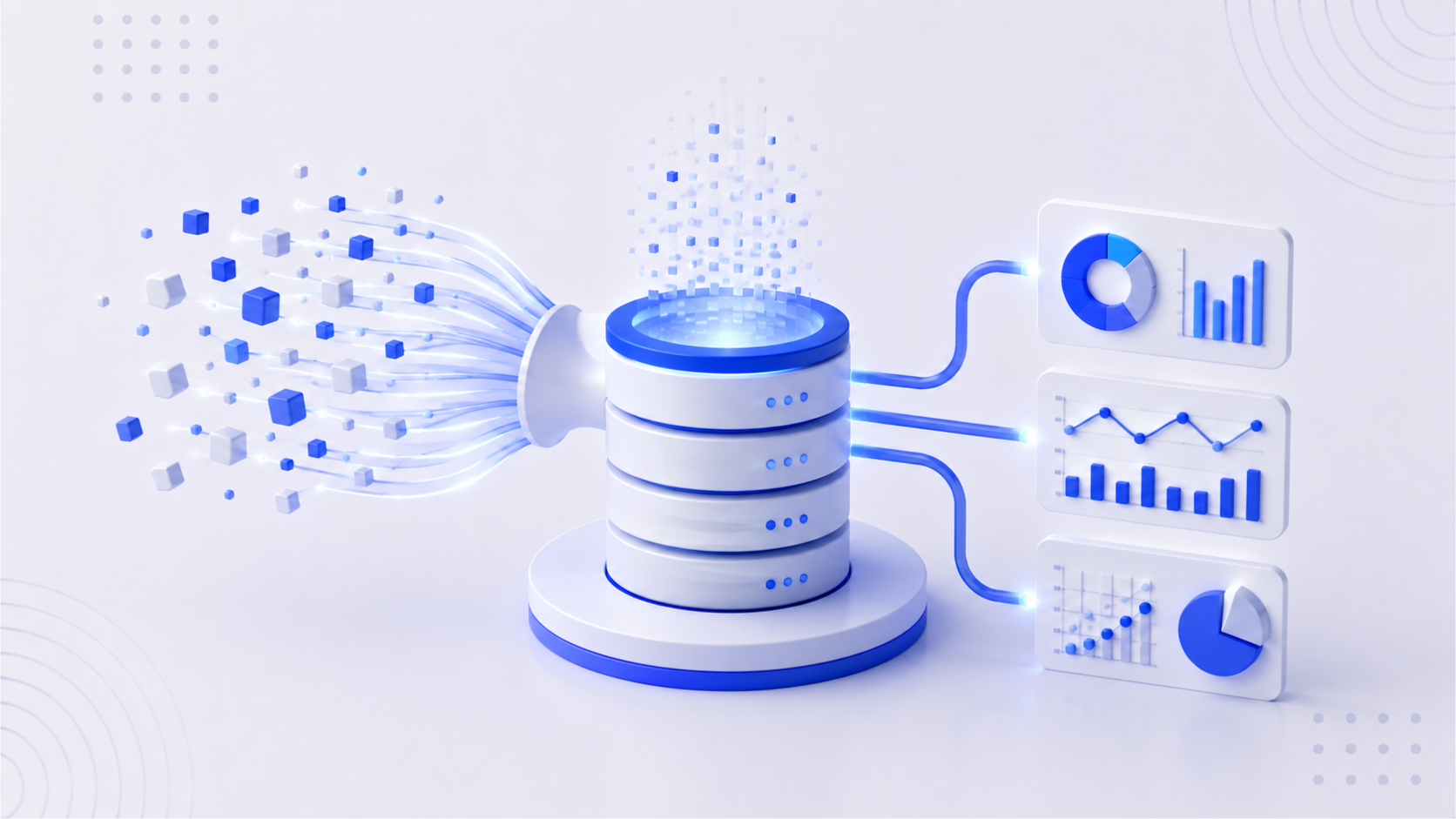
Most enterprise analytics environments use a combination of these, forming a data pipeline that collects → stores → processes → analyses → visualises. Choosing the right combination requires understanding your data architecture first. That's where business intelligence consulting adds value: designing the stack around your use cases rather than accumulating tools without a strategy.
How to Get Started with Big Data Analytics
The companies that get the most value from big data analytics share a common trait: they start with a business question, not a technology selection. Before thinking about tools, answer these:
-
What decision do we want to improve? The answer identifies the data you actually need.
-
Is the data we need accessible and clean? Gaps here are the most common reason analytics projects stall.
-
Who needs the output? A dashboard for a data scientist looks different from one for a sales manager.
-
How quickly do we need answers? Real-time fraud detection requires different infrastructure than monthly churn reporting.
Getting these questions right — and building data engineering infrastructure around the answers — is what separates companies that generate useful insights from those who invest heavily in analytics and end up with another underused dashboard.
Let's Sum Up!
The importance of big data analytics isn't in the technology. It's in what the technology enables: faster decisions, better risk management, more targeted customer engagement, and a product development process grounded in real user behaviour rather than assumption.
Data-driven businesses consistently outperform their peers across every commercial metric. But most of that advantage comes from operationalising analytics — embedding insights into how the business runs — not from having more data or more powerful big data analytics tools.
At Classic Informatics, we help organisations build the business intelligence and analytics infrastructure that makes data usable — from data pipelines to BI dashboards to predictive models. Whether you're starting from scratch or trying to get more value from data you're already collecting, we can help you build a system that actually gets used. Talk to our team when you're ready to explore what your data can tell you.

FAQS

Frequently Asked Questions
Big data analytics is the process of analysing large, complex data sets to find patterns, correlations, and insights that help organisations make better decisions. It differs from standard reporting because it handles data that's too large, fast-moving, or varied for traditional tools — and it surfaces insights that aren't visible in smaller, structured data sets.